

Published Jul 04, 2026 | 7:00 PM ⚊ Updated Jul 04, 2026 | 7:00 PM

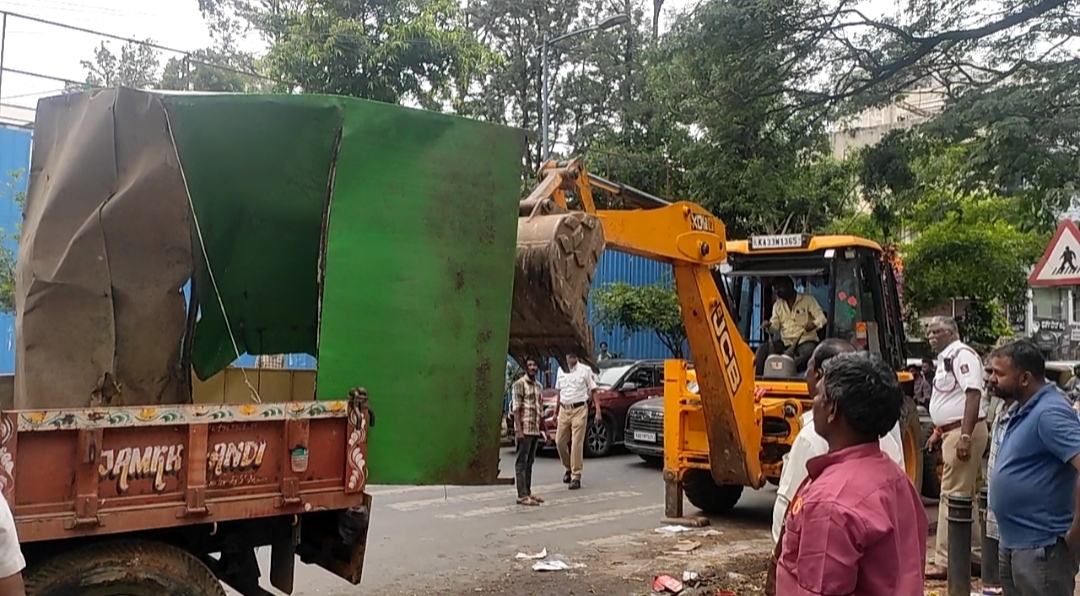
GBA clearing the pavements on Edwards Road.

Synopsis: Street vendors evicted as part of the Greater Bengaluru Authority’s Safe Footpath Campaign — a move to reclaim pedestrian spaces — are a lost lot. The civic body’s move came as a surprise, and most hawkers have nowhere to go. Activists blamed the civic body for acting in haste, without having a comprehensive, inclusive plan.
On the second Friday after 19 June, Girish M stood confused and mighty worried near a truck on Bengaluru’s Edwards Road.
Two Fridays ago, the Supreme Court declared that the Right to Walk is a fundamental right of every Indian citizen. The apex court made the judgment while hearing a motor vehicle accident compensation case involving the death of a five-year-old boy.
“If the road exists, there is a duty to ensure that there are demarcated and well-maintained footpaths for walkers,” a Bench of Justices PS Narasimha and AS Chandurkar ruled.
“The duty bearers are the urban development authorities, municipal corporations, municipalities and even panchayats, who must endeavour to demarcate, construct, maintain, and safeguard footpaths and other necessary pedestrian infrastructure, as walking is integral to life,” the Bench added.
Also Read: Where pedestrians scurry to save a limb — and even life
The Greater Bengaluru Authority’s (GBA) action was swift. On 1 July, it rolled out ‘Safe Footpath Campaign‘, a move to reclaim spaces meant for pedestrians.
Girish had been running a small sewing shop on Edwards for more than 15 years. On Friday, 3 July, the man stood in the space which he had considered to be his workplace.
Earlier this week, the GBA asked him to vacate, saying he had encroached upon the footpath.
“I used to get regular customers. The government suddenly comes and evicts me. Where do I go?” Girish asked as he loaded his belongings onto the truck on Friday, 3 July.
The question has been reverberating across Bengaluru since 1 July.
Also Read: ‘Brand’ Bengaluru’s fatal reality
Like Girish, thousands of others across the city have shifted, albeit reluctantly. They have to find temporary spaces before setting up shop elsewhere. They are not sure of winning their regular customers back.
By the fourth day of the Safe Footpath Campaign, the GBA had cleared nearly more than 200 kilometres of footpaths on arterial and sub-arterial roads. Vendors have been asked to leave, kiosks have been demolished, and debris — including abandoned vehicles — has been moved.
The civic body said the drive will continue till 10 July.
The drive evoked mixed reactions. But for vendors, the campaign has come at the cost of their livelihoods. Many alleged they were evicted without prior notice or rehabilitation despite existing legal safeguards under the Street Vendors (Protection of Livelihood and Regulation of Street Vending) Act, 2014.
Also Read: The stretch Bengalureans fear to tread
The KR Market — also known as the City Market — looked brighter and less cluttered on 2 July.

Jayamma, 63, looked forlorn as she waited for customers at Malleshwaram.
Footpaths were largely free of vendors. Cloth hawkers who had lined the stretch for years said they were asked to vacate the previous day. Many of them have no alternative place to sell their wares.
Mohammed Ayub held a government-issued hawker identity card, not knowing whether to keep it or not. He had been selling clothes near KR Market for decades before getting evicted.
“How do we pay our children’s fees and repay loans? We don’t have anywhere to go. If this continues, people will be pushed into desperation and may resort to crime to make ends meet,” he said.
On Mission Road, hotel owner Udaya M said authorities demolished the frontage of his establishment during the drive.
“I had all the required licences and paid my taxes. But they removed the front part of my shop without giving any reason or providing prior information. I have suffered a loss of nearly ₹1 lakh,” he said.
At 63, Jayamma cut a lonely figure as she arranged the flowers and holy basil near the Sri Kanyaka Parameshwari Temple on Malleshwaram 8th Cross. She was hoping for a brisk business before someone asked her to leave — like they had done the previous day.
“On 1 July, we were evicted from our spots. Police created problems, telling us to go elsewhere,” she said.
The woman sounded resigned as she mumbled. “This is a hassle. I have a card issued by the corporation long ago. Now, I put up shop wherever I get space. We can’t do anything against them.”
Also Read: A pothole-riddled city where commuters seek balms for persistent backaches
The civic body’s drive has raised questions over whether it complies with the Street Vendors Act, 2014.
The Act requires local authorities to conduct a survey of street vendors and issue Certificates of Vending before eviction or relocation. It also mandates Town Vending Committees (TVCs) to identify vending zones and regulate street vending.
Advocate Lekha Adavi, associated with the Karnataka Pragatipara Beedhi Vyaparigala Sangha (AICCTU), alleged that the ongoing evictions were “completely illegal.” She argued that the Act provides for regulation rather than arbitrary eviction.
She said relocation must be carried out through Town Vending Committees along with a survey and the issuing of a certificate, which she claimed are currently non-functional.
Activist Vinay Kumar echoed similar concerns.
“Street vending is not just an economic activity; it is a social and cultural institution that has been part of Bengaluru’s neighbourhoods for decades,” he said, arguing that the law recognises vending as a legitimate livelihood and that the city should identify proper vending zones instead of carrying out blanket evictions.
Also Read: Bengaluru’s Bellandur, ORR and years of neglect
Not everyone in Bengaluru is against the campaign.
Pankaj S, a regular commuter on Edwards Road, said the stretch is significantly easier to walk on after the stalls were removed.
“For the first time in a long time, I could use the footpath instead of walking on the road,” he said.

Fruit carts line a pavement at NR Colony. Many residents said street venders were a part of the neighbourhood’s identity.
Residents of NR Colony expressed mixed views. While some welcomed improved walkways, others said vendors had become part of the neighbourhood’s identity and should be relocated rather than removed.
Manju Prasad, a long-time resident of the area, said the street vendors have long been an integral part of NR Colony’s identity.
“These vendors have been here for years and are what make this area unique,” he said, while agreeing that the space for pedestrians has improved after the drive.
Karthik Kumar, who moved to Bengaluru a month ago, welcomed the clearance drive. “Walking on the road was dangerous. I was almost hit by a bike a week ago,” he said.
However, he added that the displaced vendors should be provided alternative spaces.

Gyaneshwar M of the Kannada Modalu Balaga welcomed the eviction drive. He even held a rally supporting the move with fewer than 10 people.
On Saturday, 4 July, fewer than 10 people participated in a rally at Malleshwaram 8th Cross, organised by the Kannada Modalu Balaga. The outfit’s president, Gyaneshwar M, welcomed what he termed a “much-needed” drive.
Citing the 300 pedestrian deaths reported annually in Bengaluru, he said it was “against humanity” to deny pedestrians safe and accessible footpaths.
According to the National Crime Records Bureau statistics released in October 2025, Bengaluru topped the country in pedestrian deaths for the second consecutive year in 2023. The Bureau put the number of pedestrian fatalities at 292.
The government, meanwhile, has taken note of the livelihood concerns. Minister for Bengaluru Development Krishna Byre Gowda said the government’s intention was not to disrupt livelihoods but to prevent pedestrian deaths caused by footpaths rendered unwalkable.
He said the drive was not a citywide crackdown but a phased exercise covering around 20% of major roads, while businesses could continue to operate on the remaining stretches.
Activists, however, differed. They felt the Safe Footpath Campaign was not the only solution. They demanded a more comprehensive approach, one that includes better planning, designated vending zones, and stronger enforcement against all forms of encroachment.
They urged the government to strike a balance between pedestrians’ right to walk and street vendors’ right to earn a livelihood.
(Edited by Majnu Babu).



