

Published Feb 09, 2026 | 1:56 PM ⚊ Updated Feb 09, 2026 | 1:56 PM

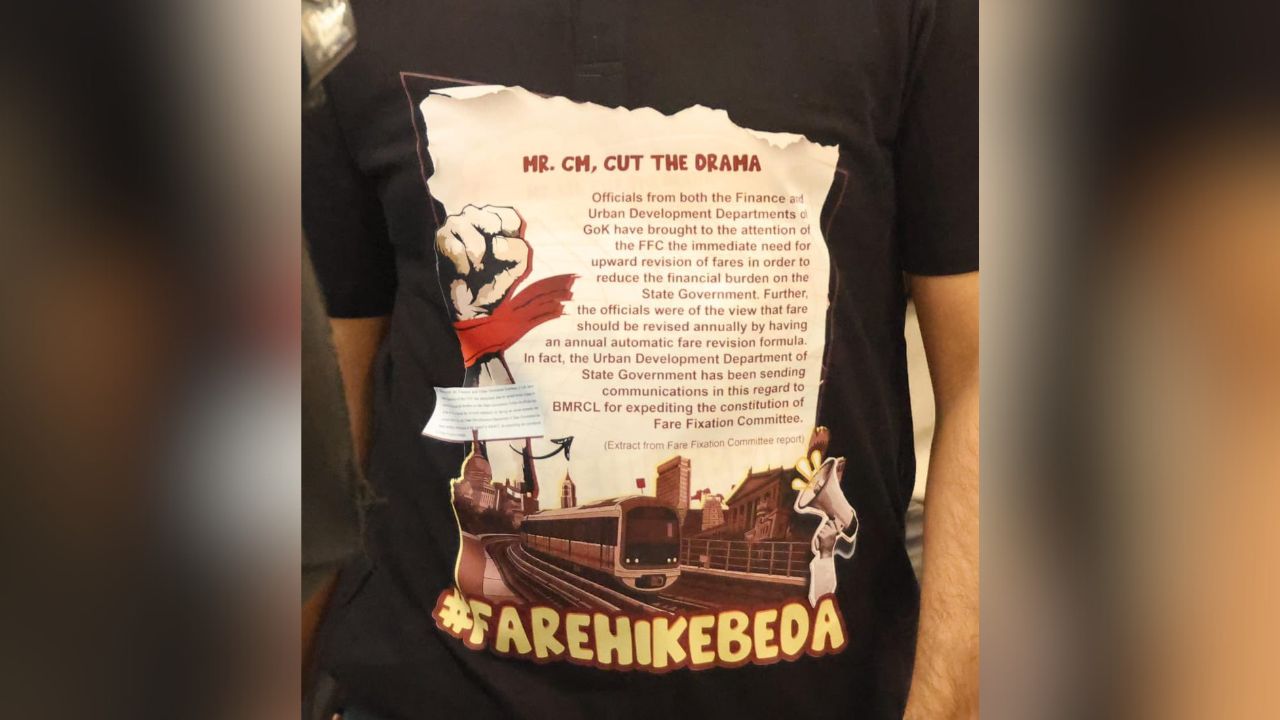
The tshirt worn by Bengaluru South MP Tejaswi Surya slamming the state government.
On the morning of Sunday, 8 February, Bengaluru South MP Tejasvi Surya arrived at the RV Road Metro station wearing what appeared to be a carefully curated t-shirt. Printed on it was an excerpt from the Fare Fixation Committee (FFC) report, handpicked to underline one clear message: The Bengaluru metro fare hike was entirely the state government’s doing.
The t-shirt was part of Surya’s spirited campaign over the past few days, in which he along with other Karnataka BJP leaders have repeatedly argued that the state government was fully responsible for the recent five percent increase in metro fares, a year after raising fares by 71 percent — and that the Union government was merely a bystander, one that can’t be blamed.
Hours later, the Bangalore Metro Rail Corporation Limited (BMRCL) announced that the “Annual Fare Revision has been kept on hold till further orders” and that a “decision on the revised fare would be communicated after the Board’s review.” Surya and other BJP leaders then changed their tune, enthusiastically crediting the Union government for stepping in and halting the fare hike.
The irony here is that the same Union government, which, according to BJP leaders, had no role in metro fares in the morning, was powerful enough by evening to pause them altogether.
Despite BMRCL being a 50:50 joint venture between the state and the Union government, BJP leaders have spent the last few days training their fire almost exclusively on the Congress government in Karnataka, accusing it of making public transport unaffordable for Bengalureans.
Bengaluru Central MP PC Mohan, in a post on X, reminded Chief Minister Siddaramaiah that he had earlier directed BMRCL to reduce last year’s proposed fare hike from 105 percent to 71 percent. “If you had the power to reduce fares then, you have the responsibility to reduce them now as well,” Mohan wrote, suggesting that it was only the state government’s responsibility to reduce the fares.
In another lengthy post, Mohan laid out how states formally record objections when they disagree with Central decisions.
“If the Centre imposed it, where is the objection?” he asked, before listing: a. No letter demanding rollback. b. No protest. c. No dissent note. Silence here is not helplessness, it is concurrence,” he wrote.
The post came close to acknowledging the Union government’s role in fare decisions, only to pivot back to blaming the state for not opposing it — again, only if the Union government was involved.
Mohan also pointed out that the BMRCL Board, which approved the Namma Metro fare hike, consists of 10 members — five from the state and five from the Centre.
“The Centre-appointed Chairman has no voting power. Hence, fare hikes are decided by five state nominees over four Central members (5:4),” he wrote, once again reinforcing the idea that the Union government’s presence is largely ornamental. However, a BMRCL representative had earlier told South First that the state and Union governments both have equal say in its functioning and decision-making.
Meanwhile, Leader of Opposition in the Karnataka Assembly R Ashoka stated on 6 February that the 51.55 percent hike in Namma Metro fares “has nothing to do” with the Union government, calling it a direct outcome of the Congress government’s “weak finances, poor fiscal discipline, and economic mismanagement.”
A day later, Ashoka struck a notably different note. He announced that he had held a detailed telephonic discussion with Union Minister for Housing and Urban Affairs Manohar Lal Khattar, who, he said, “responded swiftly to this concern” and “directed officials” to keep the proposed fare hike on hold.
Khattar, Ashoka added, had also assured him that he would personally review the “shortcomings and anomalies” in the Fare Fixation Committee’s recommendations.
Meanwhile, Surya, who has been championing the Opposition against the state government, also credited Khattar and the government of India for their timely intervention to withhold the state government’s anti-people proposal.
What he failed to mention and print on his t-shirt was that, according to Section 37 of the Metro Railways (Operation & Maintenance) Act, 2002, under which the FFC is constituted, the recommendations made by the Committee are “binding on the metro railway administration.”
(Edited by Muhammed Fazil.)


