


Published Jan 22, 2026 | 2:52 PM ⚊ Updated Jan 22, 2026 | 2:52 PM

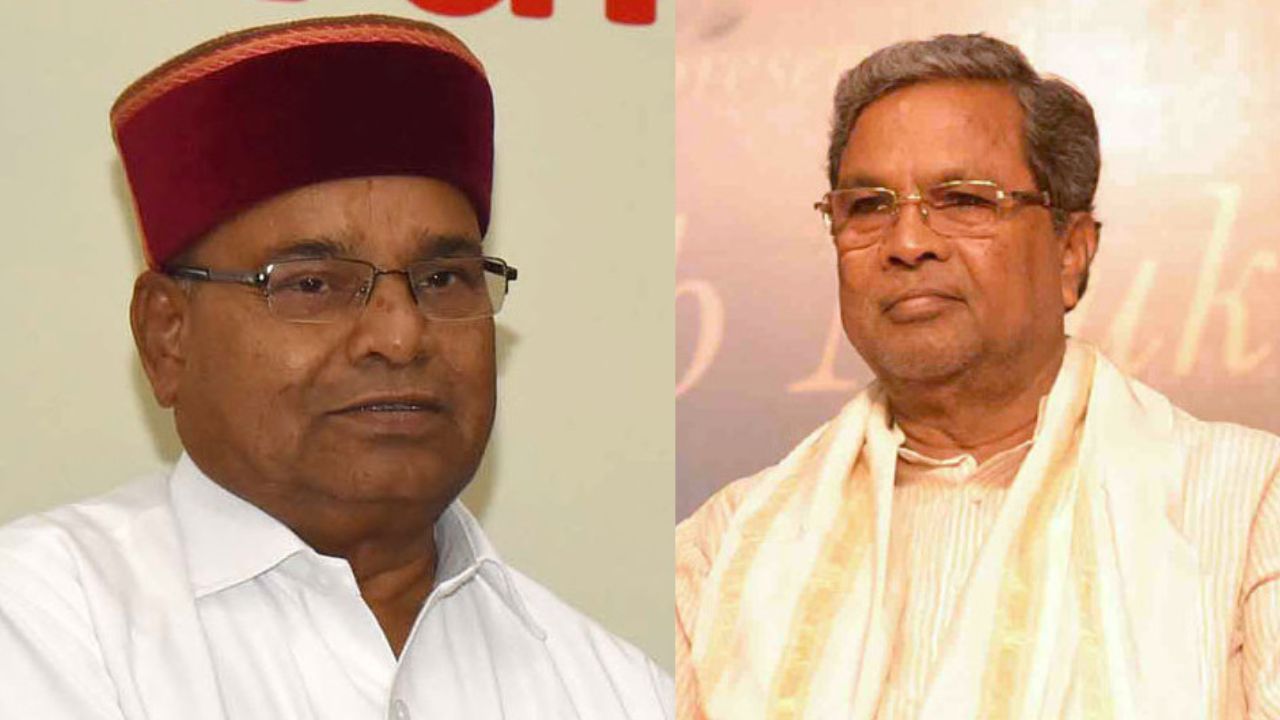
Karnataka Governor Thaawar Chand Gehlot and Chief Minister Siddharamiah.
Synopsis: A day after the governors of non-BJP-ruled Tamil Nadu and Kerala refused to read the Cabinet-drafted customary speeches, Governor Gehlot followed suit in Congress-governed Karnataka. Gehlot seemed to have a beef with parts critical of the Union government, which the Siddaramaiah-led Cabinet refused to remove. Siddaramaiah said the governor’s act violated the Indian Constitution.
After Tamil Nadu and Kerala, the governor of yet another non-BJP-ruled South Indian state has stirred a controversy by refusing to deliver the Cabinet-prepared customary speech.
Governor Thaawar Chand Gehlot read the opening lines of the state’s speech before adding a few brief comments himself to open a special joint session in Congress-ruled Karnataka on Thursday, 22 January.
Gehlot’s refusal to read the Cabinet-approved speech came a day after the governors of non-BJP-governed Tamil Nadu and Kerala refused to deliver the customary speech approved by the Cabinet.
While Tamil Nadu Governor RN Ravi walked out of the Assembly without reading the speech over 13 reasons cited later, Kerala Governor Rajendra Vishwanath Arlekar deviated from the Cabinet-approved text by omitting passages critical of the Union Government and subtly qualifying others.
Although the Karnataka government had drafted a 22-page speech with 122 paragraphs, Gehlot addressed the session briefly, concluding his address in just two lines before walking out.
“I welcome you to the joint session of the Karnataka Assembly. I am proud to be addressing the Karnataka Assembly one more time. My government is committed to doubling the economic, social and infrastructural development of Karnataka. Jai Hind, Jai Karnataka,” Gehlot said before leaving.
Chief Minister Siddaramaiah said the governor’s act amounted to the violation of the Indian Constitution.
“He (Gehlot) spoke from the speech that he prepared himself and not the one drafted by the government. It clearly violates Articles 176 and 163 of the Indian Constitution. He has not discharged his duties as per the Indian Constitution,” Karnataka Chief Minister Siddaramaiah said.
He said that the government would protest against the “attitude” of the governor. “We are examining whether we should approach the Supreme Court,” he said.
Gehlot, reportedly, objected to 11 paragraphs in the government-prepared speech.
Speaking to reporters after leading a delegation to Lok Bhavan — previously Raj Bhavan — on Wednesday, 21 January, Law and Parliamentary Affairs Minister HK Patil said that the paragraphs in question criticised the central government for repealing MGNREGA, alleged injustice to the state in devolution of funds, GST-related issues, delay in drought relief, and injustice in the 15th Finance Commission.
The governor demanded their complete removal. The government refused.
The second point of the approved speech began with the ‘repressive situation’ the state was now facing in economic and policy matters.
“It has suffered injustice in tax devolution, centrally sponsored schemes, central sector schemes, and special schemes. The Union Government must seriously consider that economically suppressing Karnataka, which occupies a driving position in the national economy, will adversely affect the entire country. During the period of the 15th Finance Commission, resources to the tune of approximately ₹1.25 lakh crore were denied to the state, and this grave injustice has been brought to the notice of the 16th Finance Commission. The Government is firmly confident that this injustice will be rectified in the coming days.”
Points three to 11 detailed the government’s opposition to the Central government’s decision to repeal the Mahatma Gandhi National Rural Employment Guarantee Act (MGNREGA) and replace it with the Viksit Bharat Guarantee for Rozgar and Ajeevika Mission (Gramin) (VB–G RAM G) Act.
“The Union Government has repealed the MGNREGA. By doing so, it has deprived rural wage labourers, small farmers, and women of their rights to employment and unemployment allowance. By repealing the MGNREGA Act, which was a monumental chapter in rural India’s development journey, the rural life of India has been weakened,” the third point said.
The fourth point explained the history of MGNREGA, tracing it back to Mahatma Gandhi’s vision of villages as independent and autonomous units.
“Mahatma Gandhi envisioned villages as independent and autonomous units. He stated, ‘If villages perish, India will perish. The message that this country has to give to the world will disappear. Village regeneration is possible only when the exploitation of villages completely ceases. All our attention must be focused on making villages self-reliant.’ He also believed that villages should not become cesspools and that people should not be forced to migrate to cities in search of food and employment. In this context, the Union Government launched the MGNREGA Scheme in 2005. Over the last 20 years, the State has undertaken 76.89 lakh works under this scheme at a cost of ₹61,030 crore and generated 182.5 crore person-days of employment.”
The next paragraph criticised the new Act for taking away the employment guarantee assured under Section 3 of the MGNREGA that mandated that every person who applied for work in a panchayat must be provided employment.
“The demand-based employment principle has been destroyed and replaced with a supply-driven scheme. The VB Gram-G scheme has been designed to protect corporate capitalist interests, thereby sacrificing rural people’s welfare. As a result, the noble objectives of rural asset creation and employing labourers at their place of residence have been reduced to nothing. My government strongly condemns this anti-progressive measure. MGNREGA had earned nationwide recognition and stood as a symbol of progress, but the Union Government has consigned it to oblivion,” the rest of the paragraph stated.
The sixth point alleged that the new law had weakened Gandhi’s core vision of Gram Swaraj embedded in MGNREGA. While Panchayati Raj Institutions, which form the foundational pillars of Indian democracy, symbolise decentralisation of power, the Union Government has uprooted this decentralised framework and laid the foundation for a centralised system, it said.
“Under MGNREGA, works were decided and implemented through Gram Sabhas. Under the new law, the powers of Gram Sabhas have been completely curtailed through centralised norms. These actions are not merely anti-democratic but are also anti-progressive measures that ignore the demands of the majority of citizens and push national interest towards destruction,” it added.
The government also highlighted that MGNREGA had significantly reduced distress migration, while the new Act reinstates migration to cities in search of employment.
“The new law has curtailed the employment rights of Dalits, Adivasis, women, backward classes, and agrarian communities,” it said.
The speech then moved on to the Centre implementing the law without consulting the states.
“While repealing an employment guarantee law and introducing a new law, the opinions of the states ought to have been sought. Centrally-sponsored schemes involve state participation. Implementing such a law without consulting states amounts to unconstitutional conduct,” the address said.
The speech further alleged that “worker-centric rights under MGNREGA have been diluted and labourers are being placed under contractors’ control.”
“Opportunities to revise wages based on inflation and price rise have diminished. Consequently, the social security of poor wage labourers is being eroded,” it said.
It also objected to the removal of Mahatma Gandhi’s name from the scheme and pointed out that states would now have to contribute 40 percent of the funding despite financial stress.
“If states fail to contribute, the Centre will withhold funds, leading the scheme towards gradual extinction,” the next point read.
While concluding about MGNREGA, the government demanded that the Union government immediately repeal the contractor-centric VB Gram-G law that “facilitates large-scale corruption, and restore the MGNREGA, which safeguards the poor, agricultural labourers, rural asset creation, unemployment allowance, and employment at the place of residence.”
The remaining part of the speech highlighted the state’s achievements across different sectors, including agriculture, public transport, water infrastructure, education, power generation, industries, tourism and welfare of unorganised sector workers, among others. A section of the speech also referred to the government’s guarantee schemes and their impact.
“Despite facing various forms of oppression within the federal framework, the state is performing exemplary work in accordance with the ideals of the Constitution drafted under the leadership of Babasaheb Ambedkar,” the final part of the speech said.
(Edited by Majnu Babu).


