

Published Mar 10, 2026 | 4:54 PM ⚊ Updated Mar 10, 2026 | 4:54 PM

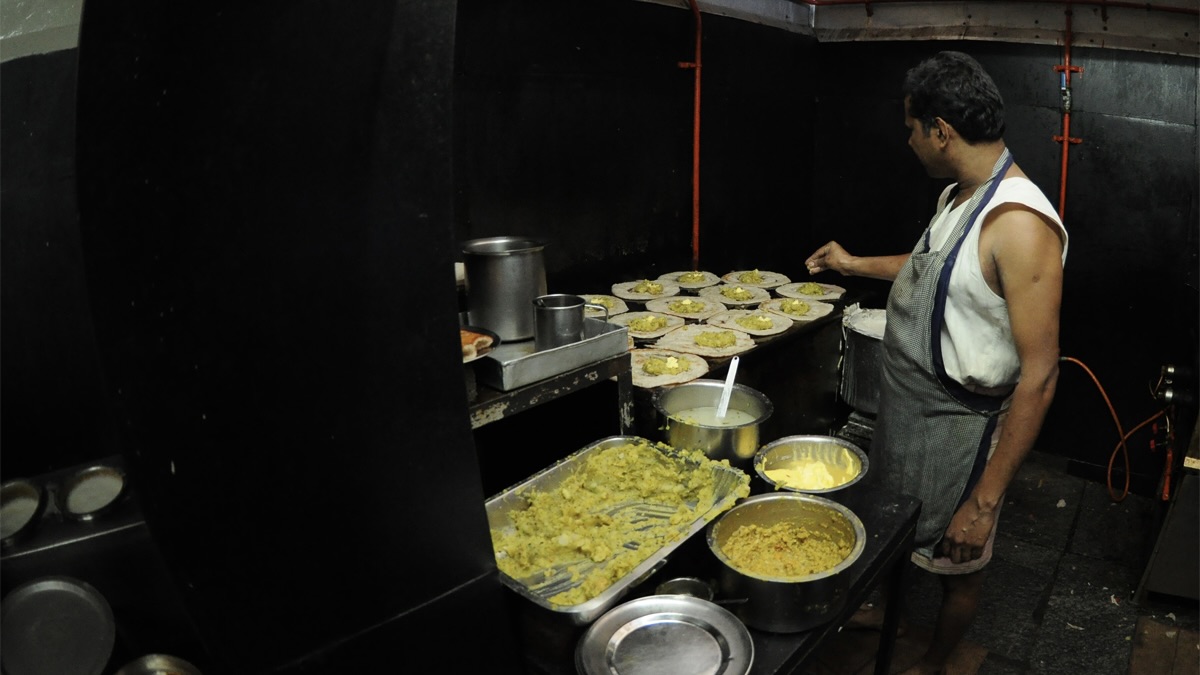
Inside the kitchen of the popular Vidyarthi Bhavan in Basavanagudi. (Courtesy: Vidyarthi Bhavan)
Synopsis: Bengaluru’s food and hospitality sector is facing a shortage of commercial LPG cylinders after the ongoing US–Israel war with Iran disrupted supply. Several eateries say they have received only a fraction of their usual deliveries and are considering shorter hours, smaller menus or temporary closures, while PG accommodations are also looking for alternatives to cook meals.
The disruption in the supply of liquefied petroleum gas (LPG) due to the ongoing US–Israel war with Iran is now hitting Bengaluru’s food and hospitality sector, with restaurants and paying guest (PG) accommodations facing a shortage of commercial LPG cylinders since Monday, 9 March.
The Bengaluru Hotels Association, which represents hundreds of eateries and restaurants, had warned that hotels and restaurants may be forced to halt kitchen operations from Tuesday if the disruption continues.
“Oil companies had assured us that there would be no disruption in gas supply for at least 70 days. The sudden stoppage is a devastating blow to the hotel industry,” the association said in a statement.
By Tuesday, restaurants had not completely shut down, but the strain was visible. Some eateries are considering limiting their menus and operating hours. Others said they were waiting for further clarity before deciding their next steps, which could include a temporary shutdown.
The disruption could also affect thousands of professionals and students living in PGs across Bengaluru, many of whom rely on nearby hotels and eateries for their daily meals.
Amid the crisis, the Union government has invoked the Essential Commodities Act, 1955, to regulate the availability, supply and equitable distribution of petroleum, petroleum products and natural gas.
On Tuesday morning, several eateries across Bengaluru were scrambling to manage with limited supplies. Many said they had received barely 20 percent of their usual LPG deliveries, with fresh supplies now completely halted.
“We use around eight LPG cylinders a day. Right now, we are trying to manage with four. But we serve at least 1,000 customers daily and offer a wide range of items, so it’s simply not enough to meet our usual demand,” said the manager of a small tiffin centre on Kanakapura Road.
For now, the outlet is considering cutting down its menu to cope with the shortage.
“We are still figuring out our options. Maybe we will limit it to just coffee and tea. But we are worried about how customers will react. Many of our workers depend on the income from the sales we make here, so they will be affected as well,” the manager added.
At SLV Hotels in Basavanagudi, the situation is similar. Owner Raghavendra Bhatt said the restaurant has enough cylinders to last only two more days.
“Apart from cooking for customers, we also have to prepare food for our workers. With the current supply situation, we simply don’t have enough cylinders to manage both,” he told South First.
The restaurant plans to drop fried items such as poori and bonda from its menu and shorten operating hours to cope with the shortage.
“Smaller eateries may suffer more, as they usually keep only a few cylinders at a time because of space and cost constraints,” PC Rao, president of the Bangalore Hotels Association, told South First.
He explained that when supply is disrupted, smaller eateries run out much faster than larger restaurants that can stock more cylinders.
This appeared to hold true on the ground. Larger chains such as KFC seemed to have some backup supply.
“We were asked if we had backup cylinders. We currently have six, and so far we haven’t been told to expect any disruption,” said a worker at a KFC outlet on Cunningham Road.
Meanwhile, PG accommodations across the city, many of which rely on commercial LPG cylinders for large-scale food preparation, have also begun taking precautionary measures.
One such PG in Koramangala said it uses 15 cylinders a month to provide meals four times a day (breakfast, lunch, snacks, dinner) to over 25 occupants. “We have enough stock for this week, but if we do not get more supply then we plan to use alternate measures like an induction stove,” said Rajesh, the owner of the PG.
But he pointed out that using an induction stove for bulk food preparation is not ideal and may slow down the process. “We are looking at changing the menu to replace roti and dosa with instant food items,” he said.
Bengaluru South MP Tejasvi Surya and Karnataka Chief Minister Siddaramaiah have both written to Union Minister of Petroleum and Natural Gas Hardeep Singh Puri about the disruption.
“The restaurant and food service industry relies significantly on commercial LPG for daily kitchen operations. Unlike several other sectors, most commercial kitchens currently do not have immediate alternatives such as PNG connectivity or electric cooking systems at scale,” Surya said in a letter addressed to the minister.
He said any disruption in LPG supply could directly affect restaurant operations, employment in the sector and services provided to consumers.
“While the industry supports the Government’s efforts to ensure adequate LPG supply for domestic households, the Bengaluru Hotels Association has requested assurance that commercial establishments continue to receive uninterrupted LPG supply through the existing distribution system,” he said.
Surya also said the minister has constituted a high-priority panel to ensure LPG supply remains uninterrupted for non-domestic users, including hotels.
Chief Minister Siddaramaiah said in his letter to the minister that the state’s commercial LPG demand has traditionally been supported through supplies from the three OMCs — IOCL (around 500–550 MT per day), HPCL (around 300 MT per day) and BPCL (around 230 MT per day).
He said the sudden disruption in this supply is now severely affecting hotels, catering establishments and other commercial users in Bengaluru.
The issue also affects a large number of students and working professionals who live away from their homes and depend on hotels and mess facilities for regular meals, he said.
Choultries (convention halls), hostels and event venues that rely on commercial LPG for food preparation are also facing uncertainty, particularly with scheduled social and community events.
“Given the scale of dependence on commercial LPG in a metropolitan city like Bengaluru, I request your kind intervention to ensure that adequate commercial LPG supply is made available to hotels, restaurants, choultries, community halls and other purely commercial establishments,” he said.
(Edited by Dese Gowda)


