

Published Oct 16, 2026 | 8:38 PM ⚊ Updated Oct 16, 2026 | 8:38 PM

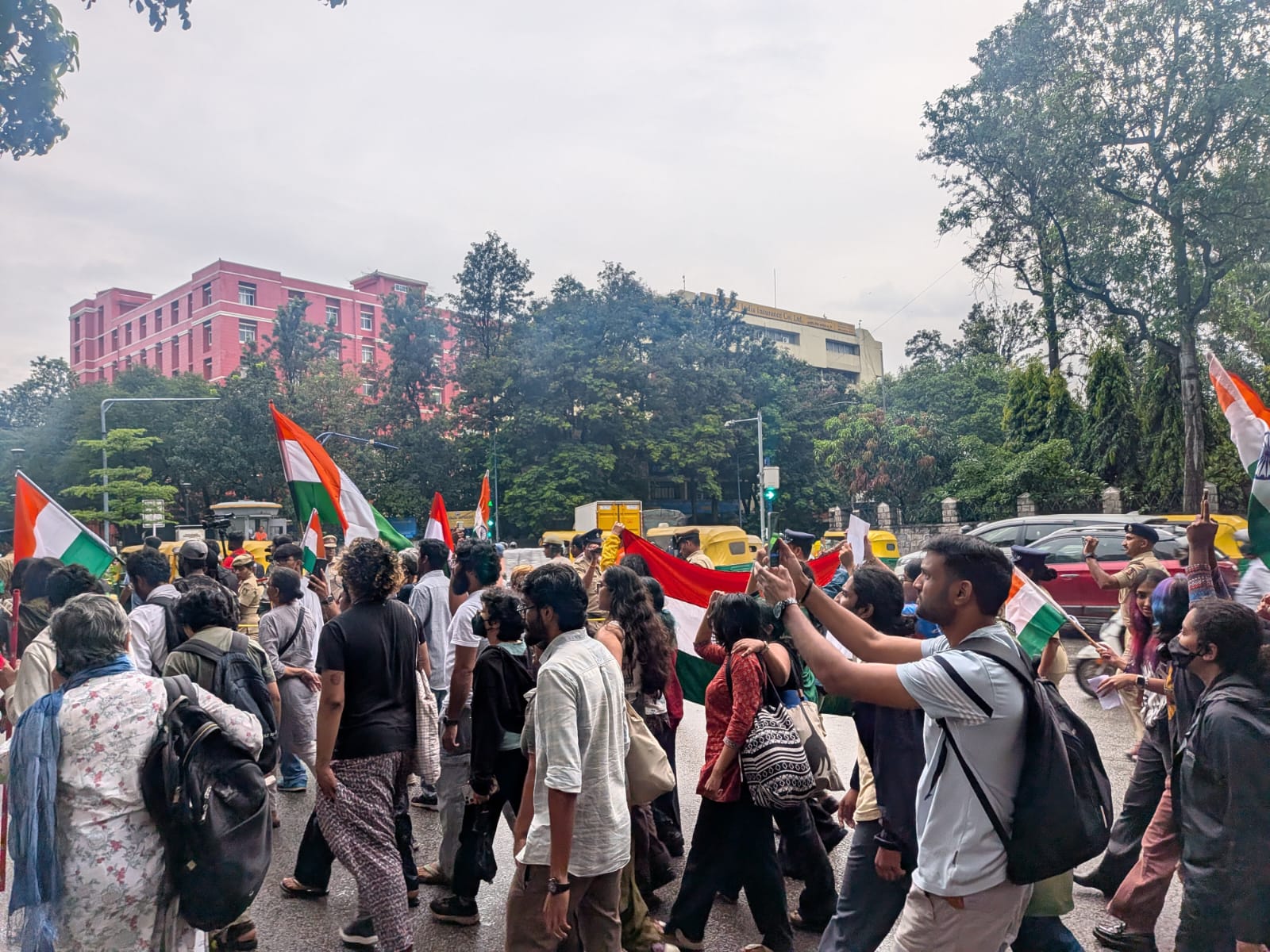
the march came days after police detained several protesters during a demonstration in Bengaluru on Monday.

Synopsis: Over 150 protesters marched from Bengaluru’s Town Hall to the Quit India Memorial in solidarity with Ashutosh Ranka and Saurav Das, questioning restrictions on peaceful assembly and what they described as the Congress government’s contradictory stance on dissent.
On a rainy Friday evening on 16 October, waving tricolours filled Bengaluru’s Town Hall as over 150 protesters gathered for a Tiranga March in solidarity with Cochroach Janta Party (CJP) leaders Ashutosh Ranka and Saurav Das, who were sent to five days in judicial custody two days ago for protesting in Jantar Mantar, seeking the resignation of Chief Election Commissioner Gyanesh Kumar.
Slogans like “Inquilab Zindabad”, “My Vote, My Right”, “Vote Chori Nahi Chalegi” and “Nanna Vote, Nanna Hakku” filled the air as protesters marched from Town Hall to the Quit India Memorial, nearly a kilometre away, waving the tricolour flag.
Organised by the CJP in association with Jagruta Karnataka, AISA Karnataka and My Vote, My Right, the march came days after police detained several protesters during a demonstration in Bengaluru on Monday.
The march took place under tight police security, with both male and female personnel escorting protesters from Town Hall to the Quit India Memorial. Participants described the police as largely cooperative. However, senior officers reportedly intervened when political slogans were raised, asking protesters to refrain from such slogans and continue the march peacefully, activists claimed.
Protesters drew parallels between present-day restrictions and colonial-era controls on demonstrations.
Janaki Nair, a protester, noted a change in the police’s approach compared to Monday’s protests.
“It looks like the Congress government has realised that they cannot protest in Delhi and slap the protesters who are protesting in Bengaluru. It’s the same cause,” she said.
Nair argued that the state police had a responsibility to protect peaceful demonstrators, particularly under a government that had publicly opposed what she described as injustices committed by the Centre.
Speaking about the symbolism of carrying the national flag, she described the march as a protest against those who had historically campaigned against the Indian flag.
“In a way, it is a double protest and to reclaim the national flag as a symbol of democratic rights and dissent,” she said.
Also Read: Police high-handedness during anti-SIR stir embarrasses Karnataka govt
Activist Vinay Kumar said the march demonstrated that citizens could exercise their constitutional right to peaceful assembly, but questioned why police permission was necessary in the first place.
“Why in a free country can’t we hoist the flag, which is a symbol of freedom? And why does it need police permission or anybody’s permission to hoist my flag? It’s my country, my flag,” he said.
Kumar argued that traffic and public-order concerns often restrict peaceful dissent, pointing out that Friday’s peak-hour march caused no disruption, according to him.
” Over 100 people marched at peak hours in Bengaluru on Kempegowda Road. Where is the traffic jam?” he asked.
Also Read: Anti-SIR protesters detained near CEO office in Bengaluru
While acknowledging that the police permitted Friday’s march, they also imposed restrictions.
“They have in fact allowed a march, but it has come with various restrictions on what you can say, what you cannot say, no political slogans, which is ridiculous,” he said.
Kumar also called for the repeal of the Licensing and Regulation of Protests, Demonstrations and Protest Marches (Bengaluru City) Order, 2021, terming it “draconian”.
On the significance of choosing the Quit India Memorial, he drew parallels between present-day restrictions and colonial-era controls on demonstrations.
“The very people who built this country, the freedom fighters who gave their lives once, were curbed by such restrictions by the British. Today, if such curbs persist in this country, it is just a reflection of the colonial times,” he said.
Yamuna, one of the detainees during Monday’s demonstration, also questioned whether Friday’s permitted march reflected any meaningful change in the police’s attitude towards protesters.
“I don’t know if the police have become more anything,” she said, observing that police behaviour appeared to depend on whether organisers had obtained permission.
She criticised Congress leaders for what she described as a contradiction between their political positions and the restrictions on protests in Bengaluru.
“Now we’re going to see how we can push that further to actually also, you know, give us more of a right to protest in Bengaluru,” she said.
Yamuna also criticised the restrictions confining demonstrations to Freedom Park, describing the arrangement as unreasonable.
At the Quit India memorial, protesters unfurled a banner of the Constitution as tricolour flags waved in unison.
Speakers raised concerns over voting rights and alleged ECI irregularities, demanded Gyanesh Kumar’s resignation, and urged greater civic participation.
As evening fell and the memorial lit up, protesters renewed their calls to safeguard democratic rights.
(Edited by Majnu Babu).



