

Published Jan 05, 2026 | 9:00 AM ⚊ Updated Jan 05, 2026 | 9:00 AM

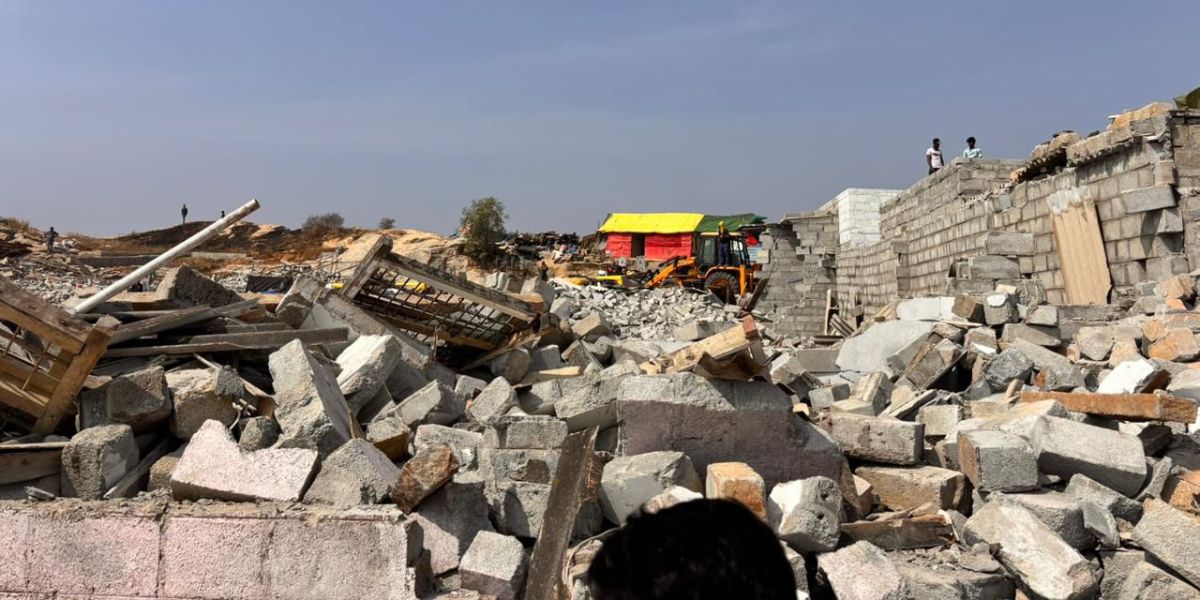
Around 300 homes were demolished in Kogilu village near Bengaluru in Karnataka.
Synopsis: The Siddaramaiah government’s “humanitarian” decision to provide alternative shelter to select families displaced after a demolition drive in north Bengaluru has drawn criticism, with observers seeing political calculation linked to the upcoming Kerala Assembly elections behind the move, while the Karnataka BJP has accused the Congress of appeasement politics. The decision is a rare exception when contrasted with similar drives carried out by successive governments in the state over the past few years.
The Congress government in Karnataka has come under fire for its decision to rehabilitate “eligible” families in the Kogilu layout in Yelahanka who were displaced during a demolition drive carried out in December.
Select families will be accommodated in multi-storey buildings built under the Rajiv Gandhi Housing Corporation (RGHC) in Baiyappanahalli, around seven km away from Kogilu. The RGHC provides housing for socially and economically weaker sections of society through Central and State housing schemes.
Chief Minister Siddaramaiah has maintained that the move is being undertaken purely on “humanitarian grounds”, even as he asserted that the demolished structures were illegal.
“Providing houses constructed by the government to those who illegally built homes will apply only to this specific case. I have instructed that strict action be taken against officials who allowed illegal shed construction,” he said.
The exception in this specific case, however, followed interventions not only from the Congress high command, specifically party general secretary K C Venugopal, but also criticism from CPI(M) leaders in Kerala, including Chief Minister Pinarayi Vijayan.
The Greater Bengaluru Authority (GBA), and the erstwhile Bruhat Bengaluru Mahanagara Palike (BBMP), have carried out numerous “anti-encroachment” drives that razed residential houses in Bengaluru in the past, but in many such cases, displaced residents did not see the kind of political intervention or immediate rehabilitation measures that followed the demolition in Kogilu.
The Siddaramaiah government’s move has therefore sparked speculation that the decision may have more to do with the Congress’s electoral considerations ahead of the Kerala Assembly elections scheduled for March–April 2026.
A month prior to the Kogilu demolitions, in November, around 150 largely Dalit families near the Kadugondanahalli railway gate in the city’s north-east were left homeless after their houses were razed to make way for the Bengaluru Suburban Rail Project.
Residents, who had been living in the area for decades with documents sanctioned by the erstwhile BBMP, alleged that officials forcibly evicted them without prior notice. Many said they were misled into signing consent forms and received no clear communication from the authorities.
The affected families approached the Karnataka High Court, challenging the demolition and requesting that the GBA be directed to provide shelter for an additional 30 days until the dispute is resolved.
The bench that heard the arguments issued notices to all respondents in the petition, including the state government, the Railway Department, the GBA, the Bengaluru Development Authority (BDA), and the slum board.
The government is yet to announce any compensation or rehabilitation for the affected families, residents told South First.
Additionally, over the last few years, governments in the state, regardless of which party is at the helm, have undertaken drives to clear encroachments on rajakaluves, or storm-water drains (SWDs).
One of the largest such anti-encroachment drives was carried out in 2022 after heavy rains brought the city to its knees. Illegal encroachments that had come up on SWDs over the years were identified as one of the major reasons for flooding.
While the then BJP-led government headed by Basavaraj Bommai had ordered the clearing of such encroachments, the drive continued even under Chief Minister Siddaramaiah’s government.
In June 2023, several residents of the Ferns City apartment complex in Mahadevapura protested against a demolition drive at their complex, alleging that their homes were unfairly singled out while larger complexes and offices, such as the Bagmane Tech Park, were spared.
Yet, despite the frequency and scale of these SWD anti-encroachment drives, no public announcements on rehabilitation or alternative housing were made at the time of these demolitions.
Between August 2023 and May 2024, 2,344 encroachments on SWDs were cleared, followed by 290 from June 2024 to January 2025, The Hindu reported.
Notably, during these drives, the Congress party’s central leadership and high command remained silent, even as homes were demolished in the name of flood mitigation. Nor was this the first time that demolitions under a Congress government in Karnataka had drawn criticism from human rights groups.
In August 2018, during Siddaramaiah’s earlier tenure as Chief Minister, the erstwhile BBMP demolished over 400 houses in Kariyammana Agrahara in the Bellandur limits, claiming they were in the buffer zone of the rajakaluve in the area, Deccan Herald reported.
The drive rendered over 1,500 people homeless, with no immediate announcement of rehabilitation.
In 2020, under the then BJP government, the area was targeted again after a video was widely shared on social media, including by BJP Mahadevapura MLA Arvind Limbavali, claiming that illegal “Bangladeshi immigrants” were sheltered in migrant settlements.
The drive saw at least 100 huts being razed. The Karnataka High Court later directed the state government to rehabilitate residents and provide relief measures for those affected in the targeted migrant settlements.
Even after the state government’s promise of shelter, families displaced from the Kogilu layout are yet to receive relief, even as a steady stream of politicians, including Deputy Chief Minister D K Shivakumar, Housing and Minority Welfare Minister B Z Zameer Ahmed Khan, and Leader of the Opposition R Ashoka, have visited the site in recent weeks.
Residents have been forced to camp outdoors, braving the winter cold since the day of the demolition on December 20.
“We are seeing a lot of videos being spread on social media about how we are illegal immigrants. Politicians are also making all these statements and doing their politics. But we are the ones who are left without homes and food. We don’t know if we will get the new houses or not,” said Mira, one of the residents whose house was razed during the demolition drive.
While the initial deadline for handing over houses was January 2, the process has been delayed due to verification hurdles aimed at identifying eligible beneficiaries.
Several residents are unlikely to meet the criteria, and there is still no clarity on when rehabilitation will actually take place.
The displaced residents have, meanwhile, have approached the Karnataka High Court, arguing that government officials razed their houses in defiance of a Supreme Court of India order that mandates show-cause notices and at least 15 days’ time to vacate houses before any eviction on grounds of encroachment.
“Those who have lost their homes and are homeless are at risk of contracting infectious diseases, and a temporary medical camp should be set up at the site and immediate treatment should be provided,” the Public Interest Litigation stated, Kannada Bar and Bench reported.
It also requested that affected students be provided with necessary educational materials, including books, notebooks, study materials, and uniforms, most of which were destroyed during the demolition drive.
After visiting the site last week, Ashoka criticised the state’s decision to provide shelter to the displaced, accusing the Congress government of creating a “mini Bangladesh” in the state due to its alleged appeasement politics.
“The Congress government led by Siddaramaiah is creating mini Bangladeshs in Karnataka. After fooling Kannadigas for so long, they are now building a mini Bangladesh in the state,” Ashoka said while speaking to reporters after visiting the site.
He further alleged that such settlements would turn into crime hubs and accused the government of favouring “Bangladeshis” in the name of rehabilitation.
“What are you giving Kannadigas? Are you giving them shells?” he asked, adding that the government was “gifting houses to Bangladeshis for the New Year.”
(Edited by Dese Gowda)


