

Published Feb 19, 2026 | 6:55 PM ⚊ Updated Feb 19, 2026 | 10:28 PM

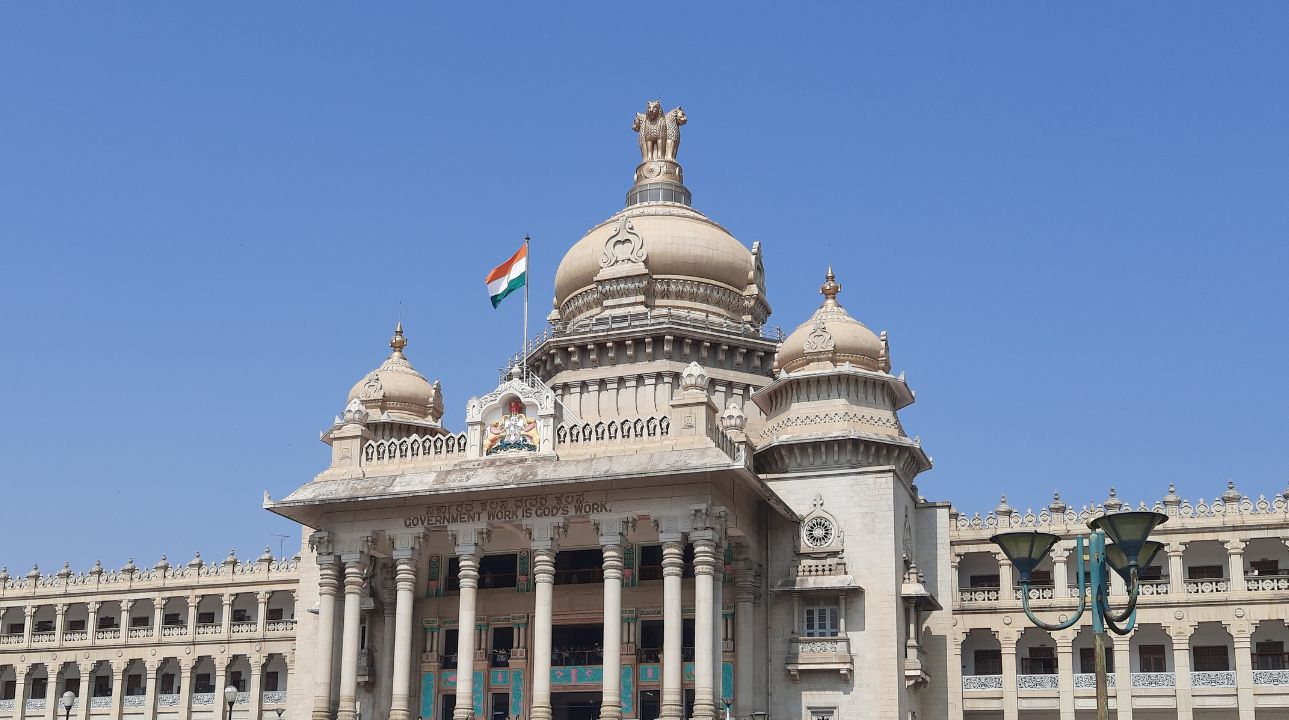
Vidhana Soudha.
Synopsis: The Karnataka government has ordered that media representatives collect statements only at a designated spot near the West Gate of the Vidhana Soudha, citing security concerns, and has restricted identity cards to those recommended by the Department of Information and Public Relations. The Congress government says the move is for safety, but the opposition BJP has called it undemocratic, while the Karnataka Union of Working Journalists has said it curbs press freedom and asked for the order to be withdrawn.
The Karnataka government on Wednesday issued a circular stating that media representatives must collect bytes/statements only at the designated area near West Gate of the Vidhana Soudha in the interest of ‘security’.
“When public representatives enter the Vidhana Soudha, media representatives follow them to collect bytes/statements. This may pose a threat to security of the dignitaries,” the circular stated.
Additionally, identity cards are being distributed only to media representatives recommended by the Department of Information and Public Relations. Only those media representatives holding such identity cards have been urged to collect statements at the designated place and not follow the Chief Minister, Deputy Chief Minister, and other ministers while entering the Vidhana Soudha.
The Vidhana Soudha, which houses the Karnataka Legislature and the offices of key ministers, is the nerve centre of the state’s political and administrative decision-making, and has traditionally been a space where reporters directly access elected representatives for on-the-spot reactions.
The latest order also follows a pattern of gradual narrowing of media access under successive governments led by the Congress, BJP and JD(S) over the past several years.
The Congress government has defended the decision, citing safety and security concerns. The opposition BJP accused the ruling party of being “anti-democratic” and “authoritarian”.
Leader of Opposition in the Karnataka Assembly R Ashoka said in a post on X, “In the red Constitution book that your supreme leader Rahul Gandhi carries and showcases everywhere he goes, is there no freedom of the press for the media?”
He further questioned whether the government feared further exposure of alleged irregularities, referring to recent media reports about the theft of lakhs of rupees worth of gold and cash from the office of minister Byrathi Suresh, among other alleged illegal dealings.
In July 2018, when HD Kumaraswamy was Chief Minister heading a Congress–JD(S) coalition government, restrictions had been imposed on media persons entering the Vidhana Soudha, Vikasa Soudha and the Secretariat building.
“You (journalists) are seen hounding ministers, including me, holding mics asking us questions on topics that we sometimes aren’t even aware of. Each person tries to get responses as and when they want. You ask us questions when we are in a hurry or in some other mood,” Kumaraswamy had said at the time.
He had given directions to give the media a separate room where ministers and officials would come and address them, whenever they intended to.
The BJP, which was then in the opposition, had called the order “undemocratic”. The order was eventually revoked after widespread criticism from the media as well.
Then in 2019 under Yediyurappa-led BJP government, the then Assembly speaker Vishweshwara Hegde Kageri issued an order prohibiting private television channels from recording the proceedings of the legislature session.
While journalists were allowed to sit in the gallery, they were not allowed to bring in their cameras or record proceedings using their phones. TV channels had to procure footage from Doordarshan while print media photographers had to make do with photos from Department of Information and Public Relations – similar to how Lok Sabha TV or Rajya Sabha TV operate at the national level.
Journalists from national and regional organisations protested the decision, with Vijay Karnataka publishing black spots on its front page instead of photographs of politicians on a story on the issue.
The restriction, which is still in place, came years after the then Karnataka Minister for Cooperation Laxman Savadi was caught watching pornography on his mobile phone while the Assembly was in session in 2012.
TV cameramen, who were positioned in the elevated media gallery, recorded Savadi, who was sitting in the front row of the House, watching the clips on his mobile phone. Less than an hour after the session concluded, TV channels flashed the uncensored visuals.
News channels also captured the then Minister for Ecology, Environment and Ports, J Krishna Palemar, and Women and Child Welfare Minister C C Patil looking at Savadi’s phone and reacting animatedly. In the aftermath of the controversy, Savadi, Patil and Palemar resigned from the Cabinet.
Subsequently, a House committee inquiry cleared Patil and Palemar citing “lack of evidence”, while Savadi was reprimanded for using a mobile phone inside the Assembly. He later returned to public office, serving as Karnataka’s eighth Deputy Chief Minister and as Transport Minister from 2019 to 2021 in the fourth B S Yediyurappa ministry.
Soon after the ‘scandal’ was broken by the media, the then Speaker KG Bopaiah had banned private television channels from recording and broadcasting live proceedings of the House. The ban was later lifted – only to be imposed later again in 2019.
In the same year (2019), the state government issued guidelines stating that only 150 chosen journalists “recommended” by the Department of Information and Public Relations would be given yellow cards valid for one year.
Only these selected journalists will be allowed to enter the Vidhana Soudha, the Vikas Soudha and the Karnataka Secretariat, the rules said. However, the proposal was reportedly put on hold. The latest circular bears a slight resemblance to this rule on “chosen journalists.”
Two years later, in 2021, the Basavaraj Bommai-led BJP government issued an order banning media persons from filming or photographing the corridors of Vidhana Soudha, as it was “obstructing” VIP movement. This order was also withdrawn following outrage.
The Karnataka Union of Working Journalists (KUWJ) condemned the latest restriction, stating that imposing “unnecessary” restrictions on the functioning of media amounts to “curbing freedom of expression”.
“Framing regulations that dictate how the media should behave within the premises of the Vidhana Soudha is a step that goes against democratic principles,” the body said in a statement.
The KUWJ has urged the government to withdraw the order.
(Edited by Dese Gowda)


