

Published Apr 20, 2026 | 8:09 PM ⚊ Updated Apr 20, 2026 | 8:09 PM

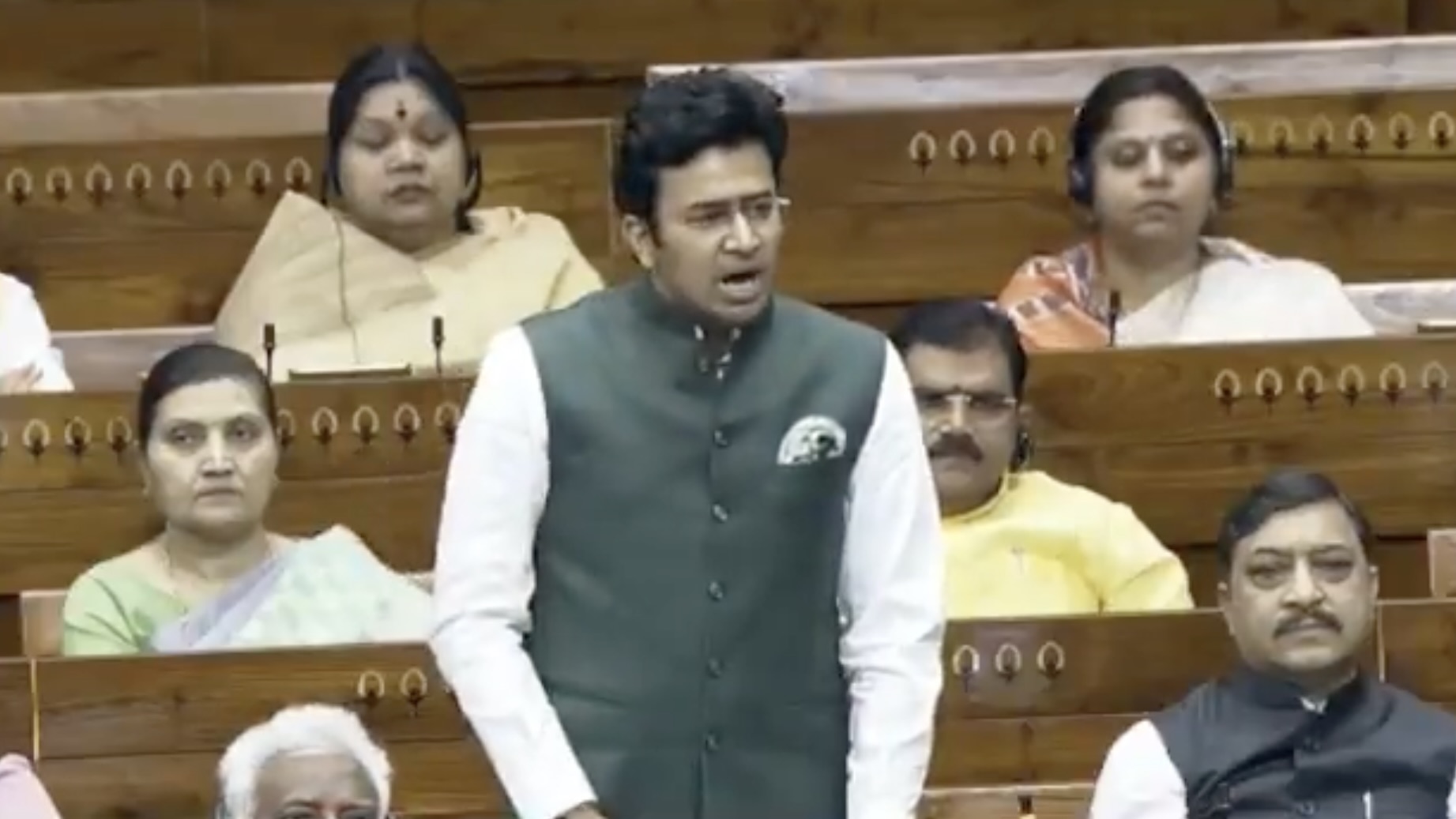
Tejasvi Surya was the first in the House to give a breakdown of seats for each southern state,

Synopsis: Following the defeat of the Constitution (131st Amendment) Bill in the Lok Sabha on 17 April, BJP MP Tejasvi Surya drew a comparison between the delimitation of wards under the Greater Bengaluru Authority and accused the Congress of double standards.
The BJP upped its attack on the Congress party days after the Lok Sabha defeated the Constitution (131st Amendment) Bill.
Bengaluru South MP and BJP leader Tejasvi Surya drew a parallel between the recently-completed ward delimitation exercise in Bengaluru under the newly-created Greater Bengaluru Authority (GBA) and the national delimitation process, which the Opposition parties, including the Congress, have opposed.
“Chief Minister Siddaramaiah and Deputy Chief Minister DK Shivakumar used population growth as a reason to create Greater Bengaluru Authority by creating five new corporations,” Surya said on Sunday, 19 April.
GBA has been split into 369 wards, nearly doubling the earlier 198 in five corporations, he said.
“Today, the same leaders are seen opposing the delimitation process across the country. A clear hypocrisy and double standards from the Congress,” he alleged.
The Constitution (131st Amendment) Bill, 2026, was tabled in the Lok Sabha along with the Delimitation Bill, 2026 and the Union Territories Laws (Amendment) Bill, 2026 as a three-Bill package to “operationalise” women’s reservation.
The Opposition maintained that there was near-unanimous agreement among all parties on supporting the reservation for women, but criticised the government for linking it to the population-based delimitation of constituencies that would redraw the country’s electoral map.
They urged the government to delink the implementation of the women’s reservation from the delimitation.
Surya, however, drew on the Bengaluru example to make his case, bringing together two distinct delimitation exercises to attack the Congress.
The BJP MP’s charge hinged on a simple claim: if population justified redrawing Bengaluru’s wards, opposing population-based delimitation nationally amounted to “hypocrisy.”
But the comparison collapsed, since both were two different exercises.
Delimitation for the GBA was undertaken primarily to restructure the erstwhile Bruhat Bengaluru Mahanagara Palike (BBMP) into five separate, more manageable, smaller city corporations (Central, South, East, West, and North). It was an attempt to improve governance, manage explosive population growth, and bring administration closer to citizens.
Under the new system, governance has been structured in three tiers: the GBA at the apex, the five city corporations at the mid-level, and ward committees at the grassroots. Each ward would represent approximately 20,000 people, based on the 2011 Census, with 2023 population projections also being applied.
Related: NDA’s push for delimitation fails
Leaders of smaller parties told South First earlier that the shift from fewer, larger wards with bigger populations to a larger number of smaller wards would advantage lesser-known parties. Smaller wards make it easier for them to campaign and build direct connections with voters, and would also help ensure local accountability.
The creation of more wards would redistribute representation within a city, without affecting other regions. It does not shift the balance of power between states, nor do they reduce their representation.
In contrast, the national delimitation exercise determines representation in the Lok Sabha and could shift political weight between states.
Urban experts pointed out that ward delimitation was about how many citizens a corporator would represent, while national delimitation determined the number of constituencies and MPs in the Lok Sabha and, by extension, the balance of political power.
“The Union is a federal republic of states. There should be a balance of power between states and the Centre. However, local bodies are largely under the control of the state, functioning as an administrative arm,” Urban infrastructure expert Ashwin Mahesh said.
To retain the balance of power between states and the Centre, the latter should have undertaken detailed and extensive consultations, he added.
The central government’s push for population-based delimitation risked reducing representation of states with better population control — a fear the southern and smaller states have consistently raised — in comparison to large states, especially in the Hindi heartland.
During the debate on the Bills, Surya was the first in the House to give a breakdown of seats for each southern state, post the now-stalled delimitation exercise.
“Tamil Nadu, which is now at 39 (seats), is going to get 59 seats. Karnataka, which has 28, is going to get 42 seats. Andhra Pradesh, which has 25, will get 38 seats, Telangana, which has 17, will get 26 seats, Kerala, which has 20, will get 30 seats,” Surya said, while defending the contentious exercise.
Like other BJP leaders, Surya, too, had mentioned that there would be a uniform 50 percent increase in the strength of Lok Sabha MPs, which found no mention in either of the Bills. In fact, Section 8 of the Delimitation Bill stated that the Delimitation Commission shall allocate seats to the states “based on the latest Census figures.”
(Edited by Majnu Babu).



