

Published Jan 06, 2026 | 11:30 AM ⚊ Updated Jan 06, 2026 | 11:30 AM

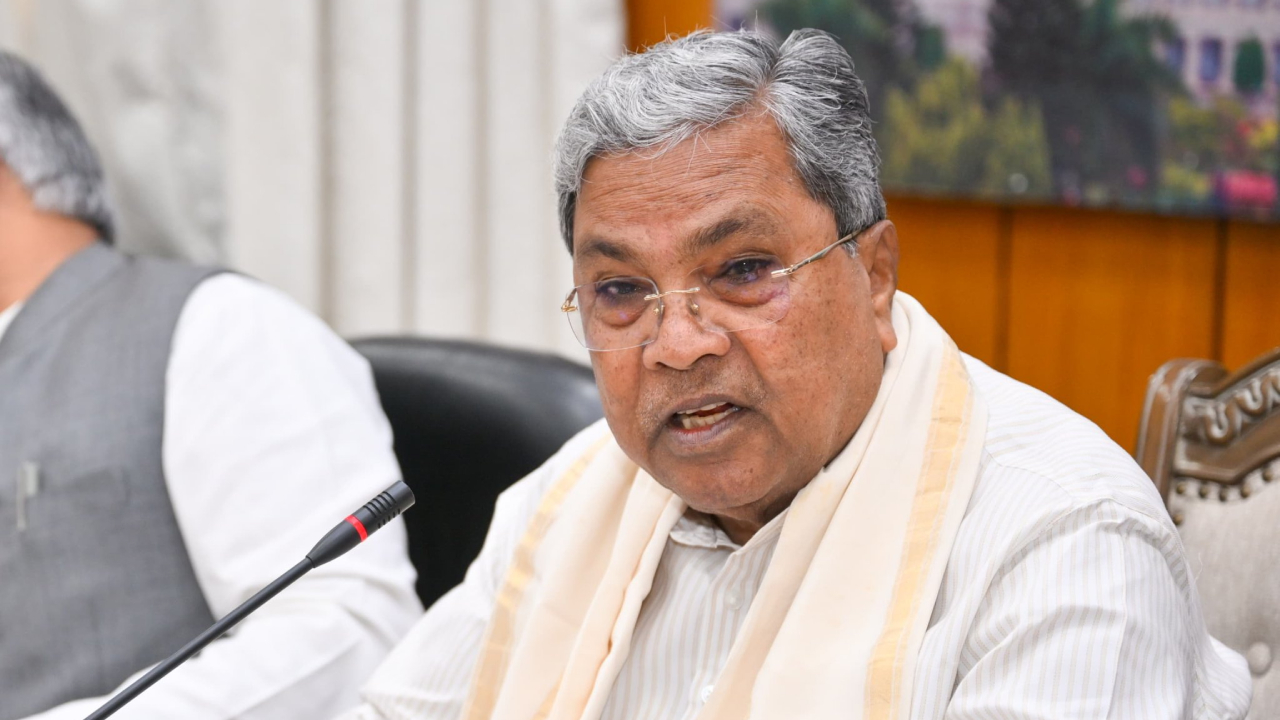
Karnataka Chief Minister Siddaramaiah. Credit: x.com/siddaramaiah
Synopsis: Siddaramaiah, amid leadership tussle speculation, surpassed Devaraj Urs’ record as Karnataka’s longest-serving CM. Like Urs, he foregrounded social justice through AHINDA and welfare schemes, though facing sharper resistance over caste census and land row. His tenure highlights both continuity and contrast with Urs’ legacy, while Congress weighs his OBC leadership’s electoral mojo ahead of crucial polls in neighbouring Tamil Nadu and Kerala.
After months of speculation around a perceived leadership tussle within the Karnataka Congress, Chief Minister Siddaramaiah on 6 January equalled the record set by Devaraj Urs, completing 2,792 days in office as Chief Minister. Tomorrow, on 7 January, Siddaramaiah will create a new record of becoming the longest-serving chief minister of the state, across two non-consecutive terms.
Urs is widely regarded as the first Congress CM to decisively challenge the political dominance of Lingayats and Vokkaligas in Karnataka. Siddaramaiah, who first assumed office in 2013, consciously revived Urs’ social justice playbook by consolidating Dalits, Other Backward Classes and minorities under the political umbrella of AHINDA — an acronym for Alpasankhyataru (minorities), Hindulidavaru (backward classes) and Dalitaru (Dalits).
In recent months, the Opposition, sections of the media, and even a segment of Congress leaders have kept alive speculation of an imminent change in leadership. The party completed 2.5 years of its current term in November 2025, a milestone that fuelled talk of a so-called “November revolution”.
Despite Siddaramaiah and Deputy Chief Minister DK Shivakumar repeatedly projecting unity, rumours of a leadership change refused to die down, morphing into whispers of a “Sankranti Kranti (revolution)” as the year-end passed.
Yet, amid sustained speculation and political intrigue, Siddaramaiah has achieved a feat unmatched in Karnataka’s political history. Siddaramaiah is also the only CM after Urs to complete a full-five year term.
“Both are from Mysuru but they never came across each other, it is very surprising. If you go through his speeches and writings, Urs never mentioned Siddaramaiah and the latter doesn’t mention Urs. Even recently, Siddaramaiah asked people not to compare him with Urs,” said Dinesh Amin Mattu, who was the CM’s former media advisor.
However, Mattu did mention that some broader similarities between the two leaders are hard to ignore.
Across his two stints in office (1972–77 and 1978–80), Urs fundamentally reshaped Karnataka’s social and economic landscape, using the state’s machinery to address the deep-rooted social imbalance in the society.
One of Urs’ most celebrated interventions came in 1974, when land reforms that he initiated enabled thousands of landless tenant farmers to gain ownership of the land they cultivated, in a bid to free them from exploitative tenancy laws and absentee landlords. The slogan —Uluvavane bhoomi odeya, or the tiller is the owner of the land, reverberated across the state.
Urs also constituted the LG Havanur Commission, which submitted its report on 19 November, 1975. He described it as the “Bible of Backward Classes.” For one of the first times, a policy on backwardness was backed by systematic data and lived social experiences, which formed the basis for reservation policies in education and employment in the state between 1977 and 1986 until another commission was appointed to look into reservations.
However, a closer look at the report shows the political vision behind Urs’s project. Appendix I of Part II of Havanur Report titled “Caste composition of the Commission and Staff” lists the actual castes and sub-castes of staff of the backward classes commission – from the chairman to the lowest ranking staffer. Urs had handpicked leaders from non-dominant communities and nurtured them – including Congress President Mallikarjun Kharge who became a minister for the first time in 1976 in the Urs government.
Operating in a different political context and facing a distinct set of challenges, Siddaramaiah is also known to have walked on a path of foregrounding social justice through policy and political mobilisation. Throughout his term, Congress leader has introduced schemes and policies for minorities, women, and the poor.
Introduced during his first term, the Shaadi Bhagya scheme provided financial assistance of Rs 50,000 for the marriage of women from minority communities, including Muslims, Christians, Jains, Buddhists, Sikhs, and Parsis. The scheme, which invited criticism from the Opposition along the lines of ‘Muslims appeasement’ was designed to reduce the economic burden of marriage on low-income families.
In his second term, Siddaramaiah introduced guarantee schemes – Gruha Lakshmi, Gruha Jyothi, Anna Bhagya, Shakti, and Yuva Nidhi – all aimed at welfare. An independent study conducted on the impact of these schemes found that they enhanced living standards among women and made them self-sufficient.
During his two terms, Siddaramaiah initiated a socio-economic and educational survey – commonly referred to as the caste census – to evaluate the status of communities and recommend amendments in reservation policies. The first report in 2015 had not been accepted by the government after it faced stiff opposition from Vokkaliga and Lingayat associations.
The second survey was conducted in 2025. Although the report is yet to be submitted to the government, it faced considerable opposition prior to and during the data collection period with demands for inclusion of several communities in the reservation categories.
Mattu however pointed out that Urs did not face the kind of political challenge that Siddaramaiah faced with the caste census.
“Siddaramaiah faces more of a challenge now because of the social structure. Who is opposing the caste census now? The same Vokkaliga leaders within Congress,” he said.
The former media advisor also stated that Urs had complete support of the high command during his term. The then high command, which included Indira Gandhi, took several “bold” and “Left-leaning” decisions such as the ‘Garibi Hatao’ programme which was in line with Urs’ ideology. “Recently there was a lot of power struggle and the current high command is very weak,” Mattu said.
Some analysts are wary of comparing Urs legacy with that of Siddaramaiah. “This term of Siddaramaiah’s has shown that he is into a of politics and group formation, which Urs never did,” Harish Ramaswamy, a political analyst told South First. He pointed out that the Mysuru Urban Development Authority (MUDA) scam and the Karnataka Maharishi Valmiki ST Development Corporation scam might have dented the CM’s image.
On 5 January, when reporters asked Siddaramaiah about him breaking Urs’ record, the CM said, “I never said that no one can break my record. Someone may emerge to break my record of the longest serving CM or the one who presented the maximum budgets.”
Over the past few months, several of his remarks have been read into as signs of a leadership tussle. At times, the CM has snapped at reporters who keep pressing him about his position, and those moments have then been lifted out of context to feed the narrative that “Siddaramaiah is anxious about what lies ahead.”
However, political observers point out that Siddaramaiah is one of the few OBC chief ministers Congress has in the country at present. Right before elections in Bihar, where OBC votes were crucial, many party leaders were of the opinion that any move to replace Siddaramaiah will have a bearing on the party’s performance. Post the grand old party’s drubbing in Bihar, it wouldn’t want to create any more trouble for itself as two crucial elections in South India – Tamil Nadu and Kerala – are around the corner.
Additionally, observers also argue that sidelining Siddaramaiah could be read as a setback to the Bahujan politics Congress, under Rahul Gandhi, has been championing for.
In July 2025, just a couple of months ahead of the onset of speculation about leadership change, Congress made Siddaramaiah a member of the All-India Congress Committee’s (AICC) OBC Advisory Council, that was set up to understand the problems faced by the communities and formulate a strategy to provide solutions to them. He had also taken on the responsibility of hosting the council’s first meeting at the KPCC office.
Meanwhile, for Siddaramaiah’s supporters, the feat of breaking Urs’ record is set to be a celebration. On 6 January, one group is planning for a a Nati Koli Oota, or country chicken feast, in Bengaluru. Later in the month, representatives of AHINDA organisations plan to hold a mega convention in Mysuru.
(Edited by Amit Vasudev)


