

Published Dec 18, 2025 | 4:12 PM ⚊ Updated Dec 18, 2025 | 4:12 PM

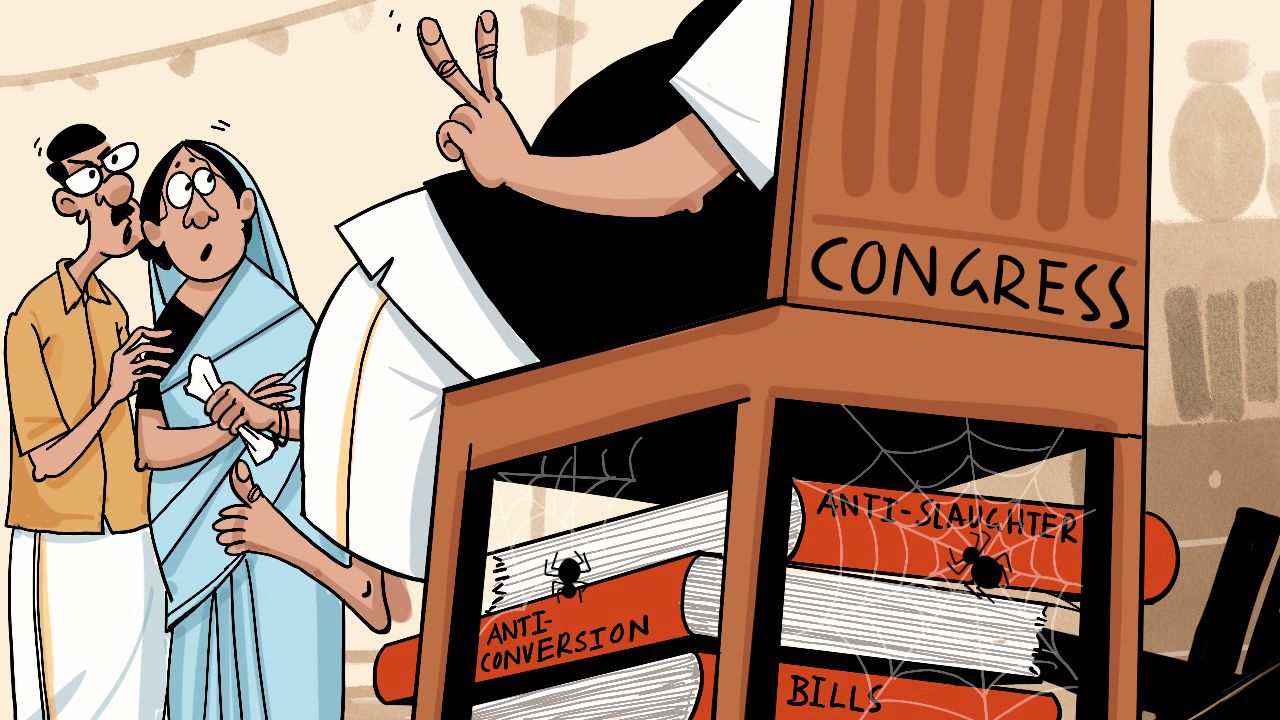
Despite being halfway through in power, there has been no indication from Congress to revisit or repeal these "controversial" laws.
Synopsis: During the run-up to the 2023 Assembly election in Karnataka, the Congress targeted three controversial Bills the previous BJP government had passed, and promised to repeal them once the party came to power. The Congress performed well at the hustings and rode to power comfortably. Even after 2.5 years in power, the party has not repealed the Acts, including anti-conversion and anti-slaughter laws.
More than two and a half years after the Congress in Karnataka pledged to repeal the “anti-people” and “unjust” laws enacted by the previous BJP regime, the government has made little headway in fulfilling the promise.
Among the measures the party had vowed to undo were amendments to the Agricultural Produce Market Committee (APMC) Act, the Karnataka Land Reforms Act, the Karnataka Protection of Right to Freedom of Religion Act, 2022—popularly known as the “anti-conversion” law—and the Karnataka Prevention of Slaughter and Preservation of Cattle Act, 2020.
These legislations were the Congress’s key targets ahead of the 2023 Assembly elections.
Despite being halfway through in power, there has been no indication of any move to revisit or repeal these “controversial” laws.
Land Reforms Act
In 2020, the BJP government amended the Karnataka Land Reforms Act, 1961, allowing non-agriculturists to purchase farmland in the state in an effort to liberalise landholdings.
The government had omitted Sections 79 A, B and C. Section 79A barred a person (or family) with an annual non-agricultural income of ₹25 lakh from acquiring agricultural land; Section 79B stated that only a person cultivating land personally could hold agricultural land; and Section 79C detailed penalties for falsely claiming eligibility to hold agricultural land.
Siddaramaiah, then the Leader of the Opposition in the Assembly, had termed the BJP government’s amendments “a scam bigger than illegal mining” and “anti-farmer”, claiming that farmland parcels worth ₹50,000 crore would be lost.
In 2024, Siddaramaiah, now the Chief Minister, announced the government’s plans to reverse these modifications once it has a majority in the legislative council.
In September 2025, with four new nominations to the legislative council, the strength of Congress went up to 37, compared to the BJP and JD(S)’s 29 and seven, respectively.
Meanwhile, farmer groups such as the Karnataka Rajya Raitha Sangha (KRRS) have continued to express their concerns over the ruling Congress government’s policies on agriculture. The incumbent government, it seemed, has been pursuing the BJP line.
“If the government continues to follow the BJP’s policies, it will be a grave injustice to the farmers,” KRRS president Badagalpura Nagendra said in February, warning that the farmers would be forced to his the streets in protest.
The APMC Act
Amid nationwide farmers’ protests against the Union government’s contentious farm laws in 2020, the BJP-led Karnataka government, under the then-Chief Minister BS Yediyurappa, promulgated the ordinance amending the Agricultural Produce Market Committee (APMC) Act.
The amended law, notified in January 2021, eased restrictions on the sale of agricultural produce and empowered private players to purchase commodities directly from farmers.
Although the Union government repealed the farm laws after widespread opposition, the then state BJP government did not follow suit. It claimed that the APMC Act amendments were unrelated to the three rolled back farm laws.
Farmers’ organisations, traders and Opposition parties repeatedly urged Yediyurappa’s successor, Chief Minister Basavaraj Bommai, to withdraw the changes, but to no avail. Ahead of the 2023 Assembly elections, the Congress promised to repeal the “anti-farmer” laws if it was voted to power.
In 2023, the government introduced a Bill in the Assembly, the Karnataka Agricultural Produce Marketing (Regulation and Development) (Amendment) Act, 2023.
It restored a key clause in the Karnataka Agricultural Produce Marketing (Regulation and Development) Act, 1966, which had been removed through the 2020 amendment: “No place except the market yard, market sub-yard, sub-market yard, private market yard or farmer-consumer market yard, as the case may be, shall be used for purchase or sale of notified agricultural produce.”
“Consequent to the said amendment, the restriction for carrying, buying and selling of notified agricultural produce in the market yards has been removed, and the role of the APMCs has been restricted to the market yards only,” the Bill explained.
Pointing out that the BJP’s modifications to the APMC Act were one of the causes for the collapse of APMC markets in the state, Siddaramaiah had said, “By amending the APMC Act, the previous government weakened the healthy marketing network and created uncertainty in the lives of lakhs of farmers who depended on APMCs for their livelihoods.”
While the Bill was passed in the Assembly, it did not make it through the Council, which decided to refer it to a select committee headed by Agricultural Marketing Minister Shivanand Patil.
The panel visited four APMCs in the state: Kolar, Shivamogga, Kalaburagi and Raichur, listening to traders and farmers. The committee heard opinions favouring the BJP-made amendments only in Raichur.
The Assembly, in February 2024, passed The Karnataka Agricultural Produce Marketing (Regulation and Development) (Amendment) Bill, 2024, based on the recommendations of the select committee.
It established a ‘Market Development Assistance Fund’ for developing market yards of financially weak APMCs. The Bill also returned the power to the market committee for regulating the marketing of agricultural produce in any place in the market area.
Right to Freedom of Religion Act
The Karnataka Protection of Right to Freedom of Religion Act, 2022, which received the Governor’s assent in September 2022, prohibited “unlawful conversion from one religion to another by misrepresentation, force, undue influence, coercion, allurement or by any fraudulent means.”
Under the law, forcible conversion can result in a jail term between three and five years and a fine of up to ₹25,000. Converting a minor, woman, or an SC/ST person would invite a jail term of three to 10 years and a ₹50,000 fine, while mass conversion would lead to three to 10 years in jail and a ₹1 lakh fine.
It also stated that “marriage done for [the] sole purpose of unlawful conversion or vice versa is to be declared null and void,” addressing the right-wing bogey of ‘love jihad’.
The Congress party had staged a walkout when the Bill was passed in September 2021, describing it as “draconian” and “anti-human”.
The party also alleged that it had been introduced to target a particular community. In fact, the law was considered to be more stringent than similar legislation introduced in Uttar Pradesh, Gujarat and Madhya Pradesh.
A report by the People’s Union for Civil Liberties (PUCL), Karnataka chapter, released in 2021, titled “Criminalising the Practice of Faith” (Regarding hate crimes against Christians in Karnataka by Hindutva groups), detailed how the myth of “conversion” was being used “to curtail Christians’ constitutional right to practice and profess their religion.”
“As a part of the demand of ensuring justice for Christians, the possibility of the anti-Conversion Bill must be resisted as the Bill can only legitimise such violence on the minority community,” the report had said while listing several hate crimes against Christians in that year.
While the state Cabinet in 2023 had announced that it would repeal the law, it decided not to table a Bill to this effect during the Budget Session of the Assembly, as Lok Sabha elections were around the corner.
In September 2025, while speaking at the inauguration of the chariot procession of Blessed Mother Mary from St Mary’s Basilica in Shivajinagar, Siddaramaiah said that the government would seek legal opinion on the law before deciding its further course of action.
Preservation of Cattle Act
The Cattle Slaughter Act, which was enacted in 2021, prohibited the sale, purchase, intrastate and interstate transport, slaughter, and trade of all cattle (cows, bulls, buffaloes, oxen). The only exemptions were buffalo above the age of 13 and terminally ill cattle, certified by a qualified veterinarian.
Violation of the Act would invite imprisonment for up to seven years, with a fine ranging between ₹50,000 and ₹5 lakh for the first offence, penalties ranging between ₹1 lakh and ₹10 lakh for second and subsequent offences.
Like the other contentious laws, the Congress, ahead of the Assembly polls, had hinted that it would repeal the law. In February 2023, Siddaramaiah had stated that the law should be removed as it has a communal agenda.
“There are no buyers for sick and aged cattle. It is a loss for the farmers,” he had said.
The state Cabinet, on 4 December, approved a proposed amendment to the Act, allowing the release of vehicles seized for illegally ferrying cattle on an indemnity bond instead of a bank guarantee.
It cited a 2022 Karnataka High Court order that directed the release of seized vehicles on an indemnity bond. The move sparked protests from right-wing groups, including the VHP and Bajrang Dal, who claimed that the proposal amounted to “sympathy for cattle lifters” and that it was part of broader actions that “target Hindus.”
The amendment hasn’t been tabled in the Assembly yet. According to multiple reports, the government has decided not to table even this proposed amendment amid concerns that the move could arm the Opposition against the ruling party on communal lines.
(Edited by Majnu Babu).


