

Published Mar 26, 2026 | 12:17 PM ⚊ Updated Mar 26, 2026 | 12:17 PM

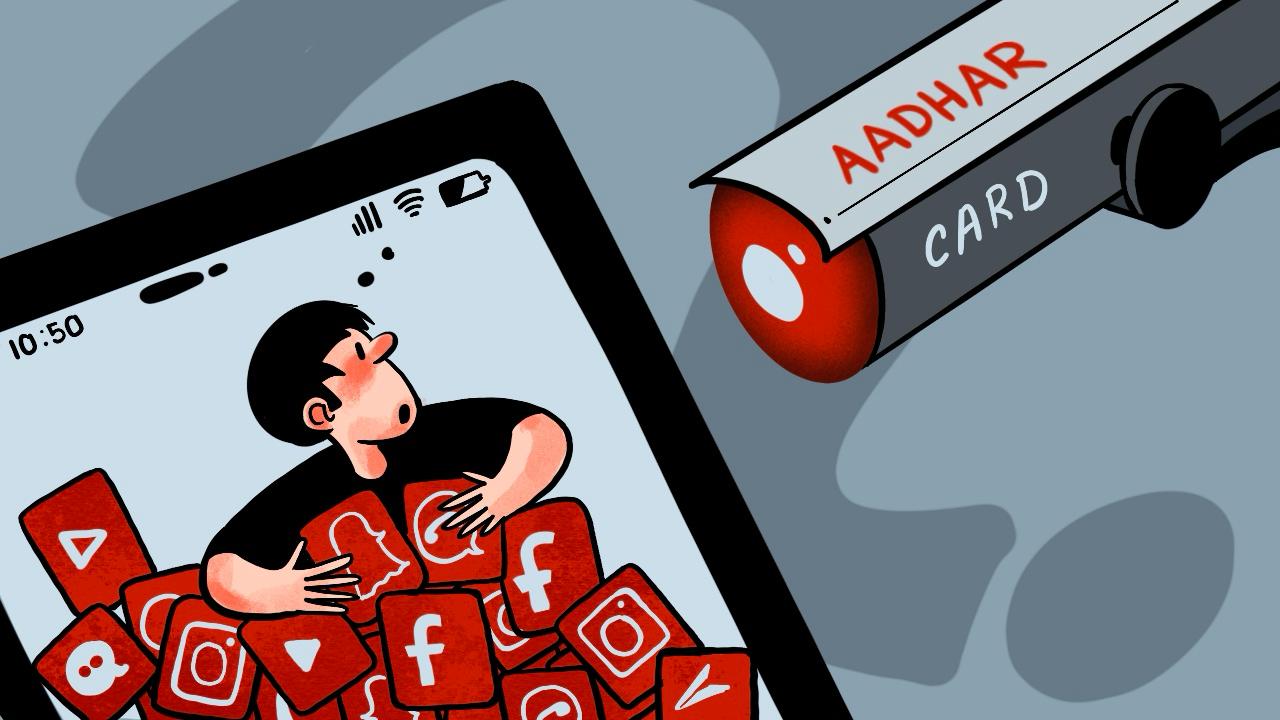
Experts differ on whether such regulation would be effective when digital access is hard to avoid.
Synopsis: Karnataka has released a draft policy on responsible digital use in schools, weeks after Chief Minister Siddaramaiah proposed a ban on social media for children under 16. Among its key proposals is Aadhaar-based sign-up for social media accounts, which has raised concerns among experts and internet rights groups about risks to user privacy. The draft also sets out rules for schools on screen time, online safety and the use of genAI.
Weeks after Karnataka Chief Minister Siddaramaiah proposed a ban on the use of social media and mobile phones for children under 16, the government has released a draft policy on ‘responsible digital use’ in schools.
Prepared by the Karnataka State Mental Health Authority, NIMHANS, and the School Education Department, the draft aims to “foster digital well-being, emotional regulation, and screen-time awareness in schools”.
It proposes an “Aadhaar-enabled sign-up to ensure age, authenticity, and avoid fake or multiple accounts” under a section on monitoring and reporting.
But it does not spell out how this authentication would work or who would oversee it. That gap has raised concerns among internet rights groups and experts about the implications of such a policy. The main concern is that it could force all users, regardless of age, to link their Aadhaar to social media accounts.
The proposal is similar to one used by Australia. In December, it became the first country to ban social media for children under 16, using mandatory age verification and fines.
Internet rights and advocacy groups have criticised such enforcement.
“Some forms of enforcement, if linked to identity verification, may also pose the risk of connecting every social media account with a government ID, creating a mass surveillance framework,” Apar Gupta, co-founder of the Internet Freedom Foundation (IFF) had earlier said.
When the Karnataka budget announced the ban, IFF raised the same questions: “Will this require state legislation? Will it mandate age-verification systems that create fresh privacy risks for all users, including adults? Will it apply to educational and informational uses of the internet? None of this is clear at present.”
While the draft policy is distinct from the proposed blanket ban, experts and internet rights groups have raised concerns about how its provisions would be implemented.
“Linking access to Aadhaar or any sovereign identity database would be a serious mistake,” Osama Manzar, Founder Director of the Digital Empowerment Foundation (a non-profit organisation that works to make technology accessible to the masses), told SouthFirst.
He said social media platforms are private entities, so giving them direct or indirect access to sovereign citizen data raises concerns about privacy and data protection.
“The role of the government in this context is clear. It must act as a protector of citizens’ rights, not as a partner to private platforms in data-sharing arrangements,” he added.
This is not the first time such a proposal has surfaced. In 2019, the Madras High Court dismissed a plea to link Aadhaar to social media accounts because it violated the Supreme Court’s judgment on Aadhaar (KS Puttaswamy v Union of India).
The issue arose when the Tamil Nadu government told the Supreme Court that users’ social media profiles should be linked to Aadhaar numbers to curb the circulation of fake, defamatory and pornographic content, as well as anti-national and terror material.
But Meta (formerly Facebook) resisted the proposal, saying sharing the 12-digit Aadhaar number would violate users’ privacy. It also said it could not share Aadhaar numbers with a third party because user content on its instant messaging platform WhatsApp is end-to-end encrypted.
The IFF, which had intervened in a PIL seeking to link Aadhaar with social media accounts, said this could give social media companies greater power over users.
“For instance, it would allow social media companies to gather deeper, more granular information about their users. A government ID, especially one such as Aadhaar which has a common identifier, would permit them to link personal data on the platform more easily,” it added.
This could lead to the creation of “more pervasive dossiers of social media users”, according to the IFF, which would let advertisers and other third parties target individuals across platforms. It also said such measures could have a chilling effect on free speech by increasing risks for users who express dissenting views online.
Moreover, experts differ on whether such regulation would be effective when digital access is hard to avoid.
“Social media platforms do not inherently provide knowledge; they host user-generated content, much of which is entertainment-driven and optimised for engagement. Placing reasonable boundaries around such environments for children is a protective measure, not censorship,” Manzar said.
In fact, a survey conducted three months after the ban in Australia reported mixed outcomes. Among parents of children under 16, 43 percent noticed more in-person social interaction, while 38 percent said their children were more present and engaged during interactions.
But 27 percent reported a shift to alternative or less regulated platforms, and 25 percent saw reduced social connection, creativity or peer support online.
Schools to enforce screen limits, safety protocols and AI checks
Beyond Aadhaar linking, the draft policy recommends that schools incorporate digital well-being and social media literacy into the curriculum, including lessons on age-appropriate, responsible digital behaviour, online safety, privacy, cyberbullying and balanced screen use.
Schools are also expected to frame their own digital use policies. These include protocols to address cyberbullying, capping recreational screen time at one hour a day, adopting traditional methods of communication instead of direct WhatsApp contact with students, and implementing a “diary system” for communication.
The draft also proposes Digital Safety and Wellness Committees in every school, comprising school heads, counsellors, teachers, parents, student representatives and cybercrime police officials to monitor implementation and address digital risks.
It also recommends that schools train teachers and staff to identify early mental health red flags among students, and set up mechanisms to refer such students to mental health professionals through school counsellors. It further sets out guidelines for the use of generative LLMs in homework and assignments, including checks for plagiarism.
The policy also recognises the role of parents in ensuring structured screen-time routines, device-free family time and increased offline engagement.
(Edited by Dese Gowda)


