

Published Oct 17, 2023 | 6:50 PM ⚊ Updated Oct 18, 2023 | 3:43 AM

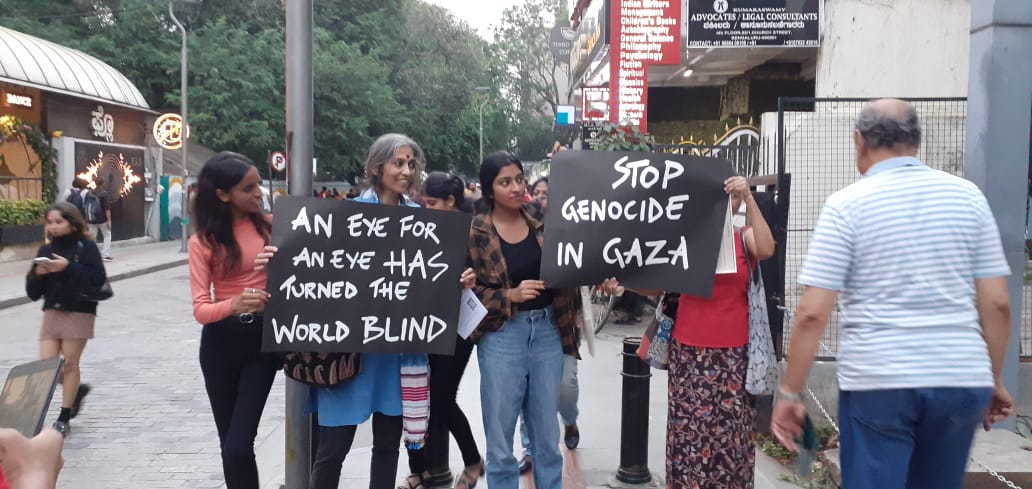
Placard holding members at the solidarity event in Bengaluru

The Karnataka police have registered an FIR against 10 activists and others for organising a “silent solidarity event” in support of the Palestinians on Monday, 16 October, at the Mahatma Gandhi (MG) Road in Bengaluru.
The Central Division’s Cubbon Park police have registered a suo motu case against the activists for not obtaining permission from the authorities as well as for creating public nuisance.
“Around 10 people and others have been booked under IPC sections 283 — danger or obstruction in public way or line of navigation, 290 — public nuisance, and 291 — continuance of nuisance after injunction to discontinue,” a senior police officer told South First.
“Notices will be issued to all the accused seeking explanation for the offence committed and their statements will be recorded,” added the officer.
Placard holding members at the solidarity event in Bengaluru
Over 200 people gathered at the iconic MG Road near the Metro Station on 16 October — around 5.30 pm — to express their solidarity and support with the Palestinians.
They also condemned what they referred to as Israel’s war crimes and its justification of ethnic cleansing in the Gaza strip.
Several civil society groups and organisations along with its members headed by an umbrella organisation Bahutva Karnataka organised the solidarity event with a silent human chain, a candle vigil, showcasing of placards and banners, and distributing pamphlets expressing their support for the Palestinians.
On Tuesday, 17 October, an FIR was registered against all the 10 activists whose names were noted down by the police.
“We have registered an FIR against 10 people and others booking them under IPC Sections 283, 290 and 291,” Shekhar H Tekkannavar, Deputy Commissioner of Police (Central Division) told South First.
“This case is for creating public nuisance and is a part of preventive measure so that next time such gatherings could happen only after obtaining permission from the police and if they are granted,” added Tekkannavar.
Bahutva Karnataka has, meanwhile, condemned police action against pro-Palestine social media posts and pro-Palestine protestors.

An Indian postal stamp of the 1981 government showing solidarity with the Palestinian people
“There is a lot of disinformation being amplified by social media handles belonging to right wingers from India supporting Israel’s decision to attack Palestinians in Gaza,” advocate and activist Vinay Sreenivas told South First.
“We organised this event to bring awareness among our own countrymen that India has been officially supporting Palestinians for many decades now, and our stand is still the same and will continue to remain so,” said Sreenivas.
“We had gathered not for protesting. We were gathered there for a silent human chain, holding placards and banners for the commuters and the general public to see. We were not shouting slogans or agitating,” said Sreenivas.
“Even then the police detained us and took them to the police station and collected our details,” he added.
“We came to know later that they had also registered an FIR against us,” Sreenivas told South First.
One of the methods being used by the groups to spread their message about Palestine is through distributing pamphlets with QR codes and URL links.
“We had designed pamphlets which had a QR code and a URL link where anyone could get access to free resources on the ethnic cleansing that is underway in the Gaza strip,” Sreenivas said.
“We had created a URL link which has access to free resources written and published by Palestinians themselves, like their news articles, books, poems, and even social media handles of people from Gaza. This could be accessed and read by anyone who is interested in knowing what was happening there,” Sreenivas said.
“Bahutva Karnataka wanted to highlight the historic injustice that was occurring to Palestinians. It is not a Muslims versus Jews issue. It’s more of a European nation colonising a part of Asia,” claimed Sreenivas.
Patrolling police teams attached with both the Cubbon Park police station and the Ashok Nagar police station were caught unawares — all of a sudden when they noticed several people gathered on the footpaths of the MG Road holding placards and huge banners.
Some of them were also distributing pamphlets to bystanders and commuters.

Placard holding members at the solidarity event in Bengaluru
The police initially contacted the organisers of the event and told them that they have disperse as they had not obtained any permission from any authorities.
The organisers comprising of several civil right activists argued back stating it was not a protest gathering for them to obtain permission from the police, but was a peaceful silent human chain and candlelight vigil for the Palestinians in crisis.
The cops refused to listen and kept instructing them to disperse. Later, they had to use force and detain the activists who were bundled to Cubbon Park police station.
Their names, contact numbers and addresses were noted down by the cops and they were later released. By the time the activists were detained, huge crowds from Shivajinagar started rushing to MG Road and showed their support and solidarity, police sources told South First.
Civil society group members and activists were distributing pamphlets describing their account of the happenings at the Gaza strip over the past week.

The Pamphlet distributed by the activists at the solidarity event in Bengaluru
“A 365 sq-km region — roughly half of Bengaluru inhabited by over two million Palestinians — has been under attack by the Israeli Defence Force (IDF). The IDF has dropped more bombs in a week over Gaza than the United States did over Afghanistan in a year,” the pamphlet read.
“On day 9 of the IDF attack, over 2,400 civilians have been killed and over four lakh Gazans have been displaced. Water and power supply has been cut for the entire population.
“The Israeli government claims this is in retaliation for the attacks by Hamas on 7 October which penetrated deep into Israeli territory and killed over 1,200 Israelis. Such retaliatory acts are examples of collective punishment, deemed war crimes that violate international law,” the pamphlet read.
“With all the disinformation flooding social media and even news reports, it is difficult to develop an understanding of this 100+ year transnational issue,” said Sreenivas.
The pamphlet also had a map of a shrinking Palestine over the past decades, from 1946 to 2014, along with “dehumanising narratives” with words like human animals and savages allegedly being used by the members of the Israeli government and the western media to describe the Palestinians.



