

Published Jun 17, 2025 | 5:19 PM ⚊ Updated Jun 17, 2025 | 5:20 PM

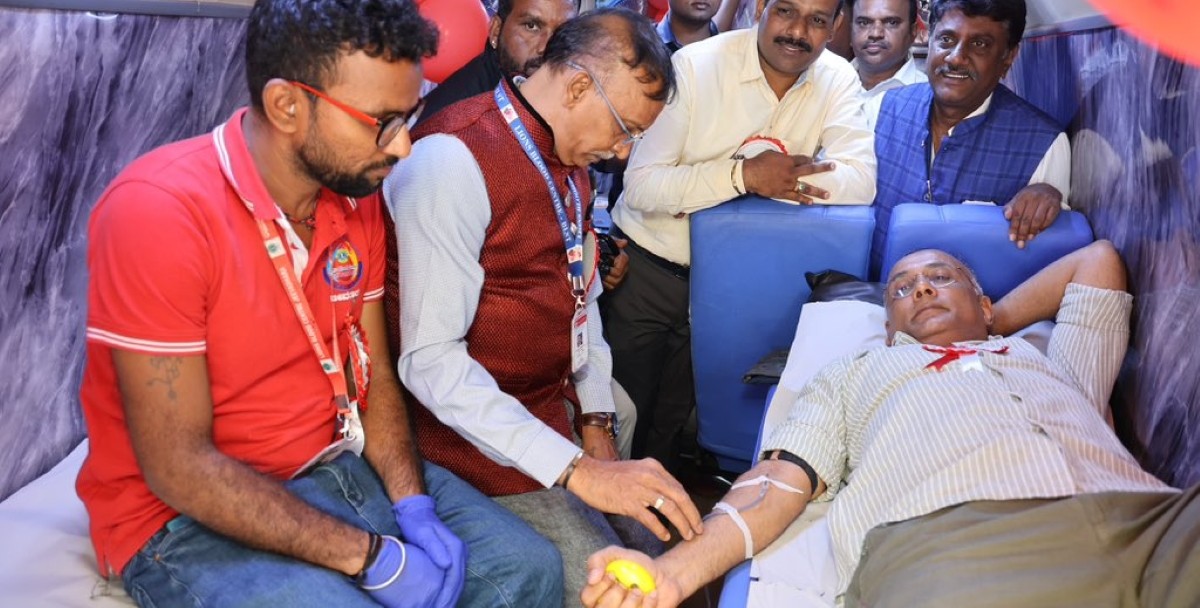
Karnataka Health Minister donates blood. (X)

Synopsis: Karnataka leads India in wind power addition and exceeds blood donation targets. BMTC’s new device aids visually impaired commuters, and health staff will shift to mobile attendance from July. IIM Bangalore concluded orientation with leadership insights. RareFore celebrated Indian culture through art and music. R Chethan was appointed DIG, Intelligence, marking progress in innovation, inclusion, and governance.
The House of Rare has unveiled RareFore, a new event dedicated to celebrating India’s cultural richness through immersive events that blend music, art, food, and storytelling.
The debut edition featured standout performances by Kashmiri Rabab artist Adnan Manzoor, storyteller Himanshu Bajpai (Dastangoi), and the genre-fluid folk group The Aahvaan Project.
Conversations on identity and culture were led by Shoba Narayan, Shilpa Sharma, and Manu Chandra, who also curated a special menu.
The Aravani Art Project, a trans and cis-women-led collective, created a powerful community installation.
RareFore is envisioned as a space for creators and seekers alike—rooted in Indian ethos yet pushing boundaries. Founder Akshika Poddar calls it “a night of discovery” for those drawn to the extraordinary.
Bengaluru Metropolitan Transport Corporation (BMTC) has launched a ground breaking “On-Board” device to make bus travel more accessible for the visually impaired.
Developed in collaboration with IIT Delhi, Raised Lines Foundation, Continental Automotive, and GIZ, the technology enables blind passengers to independently identify buses and notify drivers when boarding or alighting.
Pilot-tested on 25 buses along the Yelahanka-Kengeri and Yeshwanthpur-Kengeri routes, the system comprises a device installed on the bus and a remote for visually impaired users.
When a bus approaches, passengers press “Find” to hear the route number. If it matches their destination, pressing “Select” alerts the crew to wait longer at the stop.
This innovation significantly reduces the reliance on others and promotes inclusive urban mobility.
R Chethan, IPS, currently serving as Deputy Inspector General of Police and Commissioner, Youth Empowerment and Sports Department, has been given the concurrent charge of Deputy Inspector General of Police, Intelligence.
The appointment is effective immediately and will remain in force until further orders.
Speaking at World Blood Donor Day celebrations at Seshadripuram College, Bengaluru, Health Minister Dinesh Gundu Rao announced that Karnataka has achieved 124 percent of its blood collection target for 2024-25 —against the set target of 8,15,402 units, the state has already collected 10,11,073 units.
He emphasized the importance of voluntary donations, stating that one unit of blood can save up to four lives, and urged the youth to participate actively.
Plasma collection facilities at 147 taluk-level hospitals are being implemented and the government is also establishing 11 new government blood centres.
For the first time in India, four government blood centres in Karnataka will be upgraded to Regional Centres of Excellence, offering training and ensuring high standards of blood safety.
Additionally, nine blood transport vehicles and seven blood collection vans are operational, with plans to add four more soon. Minister Dinesh Gundu Rao also personally donated blood at the event.
The Indian Institute of Management Bangalore (IIMB) wrapped up its week-long orientation programme for the PGP and PGP-BA Class of 2025-27 with a closing ceremony held from 9 to 15 June 2025. The event saw participation from students, faculty, alumni, and guests, and included the presentation of the Distinguished Alumni Awards (DAA) 2025, alongside various academic recognitions and scholarships.
The keynote address was delivered by Raghu Polisetty, Senior Managing Director and Global Lead at Accenture Strategy and Consulting. Sharing insights from over 30 years of experience, he urged students to stay anchored in enduring values amidst rapid changes driven by AI and GenAI.
He outlined five keys to lasting success: Lifelong learning, personal branding, responsible influence, optimism, and a strong moral compass.
Closing his address, Polisetty said, “Success is not just about talent — it’s about grit, curiosity, and character.”
Karnataka has emerged as the top state in wind power capacity addition for 2024-25, adding 1,331.48 MW — the highest in India. The achievement was recognized at Global Wind Day 2025 celebrations, themed “Pawan-Urja: Powering the Future of India”.
Tamil Nadu and Gujarat followed with additions of 1,136.37 MW and 954.76 MW, respectively.
Energy Minister KJ George, receiving the award from Union Minister for New and Renewable Energy Pralhad Joshi, noted that Karnataka’s total installed wind capacity now stands at 7,351 MW, contributing to India’s 2030 renewable energy goal of 500 GW.
Starting 1 July, health institutions across Karnataka will adopt a mobile-based attendance system for staff, replacing the current Aadhaar-enabled biometric devices.
The state government has mandated the rollout of the Karnataka Attendance Management System (KAMS) across the Department of Health and Family Welfare.
The shift aims to resolve multiple issues plaguing the existing hardware-based system, such as high maintenance costs, limited accessibility in remote areas, and frequent technical failures.
The new system will utilize Aadhaar-enabled face authentication, allowing attendance tracking across more than 12,000 healthcare institutions without the need for physical infrastructure.



