

Published Feb 14, 2026 | 8:00 AM ⚊ Updated Feb 14, 2026 | 8:00 AM

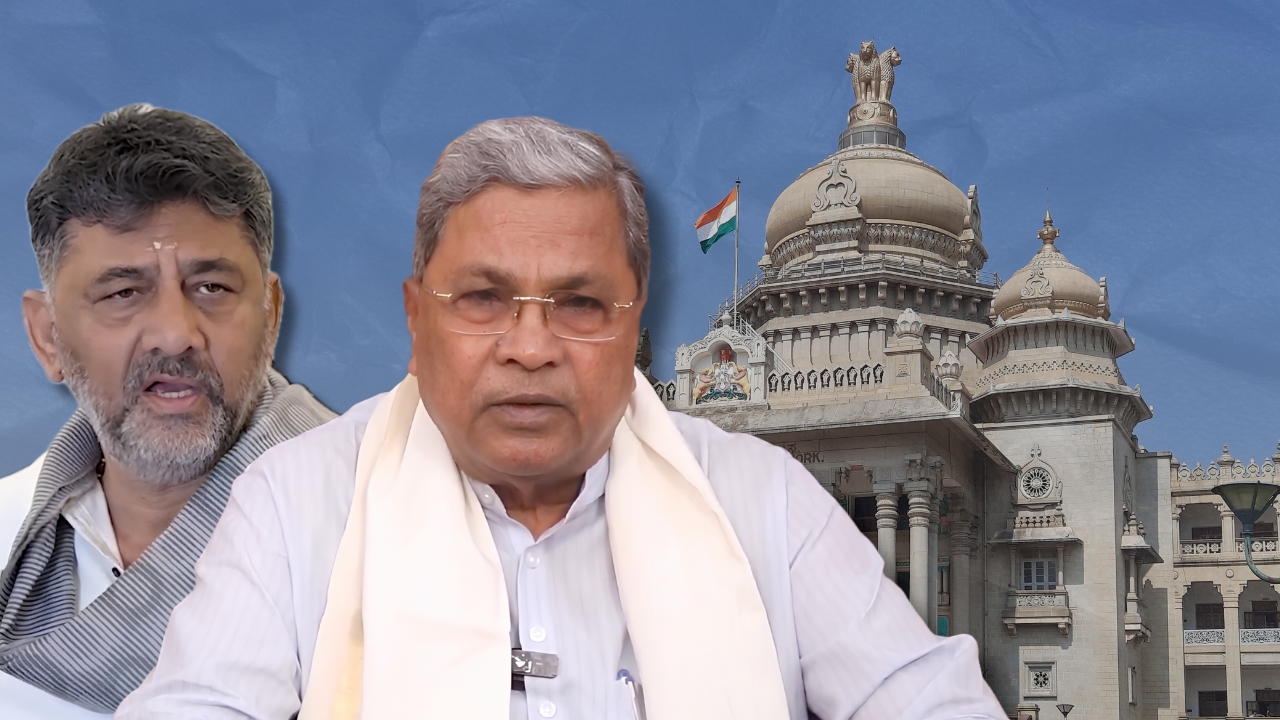
Deputy Chief Minister DK Shivakumar did not deny the development and said the government had learned the practice from the BJP.
Synopsis: The Karnataka government has granted ‘Minister of State’ status to 53 chairpersons of boards, corporations and authorities, inviting allegations of fiscal irresponsibility and a backdoor expansion of the executive from the opposition. The development follows earlier controversial appointments of political secretaries and advisors with cabinet rank. Political analysts say such appointments help manage internal dissent and reward loyalists, though they also carry financial implications.
The Congress government in Karnataka has granted ‘Minister of State’ status to 53 chairpersons of various boards, corporations and authorities—close to one-fourth of the total strength of the state Assembly.
A notification issued by the Personnel and Administrative Reforms Department on 7 February states that these chairpersons have been granted the status of ‘Ministers of State’ until further orders.
The opposition criticised the decision over additional expenditure and said the state has been facing questions about its finances. Its “five guarantees” welfare schemes, which cost the exchequer 52,000 crore annually, and the Union government’s GST rate rationalisation are major pressures on the state’s finances, according to various financial reports.
The government is also facing criticism that these appointments expand the executive through the back door. They are not technically part of the Council of Ministers, but the status, perks and executive influence resemble ministerial office.
In recent days, several media reports said the government has made a fresh round of appointments, increasing the number of people with ministerial privileges to around 149, including the 32 Cabinet Ministers.
Chief Whip of the Opposition in the Legislative Council N Ravikumar demanded that the state government make public the list of people granted ministerial status and release a white paper on the expenditure incurred on these appointments.
He pointed out that the Constitution (91st Amendment) Act, 2003 caps the state Cabinet at 15 percent of elected MLAs. In Karnataka, that is 33 out of 224 MLAs.
When questioned, Congress state president and Deputy Chief Minister DK Shivakumar did not deny the development and said the government had learned the practice from the BJP.
He said the move was meant to acknowledge Congress workers who brought the party to power in the state. “They have got us to power, they will get power. It’s about status. More will get it,” he said.
The ‘Minister of State’ designation carries significant financial and symbolic benefits.
“A Minister of State typically gets more than 60,000 in salary, plus official support, furnishing for the house, free telephone, air travel and many other benefits,” political analyst Harish Ramaswamy told South First.
In 2025, the Karnataka Legislative Assembly passed two amendment Bills revising the salaries and allowances of elected representatives and ministers.
The salaries of MLAs and MLCs were doubled from 40,000 to 80,000 per month. The Chief Minister’s salary rose from 75,000 to 1.5 lakh, along with higher allowances. The salary of a Minister of State increased from 50,000 to 75,000.
The Bills said the revisions were necessary because living costs had risen and there had been a long gap since the last revision of salaries and allowances for the Chief Minister, Ministers, Ministers of State and Deputy Ministers.
Experts note that there was earlier no constitutional limit on the size of the Council of Ministers, but the 91st Constitutional Amendment, 2003 imposed a cap to curb jumbo Cabinets.
“So, political parties in power, under constant pressure to accommodate more party functionaries in positions of power, use the shortcut of elevating other posts to ministerial status,” said Narayana A, Professor of Policy and Governance at Azim Premji University, Bengaluru.
Once a few posts are given such status, he explained, pressure builds to extend it to similar positions, which may explain the scale of the current move.
Politically, Narayana said, the calculation is clear: those accommodated are likely to feel rewarded and may work harder for the party in future elections.
“Whether it helps administratively depends on the individual. Some chairpersons in the past have done excellent work; others have merely enjoyed the perks,” he said.
Ramaswamy added that such appointments also help manage internal dissent. “Politically, these moves help silence bickering and factional tensions within the party,” he said.
Talk of a Cabinet reshuffle was rife in November, with rumours of a ‘November revolution’ also circulating. Siddaramaiah had earlier said the reshuffle would take place after the Bihar Assembly elections. At the time, several Congress leaders reportedly spoke with the Chief Minister to press their case.
Curiously, the first list issued by the government also granted Minister of State rank to BJP leader from Shivamogga district BD Bhookanth, only to later withdraw it. Bhookanth heads the Karnataka State Cooperative Horticulture Marketing Federation Limited.
His inclusion reportedly upset Congress workers in the district, who informed the state Congress leadership. On 11 February, the CMO amended the earlier order and withdrew the Minister of State rank granted to Bhookanth.
Among those given the status is Karwar MLA Satish Krishna Sail, who is under investigation by the Enforcement Directorate in a money laundering case. He was arrested on 9 September 2025 and was recently granted bail on medical grounds. Madhusudhan R, Chairperson of the Karnataka State Commission for Backward Classes, has also been granted the status. Siddaramaiah loyalist and Congress veteran VS Aradhya, appointed Chairperson of the Bengaluru Metropolitan Transport Corporation (BMTC) in September 2025, is also on the list.
Aradhya’s appointment to the BMTC had already drawn scrutiny. On 26 September, Nikethraj Maurya was appointed Chairperson of BMTC and HD Ganesh as Chairperson of Mysuru Paints and Varnish Limited. Days later, on 29 September, Maurya was removed as Chairperson and Aradhya was appointed in his place, while Maurya was moved to Vice-Chairperson of the transport body.
The full list of people who have been given the status is as follows:
Appointments in the state government have drawn scrutiny before. In 2023, the government appointed five leaders—including two members of the Karnataka Legislative Council and one member of the Legislative Assembly—as political secretaries and legal adviser, with Cabinet rank.
Congress MLCs Naseer Ahmed and K Govindaraj—both seen as close aides of Siddaramaiah—were appointed political secretaries to the Chief Minister.
Congress Virajpet MLA AS Ponnanna, a former Additional Advocate General, was appointed legal adviser to the Chief Minister. KV Prabhakar, long seen as close to Siddaramaiah, was appointed media adviser to the Chief Minister, and Congress poll strategist Sunil Kanugolu was appointed Chief Adviser to the Chief Minister.
Article 164(1A) states that the total number of ministers, including the Chief Minister, cannot exceed 15 percent of the total strength of a state Legislative Assembly. Since the Karnataka Assembly has 224 members, the Cabinet can have a maximum of 34 ministers under this rule.
The issue has also reached the High Court. In February 2025, the Karnataka High Court issued notice to the state government on a PIL that challenged a notification appointing 42 MLAs and MLCs to various boards, corporations and other posts, granting them Cabinet rank and pecuniary benefits. The case is pending before the Court.
(Edited by Dese Gowda)


