

Published Mar 06, 2026 | 3:14 PM ⚊ Updated Mar 06, 2026 | 3:14 PM

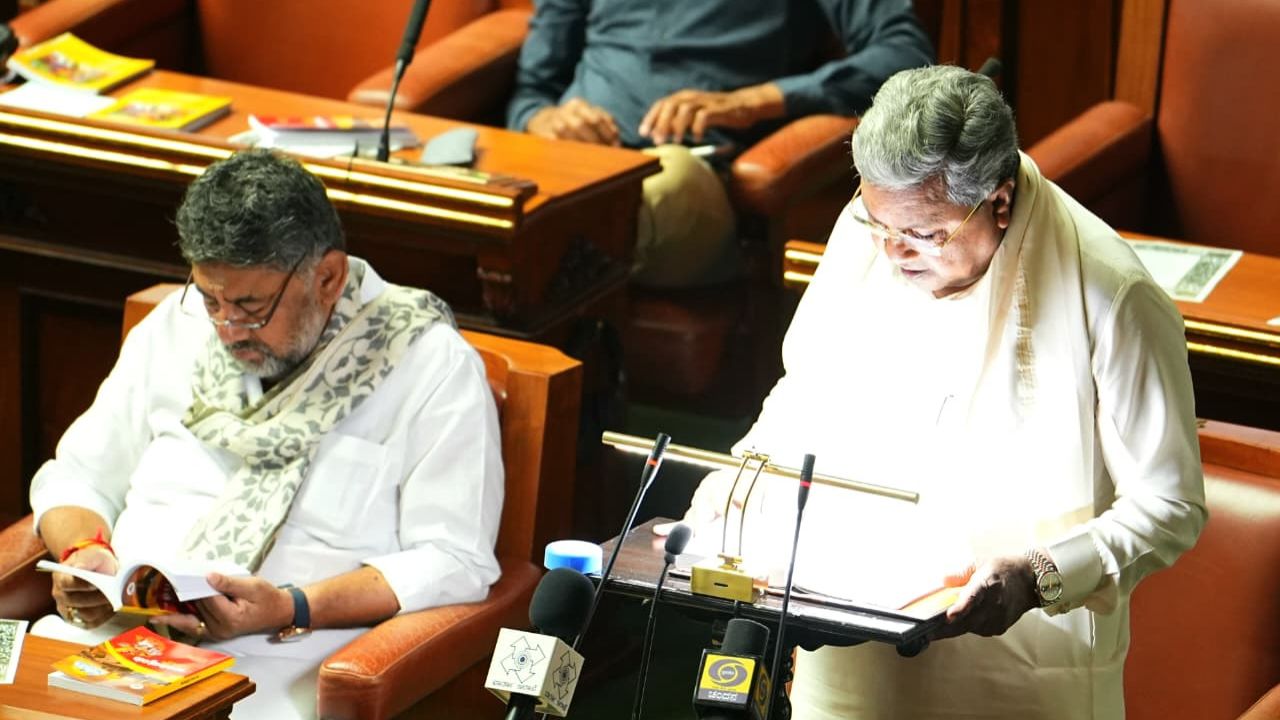
Karnataka Chief Minister Siddaramaiah presenting the 2026-27 state budget.
Synopsis: Karnataka Chief Minister Siddaramaiah presented the state budget for the financial year 2026-2027 on 6 March. Here is an overview of the major announcements.
Karnataka Chief Minister Siddaramaiah presented the state budget for the financial year 2026-2027 on Friday, 6 March. While presenting the budget, he underscored the need for development and holistic support for all regions and all communities in the state.
According to the budget for 2026–27, total revenue receipts are estimated at ₹3,15,050 crore, comprising the state’s own tax revenue of ₹2,20,000 crore, non-tax revenue of ₹16,000 crore, and receipts from Uinon government of ₹79,050 crore.
Total expenditure for 2026–27 is estimated at ₹4,48,004 crore. This includes revenue expenditure of ₹3,38,007 crore, capital expenditure of ₹74,682 crore, and loan repayment of ₹35,316 crore.
For 2026–27, the revenue deficit is estimated at ₹22,957 crore. The fiscal deficit is estimated at ₹97,449 crore, which is 2.95 percent of Gross State Domestic Product (GSDP), and total liabilities at the end of the year are estimated at ₹8,24,389 crore, amounting to 24.94 percent of GSDP.
Chief Minister Siddaramaiah said the government will be filling 56,432 vacant posts across all government departments. He added that ₹4,000 crore has been allocated for the second phase of the Chief Minister’s Infrastructure Development Fund for road and infrastructure works.
In the budget, the chief minister announced four pillars of farmer support — providing scientific farming guidance, financial assistance, provision of high-quality agricultural inputs, crop management and expansion of post-harvest storage.
He said the Chief Minister Krishi Vistara Yojana will be implemented at ₹100 crore over the next three years for value addition of agriculture crops and to encourage the reuse of agricultural waste, along with Millet Hub, a single window system, for encouraging millets and organic products.
Announcing the plans for NABL accreditation for all the laboratories of the department, he said the Vasudhaamruta scheme to promote eco-friendly and sustainable agricultural practices will also be implemented.
He said the District Agriculture Training Centre of Babbur in Chitradurga district would be upgraded to a state-level ‘Agri Business Centre’ and Silk parks will be established in Ramanagara, Shidlaghatta, Haveri, Tandavapura and Kalaburgi.
Siddaramaiah also announced the construction of 100 new veterinary institution buildings with NABARD assistance and a subsidy of 25 percent on the purchase of sheep/goat and cow/buffalo for 10,000 beneficiaries under each in Belagavi and Kalaburagi divisions.
He said a Centre of Excellence will be established in Mangaluru Fisheries College and Matsya Darshinis in Belagavi, Davanagere, Hubballi and Chikkamagalur, along with high-tech Fish markets in Uttara Kannada, Dakshina Kannada, Udupi and Bagalkot.
Siddaramaiah said ₹225 crore has been allocated for the empowerment of weavers.
Siddariamaiah said the government targets the distribution of ₹30,000 crore agricultural loans to 38 lakh farmers at zero percent interest.
He added that the state government will move forward with the execution of the Mekedatu Project after obtaining forest clearance from the Union Ministry of Environment.
The chief minister added that a balancing reservoir of 1.2 thousand million cubic feet (TMC) capacity will be constructed at Vaderahalli in Koratagere Taluk under the Yettinahalli Project to store excess water.
He also announced the installation of 33 new gates to replace dilapidated ones in the Tungabhadra dam before the onset of the monsoon.
Siddarmaiah announced 800 new Karnataka Public Schools (KPS) at a cost of ₹3900 crore with assistance from ADB, KKRDB, and KMERC and the filling up of teaching posts in Karnataka Public Schools on priority, along with 15,000 vacant teaching posts in schools and colleges.
He said one mental health counsellor will be appointed for 204 BRC centres to reduce the mental pressure among the students.
The chief minister also mulled a ban on social media usage by children below the age of 16, adding that strict action will be taken for the prohibition of drugs in schools, colleges and universities.
Further, in another important move, he announced the conduct of Student Union elections in colleges and universities.
He also promised the enactment of the Rohith Vemula Act to prevent educational and social atrocities against students on caste lines.
Siddaramaiah said infrastructure facilities to 75 government degree colleges, 23 polytechnic and 5 engineering colleges in the Kalyan Karnataka region will be upgraded and announced first-grade degree colleges in Chadchan, Belagavi Rural, Narasimharaja constituency and Maski.
He said University of Visvesvaraya College of Engineering (UVCE) will be developed on the IIT model at a cost of ₹500 crore.
The chief minister also announced a scholarship of ₹30,000 for girl students for higher education, if they studied in government schools and colleges and 90 days of maternity leave for female guest lecturers of first-grade college, polytechnic and engineering colleges.
Siddaramaiah announced the extension of Nutritional Rehabilitation Centres (NRC) to 63 taluks for children with Severe Acute Malnutrition at a cost of ₹6 crore and the comprehensive care of low birth weight and sick newborns at the cost of ₹10 crore.
He also announced the distribution of free insulin pens for children under 18 years of age suffering from Type 1 diabetes, along with home-based palliative care for severe illness patients on the Kerala Model in collaboration with Pallium India.
The budget also allocated funds for the construction of medical colleges, super speciality hospitals and hospitals at ₹620 crore and procurement of equipment at ₹220 Crore.
Further, Jayadeva Cardiovascular Hospital at Mysuru will be upgraded to a 600-bed hospital at a cost of ₹180 Crore. The state government will also prepare a Detailed Project Report for the establishment of new Government Medical Colleges in Vijayapura and Kolar. Super-speciality hospitals will be established in Karwar and Yadgir at a cost of ₹100 crore each and a cancer hospital at Munirabad–TB Dam.
The budget also envisioned a programme for providing higher education, self-employment and personal income-generating activities for children of former Devadasis at ₹5 crore and enhanced the incentives for income-generating activities to former Devadasis, Gender Minorities, Chetana and Dhanashree scheme beneficiaries to ₹45,000.
The government will also be providing hot cooked meals to pregnant and lactating women under the Matrupoorna Scheme in anganawadi centres.
The budget allocated an additional ₹56 crore for revision of maintenance rates for pre-matric & post-matric hostels of SC, ST, BC and Minorities and announced the upgradation of 31 residential schools for pre-university education for SC, ST and BC students and 40 new residential schools for SC, ST and BC.
Siddaramaiah also announced the constitution of Mess Committee in 50 post-matric hostels on a pilot basis to improve the hostel food system and the commencement of 10 working women’s hostels in Bengaluru, Mysuru, Hubballi-Dharwad, Mangaluru, Belagavi, and Kalaburagi for SC/ST working women.
The state government announced the implementation of the One-Time Settlement Scheme for waiver of interest on loans of those who repay the principal of the loan availed from the SC, ST, BC and Minority Corporations till 31-03-2021.
A High-level Committee under the chairmanship of the Chief Minister will be constituted for the reservation in employment & education, filling up of backlog posts and development of backward classes.
Extension of facilities to students belonging to 46 nomadic and semi-nomadic tribes coming under Category-1 of Backward Classes on the lines of facilties extended to
The budget also set aside ₹50,000 each to 5,000 minority meritorious students for the purchase of laptops and announced the establishment of Integrated Geriatric Palliative Care units with an assistance of ₹50 lakh each in 10 old-age homes run by Christian institutions.
The government announced the distribution of Indira Food Kits instead of five kg of additional rice under the Anna Bhagya Scheme.
IT said 10 GTTC centres will be established at a cost of ₹60 crore each for the education of children of construction workers, adding that modern agricultural skill training will be provided for 5,000 women farmers as part of the International Year of Women Farmers 2026.
Presenting the budget, the chief minister also announced an action plan of ₹5,000 crore for the comprehensive development of Kalyan Karnataka, with an objective to increase the contribution of Kalyana Karnataka towards the GSDP of the state.
The chief minister further announced the increase in Local Bodies devolution from 48 percent to 50 percent on the basis of the report of the 5th State Finance Commission.
The state government also decided to prepare the “5th Edition Karnataka State Human Development Report-2026” and “State Integrated and Sustainable Development Vision Document -2031”.
As part of urban planning, ₹7,000 crore has been allocated for infrastructure development of Bengaluru, and a new revised Master Plan-2041 and Comprehensive Mobility Plan (CMP) for Bengaluru.
₹3,000 crore has been allocated for white-topping of 450 km roads in Bengaluru.
It announced the construction of a 40-km-long tunnel road on a BOOT model at an estimated cost of ₹40,000 crore and a tunnel road and an elevated corridor from Hebbal Junction to Mekhri Circle at a cost of ₹2,250 Crore.
Underground drainage system will be implemented in Annigere, Gundlupete, Nelamangala, Doddaballapura, Bhadravathi, Devanahalli and Mysuru and out of KKRDB (micro) funds and with government assistance in Aland, Afzalpura, Chittapura, Yadagiri, Harapanahalli, Jewargi & Surapura.
It said 100 Miyawaki parks will be developed in selected areas of urban regions.
The government allocated ₹100 crore for the development of basic infrastructure in various areas inhabited by SC, ST and minorities in Davanagere South Assembly Constituency.
In the budget, the chief minister announced an electricity subsidy of ₹19,290 crore to 36 lakh irrigation pumpsets and allocated ₹10,578 crore for Gruha Jyothi.
He further announced 20,00 MWh capacity Battery Energy Storage System (BESS) at Huliyur, Pavagada and Kushtagi, at a cost of ₹3,400 crore, and 1,250 Electric vehicle charging stations will be established under the PM-E-drive scheme at a cost of ₹777 crore.
The government announced the construction of bridges at a cost of ₹2,000 crores over the next two years and 300 foot bridges connecting habitations in Malnad and Coastal areas.
₹600 crore has been earmarked for the Bengaluru-Mumbai industrial corridor project.
The chief minister announced that all necessary measures will be taken over the next five years for the man–animal conflict mitigation strategy at a cost of ₹1,500 crore.
He also announced the afforestation works in 75,000 hectares across various districts of the state.
Siddaramaiah said that under ESDM and the semiconductor sector, an investment of ₹45,000 crores is anticipated. The chief minister said Mysuru city will be developed as the second IT city of the State.
The state government also announced the promotion of coastal tourism by formulating the ‘Comprehensive Coastal Tourism Development Plan’.
Soft skill training will be given for taxi drivers, auto drivers and security police personnel, and diploma courses will be started in selected universities for tourist guides.
Siddaramaiah said women beneficiaries have taken 684 crore trips under the Shakti Scheme, and that ₹53,00 crore has been provided for the implementation of the scheme in 2026-2027
He said ₹1,271 crore has been allocated for the payment of arrears to employees of Road Transport Corporations. The chief minister also announced the reduction of sales tax on LNG from 14.34 percent to five percent.


