
Published Sep 23, 2026 | 12:45 PM ⚊ Updated Sep 23, 2026 | 12:45 PM


Synopsis: Bengalureans see them regularly, yet their identities remain hidden beneath their uniforms and the brooms they wield to clean the streets and surroundings after us. We hesitate to speak with them or acknowledge their service. For many of us, they all go by one common name: pourakarmika. The pourakarmikas — or sanitation workers — live in society’s shadows, ignored and sidelined. South First spoke to a few of them to better understand their lives, because they, too, matter in a civilised, modern society.
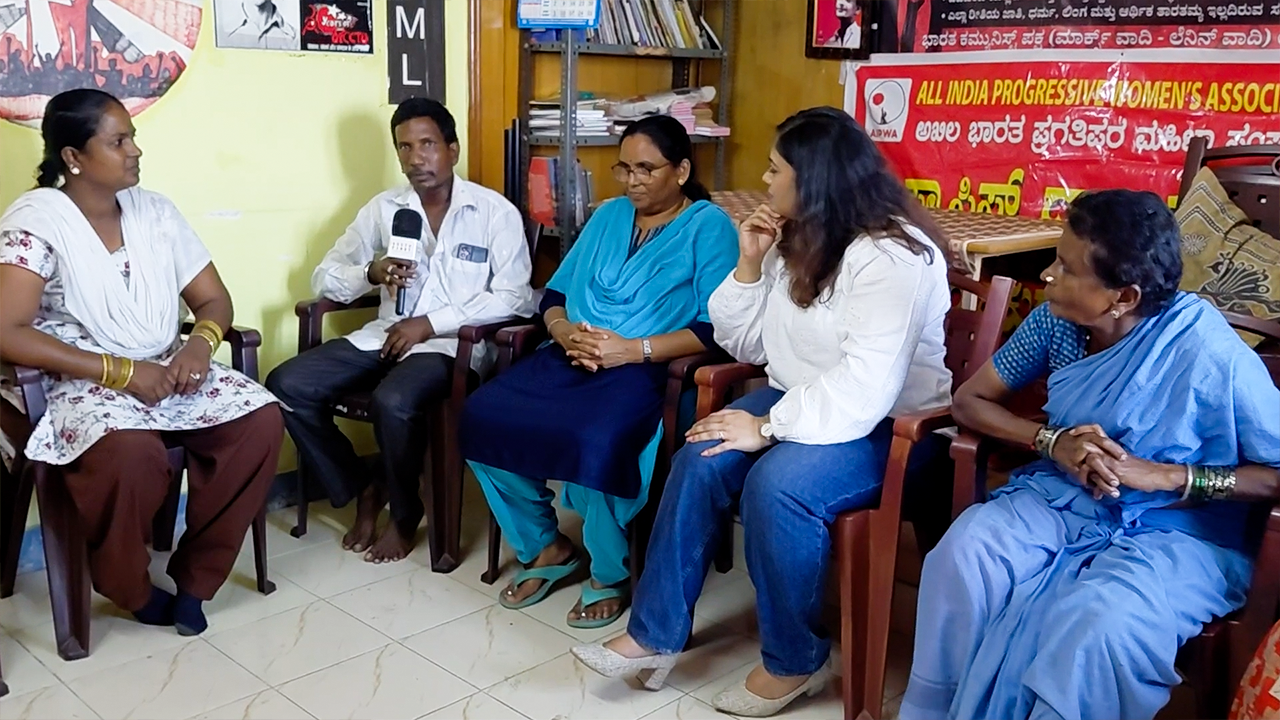
Civil society is divided after a video of Bengaluru Development Minister Krishna Byre Gowda pulling up municipal workers (pourakarmikas) went viral. One section firmly backs the minister in demanding a “work ethic” from municipal workers. At the same time, the other has vehemently condemned the accusatory tone and public shaming of pourakarmikas, who already work under stressful conditions. Anusha Ravi Sood caught up with pourakarmikas Jayalakshmi, Lalithamma, Sunandamma, Sujatha, Nirmala, and Narasimhamurthy to take the raging video-spurred discussion beyond the controversy—to catch a glimpse of the human beings, their dreams, aspirations and how different life would have turned out for them.
Edited excerpts:
Q. Every time a garbage vehicle arrives outside, we respond to the whistle and throw our household waste into it—that’s all. Beyond that, we see pourakarmikas in uniform cleaning our streets, but we rarely think of them as human beings with dreams and aspirations beyond that broom, uniform, and garbage truck. Meet some of Bengaluru’s workers.
Jayalakshmi: My name is Jayalakshmi. At first, we lived in extreme poverty at my mother’s house. When I was young, I strongly wanted to study, but my parents couldn’t educate me because they had too many children. They got us married off at a very young age. I kept doing labour like this. We came to Bengaluru because crops failed and there was no yield back in the village.
Q. What crops did you grow back in your village? Which village was it?
Jayalakshmi: I was married to a man in Madakalli. My maternal house was near Kunigal, Basamathikere. My parents’ home was near Yediyur. In Madakalli, we couldn’t make a living due to poverty, so we moved to Bengaluru. I worked as a housemaid and endured a lot of hardship raising our children—a daughter and a son. After a lot of manual labour, I eventually joined this work.
Q. While you were speaking, I noticed your sparkling nose stud and earrings. Have you liked these since you were young? How many years of hard work did it take to save up and buy this nose stud?
Jayalakshmi: A lot of hard work. My earnings were very low, even while doing domestic work. They used to pay me ₹50 a month. Even when working in homes or banks back then, they paid ₹50 or ₹100. Later, I worked at the Vinayaka Hospital for 3-4 years. Even there, the pay was low—₹3,000 or ₹4,000. I saved little by little; I didn’t have anything else to buy jewellery with. There was a savings scheme; I contributed ₹100 to that while working at the hospital to buy these pieces of jewellery. It took around 4, 5, 6 months… almost a year.
Also Read: 40,000 pourakarmikas on indefinite strike for job permanency
Q. How long have you been working as a pourakarmika?
Lalithamma: My name is Lalithamma. I have been working for 15 years as a pourakarmika.
Q. You mentioned working for 15 years. What time do you wake up in the morning, and what does your day look like from when you get up until you go to sleep at night?
Lalithamma: We wake up around 5:00. I live far away and need to catch a bus, so I have to get to the bus stop by 5:30 am. If we come early, we can catch the bus easily; otherwise, we have to pay ₹60 or ₹70 for an auto. When travelling from so far, even a 10-minute delay can cause biometric/attendance issues. So we manage and start our shift at 6:30 am. By the time we finish work and take the bus back, it’s 2:30 pm, 3:00 pm, or 3:30 pm. Then we go home and rest a bit.
Q. What about meals and breakfast in between?
Lalithamma: We buy breakfast from hotels. We can’t bring food from home because sometimes it isn’t ready in time. Since we live in rented houses far away, we get delayed getting to work. After we get home, if we have prepared food set aside, we eat that; otherwise, we cook and eat. In the evening, we do household chores. We do the laundry, prepare for the next morning, and go to bed. That is our routine.
Q. How many streets do you sweep, and how many hours do you work in a day? Please tell us in detail about your assigned work.
Sunandamma: My name is Sunandamma. I live in a rented house in Kodigehalli. We wake up at 4:30 am. I have two sons; I cook for them, pack my lunchbox, and arrive here by 6:10 or 6:20 am. After recording biometric attendance, we head to our assigned route. They have given us five roads. We work until 10:00 am, then come back around 10:30 am, wash our hands and feet, and eat breakfast somewhere. After the second attendance punch, they send us to other routes. Then five or six of us go to specific areas in a group and are assigned a certain number of roads. After finishing that around 2:10 pm, we punch attendance again and head home, reaching home around 3:00 or 3:30 pm. There, we wash up, wash dishes, do laundry, and attend to household work. We get no rest—we have to work both here and at home.
Q. What is your salary?
Sunandamma: Now they pay around ₹40,000 a month. Initially, it was ₹10,000 or ₹11,000.
Q. After all your expenses, at the end of the month, do you save anything?
Sunandamma: We pay ₹20,000 rupees as rent for a simple hall and kitchen. Grocery prices are very high—pulses cost ₹180, ₹200, or 300. Now, with the Gowri festival, we need to give festival offerings (bagina) to our daughters and nieces. Without timely salaries, we have to borrow money from others for bagina; otherwise, the women are very distressed. Because we don’t get paid on time, we accumulate debts that we need to pay. That is our situation, and we can’t change it.
Q. Apart from your salary, do people ever give you money?
Sunandamma: Nobody gives us money. If we ever ask anyone for money, they record videos on phones like the one you are holding. If we ask for money, they record our voices. So out of fear, we don’t ask anyone. Previously, someone might have offered us a cup of tea, but now people say, “You get a proper salary; why should we give you anything?” Nobody even gives us tea or coffee anymore. If we have money, we drink; if not, we don’t.
Q. Your primary request now is to make your jobs permanent. Why do you feel permanent status is essential?
Sujatha: My name is Sujatha, and I am 40 years old. When we were initially working under contract, our salary was ₹5,000 to ₹6,000. Then we started protests, joined Comrade Clifton D’Rozario, and formed a union. Only after forming the union did we gain some courage. Earlier, they wouldn’t let us join unions or attend union meetings; they set conditions, saying, “Don’t go; you will reveal everything.” But the union leaders encouraged us, saying, “If you remain scared, you will stay like this forever. Step forward courageously to secure your rights.”
As we slowly mustered the courage to attend the union meetings, we gained the confidence to speak up. We can speak here today because of them. From then on, our pay was raised to ₹14,000, and later to ₹18,000. After serving for over 10 years and protesting continuously for several days, our jobs were finally made permanent.
You asked if a ₹40,000 salary is sufficient—absolutely not. We can’t save a single rupee. Even a salary of ₹1 lakh wouldn’t be sufficient given our current situation.
My son completed his second year of education, and my daughter studied first-year B.Com. I couldn’t educate them further because my salary was very low back then. So my children started working. My daughter got married, and she now has a child. My son is 23 years old and works.
I had a dream—you asked if we had any aspirations. Since childhood, I wanted to study well. Even now, I feel like studying. Back then, my grandmother raised me because my mother had passed away, and my father remarried. My grandmother used to drag me to school, but I couldn’t stay away from her as I was her beloved granddaughter, so I kept running back home instead of attending school. After my grandmother passed away, my stepmother didn’t educate me; she only educated her own children. So I started working at age 12 as a construction/masonry labourer. I have done every kind of hard labour in Bengaluru since I was young. Eventually, I joined this sanitation work and have been doing it ever since.
Also Read: Karnataka regularises over 12,000 pourakarmikas after years of struggle
Q. If you had studied, what would you have liked to become?
Sujatha: If I had studied well, maybe I could have become someone like you! Or an engineer, an artist in the film industry, a musician, or at least a school teacher. That thought kept coming to my mind.
When you ask what we do after going home—we finish work and go home, but we don’t even have a minute to sit down. We wake up at 4:00 or 5:00 am, cook for the kids, pack lunchboxes, clean the house, and leave. On Tuesdays and Fridays, there is extra household work/puja preparations. In the afternoon, we don’t have a single moment of free time. We do something or the other, and it’s 10:00 or 11:00 pm before we can finally sleep.
Q. You mentioned being assigned specific point-to-point locations. Explain how difficult your work is and how you carry it out.
Narasimhamurthy: My name is Narasimhamurthy, and I am 43. I have been working under contract with BBMP for four years. We have to collect garbage point-by-point. When we collect garbage at those points, people throw it carelessly without putting it in the vehicle. They dump it and leave, and we have to pick it up.
Whether it’s dead rats or used sanitary napkins, we have to pick them up without hesitation. It’s our duty, so we must do it. Despite this, we haven’t received our salaries on time. Madam, they deposited our salary just yesterday, on the 17th (of September 2026). If we ask anyone about it, they threaten to fire us. Scared of getting fired, no one comes forward to speak up.
Q. In 2013, the Karnataka government issued regulations mandating safety gear for pourakarmikas—boots, gloves, masks, etc. Do you have all of these?
Narasimhamurthy: Nothing. We have none of them.
Q. Why don’t you ask for them? Don’t you know you are supposed to use them?
Narasimhamurthy: We know, but even if we ask, they don’t give them. It has been three years since they gave us a uniform shirt; they gave just a single T-shirt three years ago. They don’t provide shoes, even though I’ve asked multiple times. If we find usable shoes near a factory or discarded on the road, we pick them up and wear them. If we ask, they keep stalling, saying, “We will give them today; we will give them tomorrow.”
Q. Despite all these hardships, why do you continue doing this work?
Narasimhamurthy: Because we are already locked into this job and cannot switch to another job now. We keep working with the hope that the government will provide some security, so that today or tomorrow it will help our children’s education or help them secure better jobs. But the government keeps delaying implementation on various pretexts.
Q. I ask this with a lot of sensitivity. Is your work a matter of pride, or do you hesitate to announce it to family members? Do your children hesitate to answer when asked about their parents’ work? You keep the city clean, and it deserves respect, but do you get the respect you deserve?
Nirmala: Your question is very accurate. Recently, as you might have seen on Facebook and social media, awareness around pourakarmikas has increased. When children go to school and sit together, some kids ask, “What do your parents do?” Our children answer with pride without hiding anything: “My mother works at BBMP.” But then children of wealthy families tell them, “Oh, so your mother picks up the garbage that we throw? Then you should sit at a distance from us because your mother does that work.” Even when our children dress neatly and go to school, they get told, “That’s why a bad smell comes from you.” I have directly heard such instances in some schools and intervened. Pourakarmikas take pride in their work and union; we even call them “Doctors” because they keep the whole city clean and allow everyone to breathe fresh air. But wealthy people don’t truly recognise this. Even when sweeping near people’s homes, nobody addresses them properly by name or shows respect. They say, “Hey garbage-woman, pick that up; my dog pooped over there, clean it up.” That is how people talk.
Ordinary citizens lack the patience, love, and goodwill our pourakarmikas show toward people. People view them as garbage pickers. Most of them belong to Dalit communities; people from other castes wouldn’t do this work even if paid in lakhs. Yet our pourakarmikas perform it like sacred work, knowing it earns their livelihood, feeds their family, pays rent, and educates their children. But common people lack that respect.
In fact, after the recent controversial remarks made by the Minister, people have become worse, saying, “Why should you get a ₹40,000 salary? That’s what you are paid for, so pick up the garbage, or we will get officers to issue notices to you.” They threaten the workers through officials.
You also asked about the need for job security compared to contract labour. Under contract systems, they pay barely ₹500 or ₹600 a month. When I started union work in this area, workers told me they worked all month without a single day off for just ₹600. They were afraid to demand more because contractors threatened to fire them. I used to go at 5:30 am to reassure them and build the union.
People go for morning walks on clean roads without realising who had cleaned them early in the morning. Pourakarmikas have no recognition. We organised meetings in their residential areas with great effort. Local leaders harassed us, asking why we were organising uneducated migrant workers.
In 2011, after a major struggle against contractors like BVG, workers finally received salary cheques of ₹5,054. That gave them confidence and dignity. In 2017 and 2018, after continuous protests at Freedom Park and Bannappa Park across different government tenures, the government declared direct payment (Nera Pavathi) systems.
However, sanitation work involves not just sweepers, but also loaders, helpers, and drivers. The government excluded loaders and drivers from direct payments and restricted them to sweepers. To this day, helpers and drivers under contract suffer—their salaries are delayed for months, and contractors siphon off funds. Furthermore, contractors bill the government for safety gear, boots, and kits, but never distribute them to the workers.
Two things stood out especially in this interaction with Bengaluru’s pourakarmikas: On paper, everything exists—from boots and masks to protective gear—but in reality, workers receive none of it. Second, pourakarmikas visit our homes every day, yet how many of us actually know their names? It may be time to see the people behind the uniform and brooms.
(Edited by Majnu Babu).



