


Published Dec 21, 2025 | 9:00 AM ⚊ Updated Jan 26, 2026 | 8:55 AM

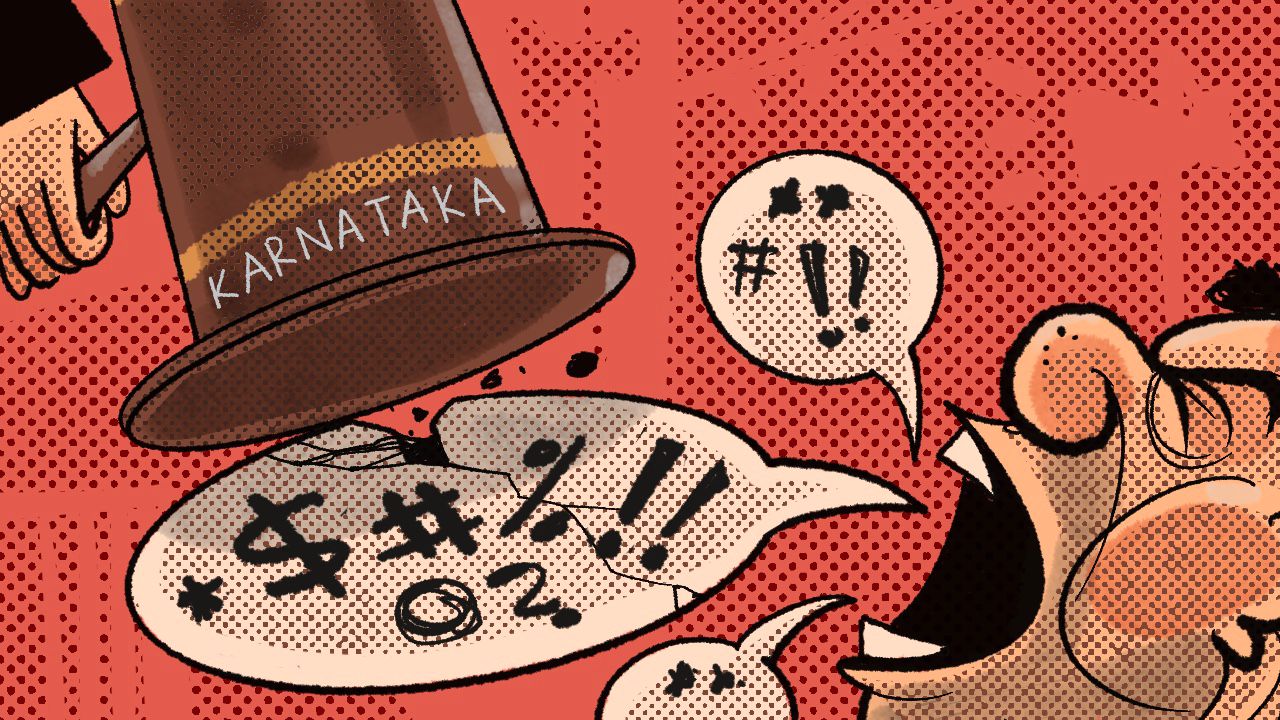
The Karnataka Hate Speech and Hate Crimes (Prevention) Bill, 2025, was passed despite unresolved concerns raised by the Opposition and free speech activists over the potential for arbitrary misuse of state powers, sweeping takedown provisions, and overly broad definitions of hate speech and criminal content.
Synopsis: Karnataka has become the first Indian state to pass a dedicated Bill to tackle hate speech and hate crimes. It was rushed through the Assembly on Thursday amid Opposition uproar and fears of arbitrary misuse, as pointed out by activists. While the government has defended it as a much-needed framework to curb speeches that have led to communal violence and murders, critics say it grants sweeping executive powers with weak safeguards.
The Karnataka government on Thursday, 18 December, passed the contentious Hate Speech and Hate Crimes (Prevention) Bill, 2025, amid uproar from the Opposition and an incomplete debate in the Assembly.
With this, the state became the first in the country to introduce dedicated legislation to tackle hate speech and hate crimes.
The Bill was passed despite unresolved concerns raised by the Opposition and free speech activists over the potential for arbitrary misuse of state powers, sweeping takedown provisions, and overly broad definitions of hate speech and criminal content.
Cleared by the Cabinet on 4 December, the Bill was presented in the House by Home Minister G Parameshwara on 10 December. Explaining the reasons for bringing such legislation, Parameshwara said on Thursday that hate speech had led to murders and clashes between communities in the state.
The legislation aims to uphold constitutional ideals by preventing discrimination and prejudice based on religion, race, caste, gender, language, and other grounds, he added.
He also claimed that it was not feasible for law enforcement agencies to indefinitely impose preventive bans on individuals making provocative remarks.
“If we get alerts that a person’s speech is going to create tension, we will ban him. How long can we do that? Therefore, a law is required,” he said, while also noting that such speeches were usually followed by violent attacks.
South First breaks down some of the contentious provisions of the legislation.
The Bill defines hate speech as any expression that is made, published, or circulated, in words either spoken or written, or by signs or visible representations, or through electronic communication or otherwise, in public view, with the intention to cause injury, disharmony, or feelings of enmity, hatred or ill-will against a person, alive or dead, a class or group of persons, or a community, to meet any prejudicial interest.
Hate crime is defined as the “communication of hate speech”.
The Bill also defines “prejudicial interest” to include bias on the grounds of religion, race, caste or community, sex, gender, sexual orientation, place of birth, residence, language, disability, or tribe.
Groups advocating free speech argue that the definition of “hate speech” is vague and emotion-based.
“The definition of hate speech under Section 2(i) is based on emotion of hatred, which has led to the failure of accountability under the Indian Penal Code and the Bharatiya Nyaya Sanhita for the offence of hate speech,” the Campaign Against Hate Speech (CAHS), a civil society group of activists, lawyers and academicians, pointed out.
They further argued that hate speech and hate crime were being falsely equated. The definition of “hate crime” excludes a range of crimes that lead to bodily and psychological harm, apart from harm to democracy, they said.
“This legislation does not see a hate speech that ‘calls for a mob lynching’ any different from committing the actual crime of ‘mob lynching’. It also does not recognise hate crimes of punitive demolitions, social and economic boycotts,” the group said in a letter dated 12 December to Chief Minister Siddaramaiah and other ministers.
While the Bill seeks to punish organisations and institutions for hate crimes, activists point out that institutions are vaguely defined as an “association of persons whether registered or not”.
The Bill has several provisions that grant sweeping powers to the state and its authorities.
Section Four of the Bill, titled “preventive action to be taken by the law and order machinery”, allows the Executive Magistrate or Special Executive Magistrate, or any police officer not below the rank of Deputy Superintendent of Police, to “take necessary preventive action for keeping the peace and good behaviour and maintenance of public order and tranquillity” upon receiving information about crimes mentioned under the Act.
However, it does not specify the scope of action that can be taken, nor the due process that is required to be followed, which could lead to arbitrary action by the state, the CAHS noted in its letter.
Another provision along similar lines, titled “power to block or remove the hate crime materials”, allows the designated officer, as notified by the state government, to direct any service provider, intermediary, person or entity to block or remove hate crime materials from its domain, including electronic media.
This provision is similar to Section 69A of the Information Technology Act, 2000, which empowers the central government to direct any government agency or intermediary to block public access to information generated, transmitted, received, stored or hosted on any computer resource in cases where it threatens national security, public order, or friendly relations with foreign states.
The government’s new dedicated portal for the takedown of content, Sahyog, goes a step further by giving a greater number of authorisations to various government departments that can directly issue takedown orders, according to the Internet Freedom Foundation (IFF).
Citing an instance of alleged abuse of power through the portal, the IFF pointed to a case in which authorised officers from the Indian Railways issued takedown orders for reports and videos related to a stampede at the Delhi Railway Station on 17 February.
In its report, the IFF noted that the Information Technology Act, 2000, contains a distinct power for blocking under Section 69A that requires higher thresholds to be met than those specified under the Sahyog Rules, 2025. Under Section 69A, written and reasoned blocking orders are approved by a designated officer of Joint Secretary rank after scrutiny by an inter-ministerial committee comprising the Law, Home, Information and Broadcasting ministries, and CERT-In.
Additionally, a notice and an opportunity of hearing are provided to the originator or intermediary, along with oversight by a review committee at least once every two months, with the power to set aside improper blocking orders. “By contrast, the new ‘reasoned intimation’ route under the Sahyog Rules, 2025 bypasses hearings and inter-ministerial committee checks, shifting to monthly in-house reviews by the Secretary of the very department making the request,” the IFF noted.
Similarly, as CAHS activists pointed out, the Bill, through the aforementioned provision, gives enormous power to a designated officer to remove or block any material that it construes as hate crimes even before the trial of the offence itself.
“This amounts to executive power to censor without the accused being afforded the opportunity to explain his intention and statement,” the group said, adding that it is unclear who this designated officer would be.
The Bill states that a hate crime shall be punished with imprisonment ranging from one to seven years, along with a fine of ₹50,000. For subsequent or repetitive offences, the punishment shall range from two to 10 years, with a fine of ₹1,00,000.
CAHS pointed out that the Bill does not provide clarity on the rationale for prescribing a punishment range of one to seven years, while also making the offence non-bailable and cognisable.
The section on “offences by organisation or institution” seeks to punish organisations and institutions collectively for the offence.
“If the person committing an offence under this Act is an organisation or institution, every person who, at the time the offence was committed, was in charge of and responsible to such organisation or institution for the conduct of its business, as well as the organisation or institution itself, shall be deemed to be guilty of the offence and shall be liable to be proceeded against and punished accordingly,” the Bill states.
However, it provides an exception that no person shall be punished if he proves that the offence was committed without his knowledge, or that he had exercised all due diligence to prevent the commission of such offence, effectively placing the onus on the accused to prove his innocence.
(Edited by Dese Gowda)


