

Published Feb 05, 2026 | 10:51 AM ⚊ Updated Feb 05, 2026 | 10:51 AM

Curiously, at the national level, the Congress has opposed the Centre’s labour codes, calling them anti-labour.
Synopsis: Karnataka has released the draft Code on Wages (Karnataka) Rules that reproduce provisions of the Centre’s contentious labour codes, despite sustained opposition from trade unions and opposition parties, including the ruling Congress at the national level, over the weakening of worker protections. Unions say the draft adopts a minimum wage formula that cuts housing costs and could push States into a race to the bottom on wages as they compete to attract investment.
Months after the Union government notified the four labour codes—the Code on Wages, 2019; the Industrial Relations Code, 2020; the Code on Social Security, 2020; and the Occupational Safety, Health and Working Conditions Code, 2020—to strong opposition from trade unions and opposition parties alike, the Karnataka government has released draft wage rules that follow the same framework.
Critics have lambasted the Centre’s labour codes for diluting existing safeguards, complicating access to welfare, and shifting the balance in favour of employers.
But even as trade unions in Karnataka continue to oppose the codes, the ruling Congress on 27 January released the draft Code on Wages (Karnataka) Rules. The draft sets out procedures for fixing and enforcing minimum wages in the State.
Labour is a concurrent subject, allowing both Union and State governments to frame rules. But several States have yet to notify rules under all four codes.
Notably, at the national level, the Congress has opposed the Centre’s labour codes, calling them anti-labour.
“The Modi government must learn from the examples of the Congress government in Karnataka and the former government in Rajasthan, which have pioneered labour reform for the 21st century with their gig worker laws that preceded the new codes,” Congress General Secretary Jairam Ramesh said in a post on X.
Karnataka’s proposed draft rules reproduce one of the most contentious features of the Centre’s Code on Wages: the criteria for calculating minimum wages.
The Code requires the Union government to fix a “floor wage”, below which no State can set its minimum wage.
“The Central Advisory Board referred to in sub-section shall be consulted by the Central Government for the purpose of fixing the floor wage, taking into account the minimum living standard including food, clothing, housing and any other factors considered appropriate by the Central Government from time to time for a standard working class family,” the section titled Manner of fixing floor wage states.
The Codes list several criteria for fixing the minimum wage:
In addition, the Union government must consider the geographical area, experience in the area of employment, and the level of skill required, categorised as unskilled, semi-skilled, skilled and highly skilled.
Labour unions, however, have criticised these criteria as a diluted version of the formula for calculating minimum wages that the Supreme Court sanctioned in the landmark Raptakos Brett judgment.
Notably, the Codes reduce the rent component, one of the largest and most significant expenses borne by workers, to just 10 percent of food and clothing expenditure.
Maitreyi Krishnan of the All India Central Council of Trade Unions (AICCTU) termed the reduction “unscientific” and said it has no relation to the real needs of people.
By contrast, the formula in the Reptakos Brett judgment, which was unanimously recommended by the Indian Labour Conference (ILC) in 1957 and reiterated at its 44th and 46th sessions in 2012 and 2015, mentions “house rent corresponding to the minimum area provided for under the Government’s Industrial Housing Scheme.”
The Centre’s Code on Wages does not take this into account. Nor do Karnataka’s draft rules.
The AICCTU compared the minimum wages Karnataka would have proposed using the formula upheld in the Reptakos Brett judgment with wages calculated under the formula set out in the draft rules, showing how sharply the new rules drive minimum wages down.
Using market value data collected by the Labour Department, monthly food expenditure alone comes to ₹8,947.46, with clothing adding another ₹629.83.
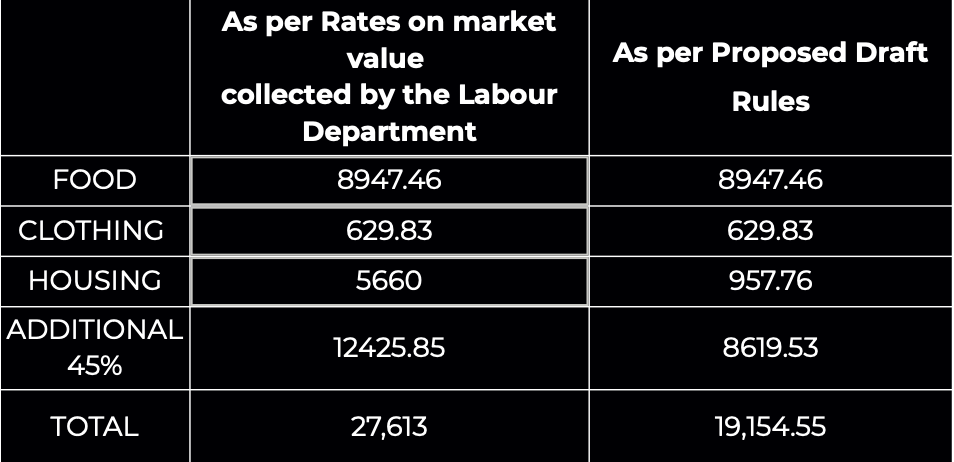
Minimum wages based on Labour Department market data vs wages under the proposed draft wage rules.
Housing costs, calculated at prevailing market rates, stand at ₹5,660. On this base, the additional 45 percent component meant to cover fuel, electricity, education, medical needs, recreation and contingencies amounts to ₹12,425.85. Taken together, this yields a total minimum wage of ₹27,613.
By contrast, the proposed draft rules retain the same figures for food (₹8,947.46) and clothing (₹629.83) but sharply compress the housing component to just ₹957.76 by pegging rent to a fixed percentage of food and clothing expenditure rather than actual housing costs.
As a result, the 45 percent additional component falls to ₹8,619.53, bringing the total minimum wage under the draft rules down to ₹19,154.55.
A research paper published in EPW notes that with State governments now responsible for setting minimum wages, the framework risks triggering a race to the bottom as States compete to lower wage rates to attract investment.
This priority is also visible in the Union government’s labour codes, which dismantle the inspector raj system.
“To replace inspector raj system, inspector will be made inspector-cum-facilitator and random web-based inspection system will also be started,” the codes state.
Trade unions said this model turns inspectors into agents of management rather than authorities tasked with enforcing workers’ rights.
A similar web-based self-certification model appeared in Karnataka’s decision to allow all information technology (IT) and IT-enabled services (ITES) companies to self-certify labour law compliance in late 2025.
The provision forms part of the Karnataka Information Technology Policy 2025–2030, which the State Cabinet approved on 13 November.
Unions said at the time that Karnataka’s IT sector already has a poor record on labour rights, making self-certification particularly dangerous. Applying such a provision to an industry they described as “notorious” for violations would be deeply detrimental to workers.
“Laws do not need ‘guidance’; they need strict enforcement. Without real powers and without the ability to conduct surprise inspections, there is no meaningful way to ensure compliance,” the AICCTU said in a booklet opposing the Union’s labour codes.
Satyanand Mukund of the All India Trade Union Congress (AITUC) told South First that Karnataka has long faced pressure from employers across industries.
“The draft rules are employer-friendly but anti-worker. There is a history of the Congress government listening to employers,” he added.
He pointed to the State government’s earlier plan to increase daily working hours from nine to ten while allowing more overtime. The proposal was withdrawn after protests and sustained pushback from workers and trade unions.
The State’s IT industry is already exempt from the Industrial Employment (Standing Orders) Act, 1946, which sets rules on recruitment, working hours, attendance, leave, benefits and termination, among other worker protections.
This exemption has left IT workers with fewer formal safeguards. Karnataka is the only State in the country to exempt its IT industry from the Act, with the government justifying the move on “ease of business” grounds. Trade unions said the draft Code on Wages follows the same line as what they describe as anti-worker legislation.
Krishnan questioned the haste in releasing draft rules that replicate the Centre’s version.
She pointed to Kerala Labour Minister V Sivankutty’s announcement that the State would not implement the Centre’s labour codes and would instead form a committee to study their impact on workers and propose alternatives.
(Edited by Dese Gowda)


