

Published May 18, 2026 | 8:25 PM ⚊ Updated May 18, 2026 | 9:59 PM

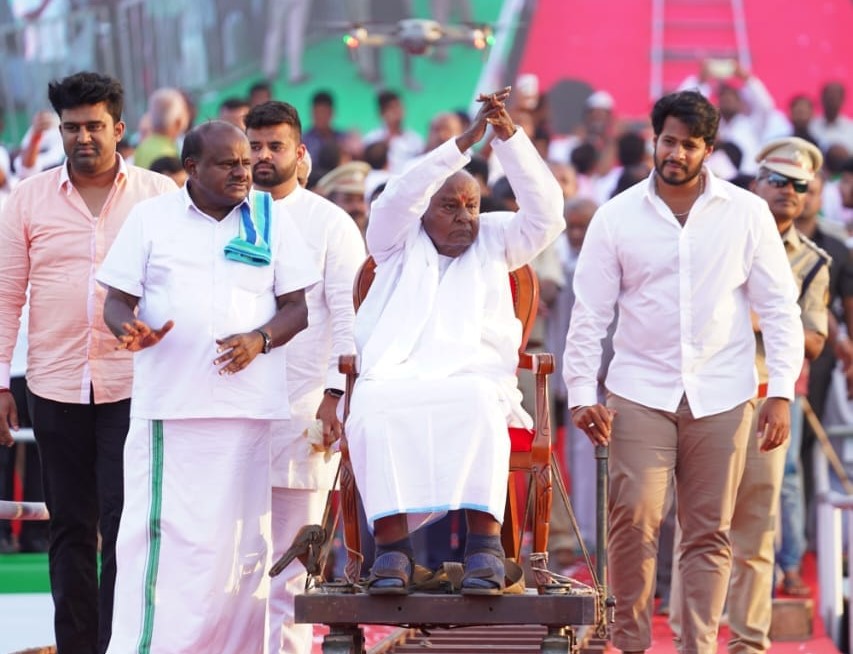
HD Deve Gowda.

Synopsis: On Monday, 18 May, former Prime Minister HD Deve Gowda turned 93. Born in a family with no political experience, Gowda’s rise in politics was nothing short of a thriller. He stood with the farmers, fought for their cause, and never hesitated to describe himself as the son of the soil. At 93, he has started a new battle by launching a protest against the Greater Bengaluru Integrated Township in Bidadi.
Saturday, 16 May 2026. Former Prime Minister HD Deve Gowda, two days shy of turning 93, sat through a press conference that lasted nearly an hour. He needs assistance to walk and climb stairs. But the moment he begins to speak, slowly but firmly, the message is clear: he wants to stand with farmers.
“My struggle starts today,” he declared, launching a protest against the Greater Bengaluru Integrated Township (GBIT) project in Bidadi, which has drawn stiff opposition from local farmers.
Yet, Gowda’s battle for farmers did not begin today. It stretches back to the 1970s, when he emerged as a political voice for irrigation and agrarian issues in Karnataka.
Over the decades, he built a reputation as a leader deeply invested in farmers’ welfare, so much so that peasants in Punjab named a high-yielding variety of paddy after him, journalist and author Sugata Srinivasaraju writes in a detailed biography of the leader titled “Furrows in a Field: The Unexplored Life of HD Deve Gowda.”
Even today, despite his physical struggles, emotion often takes over when he speaks about Karnataka and its farmers. Earlier this year, photographs of Gowda sitting in the Rajya Sabha with folded hands appeared across newspapers and Kannada news channels. He was appealing for urgent attention to Karnataka’s drinking water crisis.
“I appeal to this House, please take care of Karnataka. With folded hands, I beg of you,” he said, his voice cracking at moments. “Please see that the problem of drinking water is solved.”
The concerns that still animate Gowda today, irrigation, drought and rural hardship, were also the issues that first propelled him into public life more than six decades ago.
Gowda was born in a Vokkaliga farming family with no political background in Haradanahalli village in Karnataka’s Hassan district in 1933. He entered active politics at the age of 20, joining the Congress in 1953, and remained with the party until 1962. During this period, he also served as president of the Anjaneya Cooperative Society in Holenarasipura and later became a member of the Holenarasipura Taluk Development Board.
His electoral breakthrough came in 1962, when he won the Holenarasipura Assembly seat as an Independent candidate. He would go on to hold the constituency for six consecutive terms between 1962 and 1989, though not always as an Independent.
During the Emergency between 1975 and 1977, Gowda was imprisoned under the Maintenance of Internal Security Act (MISA). The period became a defining chapter in his political life and strengthened his image as an anti-authoritarian leader aligned with the broader socialist and Janata movement that emerged in opposition to the Congress.
Over the years, Gowda developed a reputation as a politician with sharp political instincts and an unusual grasp of administration. James Manor, a professor at the University of London and a long-time observer of Karnataka politics, wrote that civil servants who worked with him often remarked on his ability to quickly identify the core issue in any discussion or government file despite not being widely read.
“He has an uncanny ability to understand the key points in any document or discussion, and to spot the difference between real and imagined problems,” Manor wrote in 1996. “He is also adept at anticipating potential difficulties, and at devising approaches that defuse them.”
In the 1980s, Gowda held the Public Works and Irrigation portfolios at a time when his friend-turned-rival Ramakrishna Hegde was Chief Minister of Karnataka. This period cemented his association with large-scale water projects and irrigation expansion across the state.
One of the most significant efforts linked to him was the Upper Krishna irrigation project, aimed at providing water to drought-prone districts in northern Karnataka. He was credited with aggressively pursuing clearances and funding at both state and central levels. The project, which had earlier faced funding suspensions from the World Bank over rehabilitation delays, saw renewed momentum under his intervention.
As SM Jaamdar, a 1980-batch IAS officer associated with the project, told journalist Srinivasaraju: “This would not have happened without the farsightedness of Gowda. He knew all the project details. No engineer, secretary or officer could compete with his knowledge. Gowda’s mastery of the subject, whichever subject he picks up to deal with, has always amazed IAS officers. How he does it, only God knows.”
Political analysts and journalists say that the image of Gowda as the “simple, humble” farmer leader was carefully constructed over time.
Pointing to his contemporaries in Karnataka politics, journalist and political analyst Preethi Nagaraj said, “Ramakrishna Hegde was a great orator and was embraced by the dominant Lingayat community within the Janata Parivar. JH Patel was well-educated, well-learned, and represented Kannada identity politics. What Deve Gowda could place himself as was a leader of the people, a leader of farmers.”
Nagaraj further stated that Gowda was someone who learnt quickly and was deeply grounded. “He learned the craft of politics almost by instinct, and eventually mastered it,” she said.
An example frequently cited was the way Gowda handled the Idgah Maidan dispute in Hubballi, a politically volatile issue at the time.
The controversy peaked in 1994, when BJP leaders and Hindu organisations launched an agitation demanding permission to hoist the national flag at the Idgah Maidan in Hubballi, which was being used by the Muslim organisation Anjuman-e-Islam for Eid prayers. The issue turned violent after six people were killed in a police firing during protests on 15 August 1994.
However, the issue was put to rest after Gowda became chief minister of the Janata Dal government in the state, when members of the Anjuman-e-Islami hoisted the national flag at the maidan.
“He had the goodwill of the Muslim community and wanted to leverage it to resolve the festering communal problem that the Idgah Maidan issue had become,” Srinivasaraju wrote in the biography.
Gowda himself said he kept his “moves under wraps,” adding, “Nobody knew what was happening.” Crediting his strategy that was far removed from confronting the communal crowd on the streets, Srinivasaraju wrote, “This was a trademark style of Gowda in approaching and solving a problem, which he had tried out earlier and employed in good measure as prime minister too.”
Also Read: Party leaders unamused as Gowda hints at Nikhil Kumaraswamy heading JD(S)
Gowda became the Prime Minister on 1 June 1996 after the 13-party United Front coalition, led by the Janata Dal, chose him to head the government. It was an extraordinary political moment: a regional leader from Karnataka, far removed from Delhi’s traditional power circles, was suddenly entrusted with leading the country.
Srinivasaraju captured the significance of that moment in his biography of Gowda: “It was one of the finest moments of democratic India when a poor peasant’s son without pedigree, pelf or patronage was given charge of the nation.”
Despite his short stint as the Prime Minister, Gowda led several important developments. Three progressive legislations—the Right to Information Bill (RTI), the Lok Pal Bill and the Women’s Reservation Bill—took significant shape in the Gowda cabinet.
In an interview with Frontline, Srinivasaraju describes how Gowda also went to Kashmir four times in 11 months and stayed in the north-eastern region for six days, becoming the first Prime Minister to do so.
Also Read: Yediyurappa announces BJP-JD(S) alliance for Lok Sabha polls
When the Congress withdrew its support for the coalition government, Gowda stepped down as the Prime Minister on 21 April 1997, but continued to remain relevant in national politics as an MP. He founded the Janata Dal (Secular) in 1999 after the Janata Dal split. The JD(S) is now led by his son and former Chief Minister HD Kumaraswamy.
Srinivasaraju’s biography of Gowda traces the later years of JD(S) politics, including the controversial alliance forged by his son, Kumaraswamy, with the BJP, to become the Chief Minister in 2006-2007. Gowda called it a ‘betrayal’ of the JD(S)’s secular values.
But in 2008, the book noted, Gowda categorically told Kumaraswamy not to transfer power to BS Yediyurappa and the BJP.
“He was one political leader who did not hesitate to wear the skull cap and pray with members of the Muslim community in public during their festivals,” the biography noted.
However, today, Gowda appears starkly different. “He is not the same Devegowda. He has become like a hapless grandfather,” Nagaraj said.
That transformation became more visible when the JD(S) formally allied with the BJP for the 2024 Lok Sabha elections. For many observers, the alliance marked a sharp departure from the secular image Gowda had carefully cultivated through much of his political career, aligning instead with a party often criticised by opponents and civil rights groups for majoritarian politics and growing communal polarisation.
Additionally, Gowda also faced criticism for the growing concentration of political power within his family. The JD(S) increasingly came to be viewed as a party dominated by the Gowda family, with multiple family members occupying positions of influence — and within his family, the trouble only deepened.
Gowda’s grandson, Prajwal Revanna, is currently serving life imprisonment after being convicted in one of the sexual assault cases filed against him.
“It took me some time to recover from the shock and pain he has inflicted on me, my entire family, my colleagues, friends and party workers. I have already said that he should be given the harshest punishment under the law if found guilty,” Gowda said in a public letter at the time.
“But Gowda cannot be dismissed,” Nagaraj said. She recalled visiting him for a routine election quote when he unexpectedly turned the interaction into a detailed political briefing.
Pulling out a map of Karnataka, Gowda began going constituency by constituency, predicting winners and losers seat-by-seat. “He got almost 90 per cent of it right,” she said. “He was a 24×7 politician.”
As the press conference drew to a close on Saturday, Gowda slowly rose from his chair with assistance. Age has visibly caught up with him. His party no longer commands the influence it once did, and the politics around him has transformed dramatically from the coalition era he helped define.
Yet, even now, his political vocabulary remains rooted in the same concerns that shaped his rise decades ago: farmers, water, land and rural distress. Deve Gowda remains the same Mannina Maga (son of the soil), a phrase he often used to describe himself.
(Edited by Majnu Babu).



