


Published Apr 08, 2026 | 11:00 AM ⚊ Updated Apr 08, 2026 | 12:40 PM

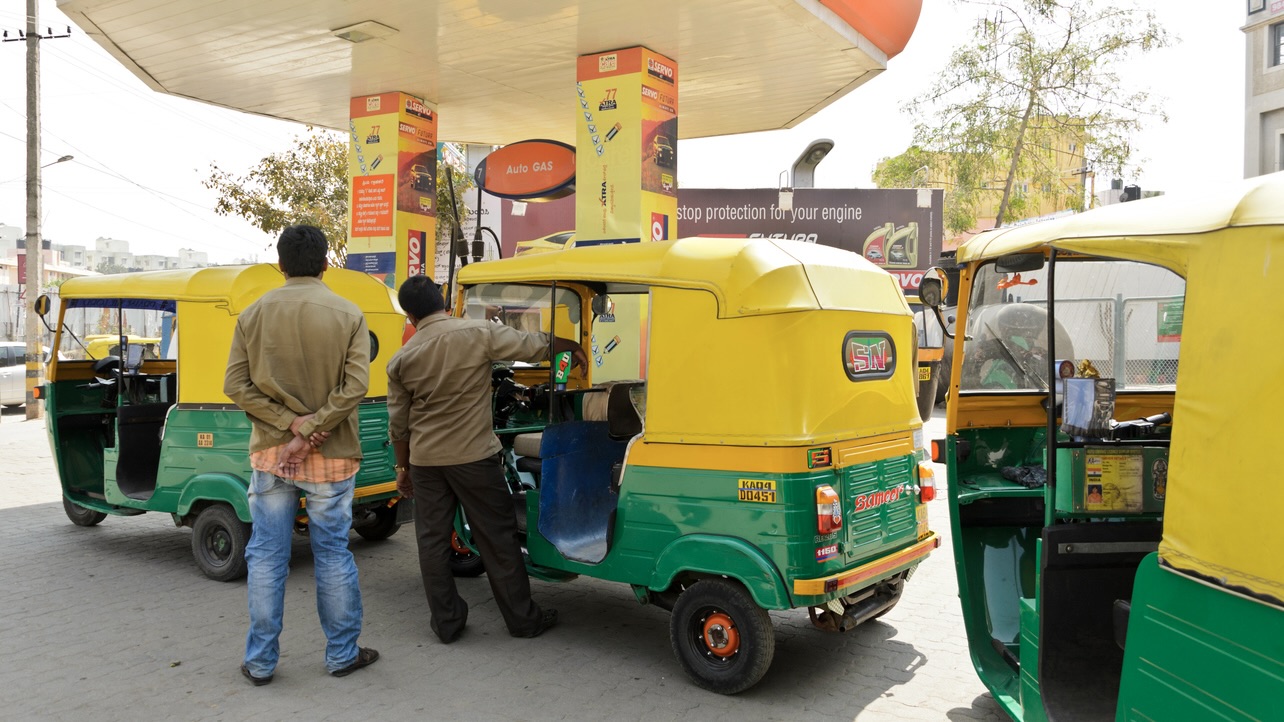
Even after long waits, drivers say they are often allowed to fill only three litres of LPG.
Synopsis: Autorickshaw drivers in Bengaluru are facing the brunt of a weeks-long LPG shortage. Rising fuel costs and supply gaps have forced many off the road, while others spend hours queuing for limited fuel and report fewer trips and lower earnings. The Indian Oil Corporation has urged a temporary shift to petrol, but drivers say lower mileage and conversion costs make this difficult.
It is midday on a Monday in Bengaluru. Rajesh, an autorickshaw driver, is parked outside Sir M Visveshwaraya Station metro in central Bengaluru, one of the busiest stops on the northwest–southwest Purple Line. Even after 30 minutes, Rajesh has yet to get a passenger.
Most autorickshaws in the city use LPG as their primary fuel, with CNG and electric vehicles making up a small share.
Soaring LPG prices amid the weeks-long nationwide shortage have forced many auto drivers off the road. Others, like Rajesh, have raised fares to make ends meet. This has led to a steep drop in passengers, lower earnings, and long detours across the city to find pumps with LPG in stock.
“I was only able to earn ₹100 today,” Rajesh said, taking notes from his pocket. “Only some stations have LPG, but they are charging as high as ₹120. The queues are usually four to five hours long. Who do we blame? Central or state government?” he asked.
Karnataka Chief Minister Siddaramaiah, his deputy DK Shivakumar, and Congress General Secretary in charge of Karnataka Randeep Singh Surjewala, on Tuesday, 7 April, accused the Union government of triggering a “full-blown livelihood crisis” in Karnataka by mismanaging LPG and fuel supply. They said this has hit auto drivers, small businesses, and gig workers.
In a joint statement, they said over five lakh auto drivers and lakhs of small hotel owners, vendors, and delivery workers are facing unprecedented hardship due to price rises, supply shortages, and administrative failure at the Centre.
For many auto drivers, the workday now begins hours before sunrise, sometimes as early as 3 or 4 am. But instead of looking for passengers, they have to search for LPG at fuel stations across the city.
“We start standing in lines at 3 or 4 in the morning and end at 8 am. When do we start working and earning?” one auto driver asked.
Even after long waits, drivers say they are often allowed to fill only three litres of LPG, far below the four to 10 litres they would typically refill before the crisis. Several stations have also capped purchases at around ₹500, which limits how far drivers can operate in a day.
One auto driver said he had to travel from Chandapura to Madiwala—almost 30 km—to get his vehicle refilled. “I leave the auto there, take a bus, and then go back home. We are not sure if we will get LPG at the same place the next day,” he said.
Drivers said LPG prices vary across stations in the city. While some petrol pumps supplied by state-owned oil companies, such as the Indian Oil Corporation Limited (IOCL), charge ₹98 per litre, private companies charge as high as ₹120. For comparison, LPG cost ₹55 per litre before the shortage.
Even when they secure fuel to start the day, it is not straightforward.
“If we ask for extra money from passengers, they say they will take our number [plates] and complain. If we tell them oil prices have gone up, they don’t listen. They say prices for them have also gone up,” one driver said.
Police often move drivers waiting near metro stations along, which cuts their chances of finding passengers, he added.
On Monday, representatives of auto drivers’ associations met Karnataka Food and Civil Supplies Minister KH Muniyappa and put forward their grievances.
The minister said he would call a meeting on 10 April to resolve the issue.
“Auto drivers’ lives depend on these LPG supplies, so I will try to resolve the issue on a priority basis,” he said. He added that the situation would not have arisen if “the Centre had planned to get the energy supplies from Russia a month in advance.”
Some drivers also said they saw news reports and statements from ministers about additional LPG supply reaching India.
“The media coverage and statements stopped there. No one has cared about whether that LPG has reached us,” Praveen, another auto driver, said.
The ICOL on Sunday urged autorickshaw drivers in Karnataka to temporarily switch to petrol until the LPG crisis is resolved.
“In Karnataka, Oil Marketing Companies (OMCs) collectively operate 72 ALDS, with Indian Oil Corporation accounting for 55 of these outlets. In comparison, over 300 ALDS were operated by private players; however, nearly 80 percent of these private stations have become non-operational due to prevailing geopolitical challenges,” it said.
It also said it has scaled up supply in Karnataka. Its average daily supply, which stood at about 43.5 MT per day in February, rose to 59.53 MT per day in March and has increased further to 68.53 MT per day from 4 April.
“Despite these efforts, infrastructure limits—including a small number of ALDS, constrained dispensing capacity, and operational challenges—make it difficult to fully offset the supply gap caused by the closure of private Auto LPG outlets,” it added.
The corporation said pricing gaps are shaping consumer behaviour. PSU-operated outlets, including those of IOCL, retail Auto LPG at ₹89.52 per litre in Bengaluru, while private marketers charge between ₹99 and ₹105 per litre.
This gap has shifted demand towards state-owned auto LPG dispensing stations, leading to higher footfall and longer waiting times at these stations, it said.
The IOCL noted that about 70 percent of the autorickshaw fleet has dual-fuel capability, which allows drivers to switch from auto LPG to petrol. The company urged users to make this switch temporarily.
“Similar transitions have already been seen in markets such as Puttur and other areas where OMC-operated ALDS are limited, which shows this approach can work,” it said.
Drivers, however, said the switch to petrol is not easy. They said their autos give lower mileage on petrol than on gas, which raises daily operating costs.
“In LPG autos, only two litres (of petrol) is allowed. If we could fill five litres, we would use it for two days. But autos have a capacity of only two litres of petrol, which lasts just 10–12 km,” Manjunath, another auto driver, said.
Effective conversion to get usable mileage from petrol is also expensive.
“Mechanics charge ₹4,000–₹5,000 for that. Where are we supposed to get that money from when we don’t even have business?” he asked.
(Edited by Dese Gowda)


