

Published Sep 14, 2026 | 3:09 PM ⚊ Updated Sep 14, 2026 | 3:09 PM

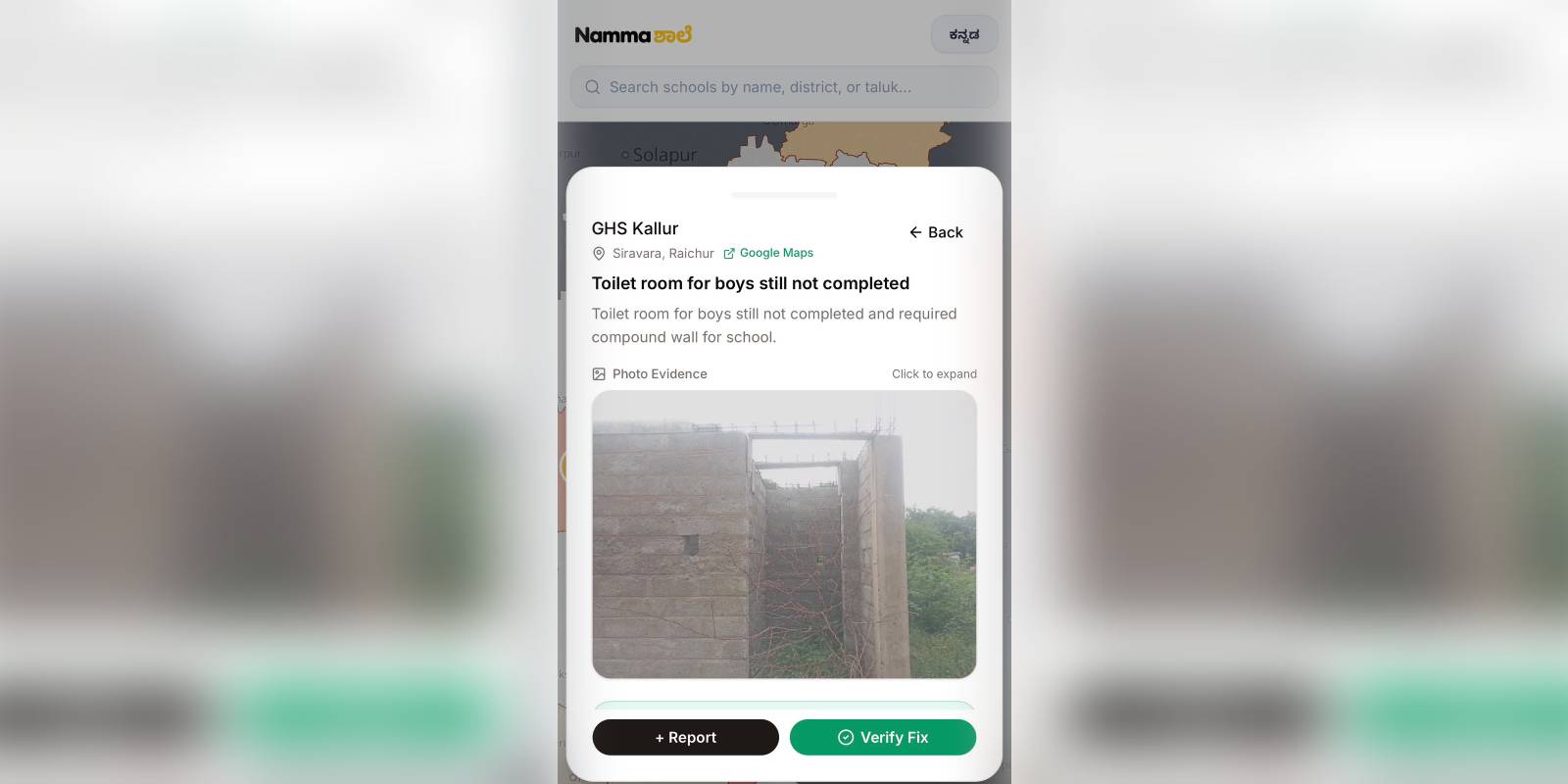
A screengrab from the NammaShale. (Supplied)

Synopsis: Launched on August 27 by Karnataka Congress spokesperson Dhruv Jatti, the citizen-led platform allows people to flag infrastructure issues in government schools. Around 120 reports have so far been forwarded to education officials, as the team seeks greater integration with the state government.
A citizen-led digital platform, NammaShale, aimed at identifying infrastructure gaps in government schools and helping route them for resolution, has been launched on 27 August, by Karnataka Congress spokesperson Dhruv Jatti.
Jatti said the initiative grew out of recurring infrastructure problems he encountered in government schools. With over 47,000 such schools in Karnataka, the platform allows citizens to flag these gaps.
“When I entered public life, I made a conscious decision: I did not want to wait for a title, a position, or a conventional political route before trying to solve problems that affect people every day,” Jatti said.
Since its launch, NammaShale has received 607 reports from 26 districts across Karnataka.
Of the 120 reports forwarded to education authorities, 13 — four in Dharwad and nine in Kodagu — have received responses from DDPIs (Deputy Director of Public Instruction) indicating that action would be initiated. Officials in the remaining cases are yet to acknowledge the reports, Jatti said.
Jatti said complaints are being forwarded in batches so officials are not overwhelmed and the team can track individual cases.
NammaShale contacts DDPIs and Block Education Officers (BEOs) through calls and messages after referring complaints.
Some officials have acknowledged the reports and indicated they would examine the issues, while responses are awaited in several cases.
NammaShale follows a three-stage model — “Report, Track, Fix”.
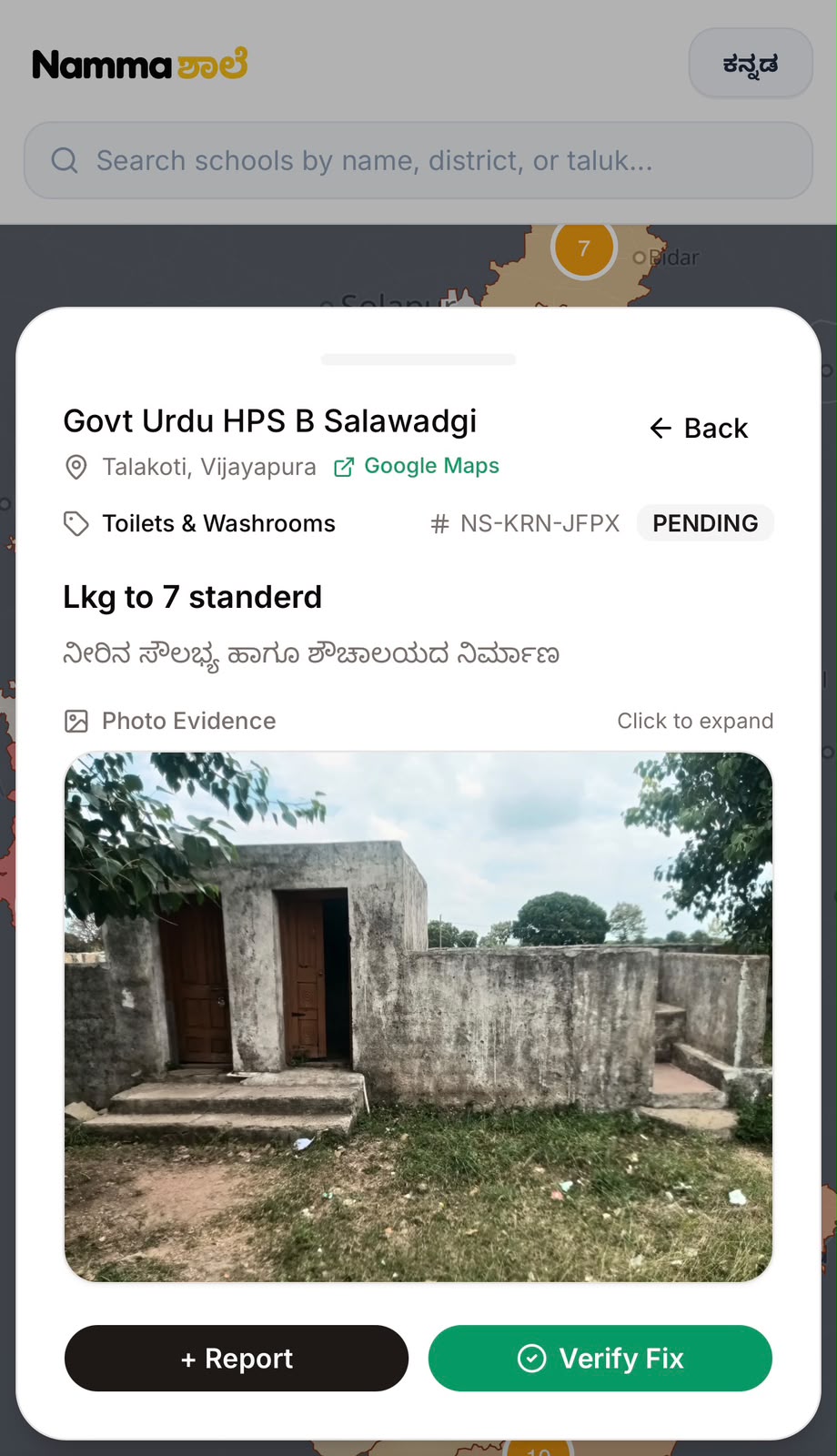
Complaint submitted to NammaShale. (Supplied)
A citizen visiting a government school can photograph an infrastructure problem, add details and submit it through the platform. Users must be within roughly 600 metres of the school while filing a report to prevent fake complaints.
The complaint reaches the NammaShale backend, where the team checks whether the photograph and description correspond with the reported issue before forwarding it to the relevant authority.
Users can later track the status of their complaint. Jatti said the team is also developing a public dashboard with district-wise complaint figures and information on official responses once they receive 700 reports.
Common complaints include dysfunctional toilets, lack of clean drinking water, electricity-related problems and damaged benches.
“Toilets especially are in very bad condition in some government schools,” Jatti said, referring to photographs received from parts of northern Karnataka.
The initiative’s launch material cites Unified District Information System for Education (UDISE) 2023–24 data stating that more than 3,580 government schools in Karnataka did not have functional toilets and nearly 4,000 lacked handwashing facilities. It also refers to Karnataka High Court observations in 2023 over inadequate toilet and drinking-water facilities in government schools.
Ballari recorded the highest number of reports at 113, followed by Bagalkote with 111, Shivamogga with 95, Bengaluru Urban with 59 and Uttara Kannada with 57.
Together, these five districts accounted for 435 reports, or about 72 percent of the total.
Jatti said that higher reporting numbers do not necessarily mean schools in those districts are in worse condition.
“Having more reports in one particular district does not define the fact that that district has poorer schools,” he said, adding, “The variation could also reflect greater awareness of the platform or stronger volunteer presence in some districts.”
Jatti estimated that around 300 to 350 teachers, citizens and others have filed reports so far.
Under NammaShale’s model, authorities are given 30 days to act on a reported infrastructure issue.
If a problem remains unresolved, the platform plans to explore support through CSR initiatives, NGOs, alumni groups, individuals or local communities.
It also has “Partner for CSR” and “Adopt a Government School” mechanisms for unresolved infrastructure requirements.
Jatti said the NammaShale team has offered to provide the platform and its backend dashboard to the state government free of cost, arguing that formal integration with the School Education Department would allow complaints and their resolution timelines to enter an official workflow.

Founder Dhruv Jatti
The push comes as Cockroach Janta Party (CJP), through its “School Thik Karo” campaign, has also sought to address issues in government schools around 31 districts.
Jatti said he hopes NammaShale receives similar engagement from the government.
The initiative is seeking a meeting with School Education and Literacy Minister Madhu Bangarappa to discuss possible integration.
Meanwhile, NammaShale plans to expand its on-ground campaign across districts through a team of around 45 people working on technology, communications and outreach.
For now, the reports range from broken benches and unusable toilets to inadequate drinking-water facilities. The onus now lies in the government’s response and willingness to address the issues once they enter the government system.
(Edited by Sumavarsha)



