


The lives of 1,300 farming families across 13 villages have been disrupted to make way for Foxconn’s “Project Elephant,” a 13-million-square-foot site which began commercial production of iPhones in August this year.

Published Sep 01, 2025 | 11:43 AM ⚊ Updated Sep 01, 2025 | 11:43 AM

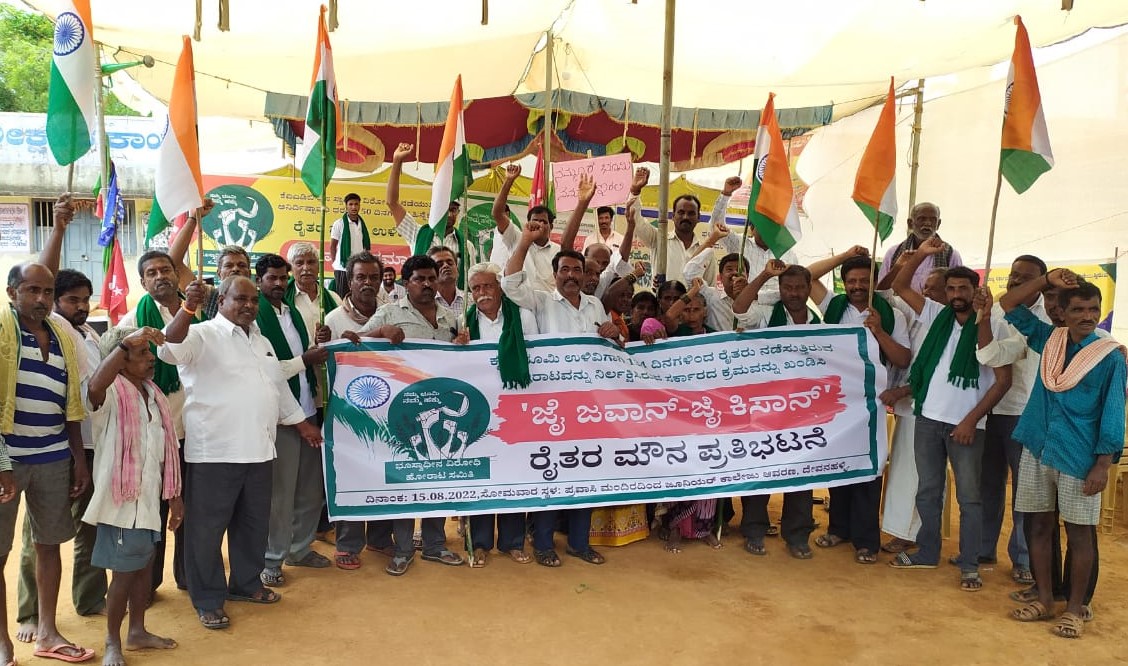
File image of farmers protesting over the land acquisition.
Synopsis: The land acquisition in Devanahalli near Bengaluru, to pave the way for Foxconn’s $2.8 billion manufacturing plant, has put farmers in distress. A common grievance among farmers in Devanahalli is the fragmented manner in which the land was acquired, which they claim has made farming increasingly difficult.
Srinu, a farmer from Devanahalli near Bengaluru in Karnataka, had long planned to pass down his ancestral farmland to his two sons. He cultivated ragi, beans and grapes, continuing a proud family tradition rooted in the soil. For Srinu, the future seemed secure – his sons would inherit not just the land, but a way of life.
However, that vision was shattered when the Karnataka Industrial Areas Development Board (KIADB) acquired a large portion of his five-acre land to pave the way for Foxconn’s $2.8 billion manufacturing plant. With most of his farmland gone, Srinu is now left with patches of land to hand over to his children.
“I used to rely on my monthly income, roughly around ₹13,000, from farming to send my elder son to a local school,” Srinu told South First. “He might have to drop out now because I can’t afford the expenses. I don’t know how I will take care of my sons or how to secure their future after I am gone.”
The lives of 1,300 farming families across 13 villages have been disrupted to make way for Foxconn’s “Project Elephant,” a 13-million-square-foot site which began commercial production of iPhones in August this year. For generations, these farmers lived off the land, eating food from crops they grew, following a way of life passed down through their ancestors. Now, their lives look different in the shadow of rapid industrial expansion.
A common grievance among farmers in Devanahalli is the fragmented manner in which the land was acquired, which they claim has made farming increasingly difficult.
“I had a fertile stretch of three acres where I used to grow ragi and sweetcorn,” said Manjunath, another farmer in Devanahalli, who has been farming for 30 years. “But the KIADB took parts of it, leaving behind uneven, scattered plots that are no longer practical for cultivation. How can I level such an uneven land?” he asked while speaking to South First.
Srinu faces a similar problem, with patches of land that he feels wouldn’t bring any profit to him.
Before the acquisition, Manjunath earned ₹ 1,00,000 annually from agriculture. In an effort to sustain his livelihood, he leased a plot of five acres of land in a different area, but it would bring a maximum profit of ₹40,000, he estimated, as the rest of the money would go to paying rent for the land.
“I am trying to make it work, but I don’t know if this new land is even half as fertile,” he said, adding, “And nature hasn’t been kind either; erratic weather has made it worse.”
Farmers in the area recalled frequent visits by local MLAs and industry stakeholders to their village before the land was acquired.
“They gave us grand promises about how the factory would transform our lives. They said the factory would offer jobs and new sources of income,” one farmer told South First. However, he noted that after the acquisition, none of them returned to see whether the farmers were facing any problems.
“They never carried out any survey to see if farmers’ needs were met, even though the factory was built on our land,” said Vijay, a 48-year-old small farmer whose two-acre fertile land, where he used to grow ragi, has been completely taken over. He used to earn between ₹50,000 to ₹70,000 annually, depending on the quality of the harvest.
Vijay had been saving all this money diligently for his daughter’s wedding, making careful plans well before the land acquisition. “I had set aside my farming income in a savings account and promised myself I wouldn’t touch it for anything else,” he said. “But after losing my land, I was forced to dip into those savings just to keep my family afloat and not risk running into debt,” he added.
Although the KIADB oversees the land acquisition process, farmers told South First that, in several cases, real estate agents and middlemen played a key role in persuading landowners to part with their land.
“Many farmers lack formal education and were easily lured with promises of high-paying jobs in modern factories. Farmers agreed, thinking they were doing the right thing,” said Ramesh Cheemachanahalli, a local farmer leader. “It’s only after the land is gone that they begin to understand the true cost.”
A farmer in Devanahalli, who wished to remain anonymous, explained how middlemen created dissent among farmers. “They made exaggerated promises about compensation, many of which weren’t even aligned with what the government actually offered,” he said.
Some farmers, misled by these claims, agreed to give up their land in return for money, while others continued to resist. “It fractured our unity and weakened our collective fight,” the farmer added.
Farming was their main source of livelihood. Now, most of them are forced to seek an alternate source of income. In most cases, this shows up as daily wage labour.
Vijay is working as a security guard in a gated apartment within the city. He is still hoping for government-promised compensation to come through. In 2024, the Karnataka High Court, while responding to petitions challenging the land acquisition, had directed KIADB to provide adequate compensation to affected farmers.
However, many farmers have since alleged that the compensation offered amounts to only 25 percent of the current market value of their land. The majority of those affected haven’t received this money yet, according to residents of Cheemachanahalli.
“I am still waiting for my compensation. Those who have received it say it’s far from adequate,” said Vijay.
Meanwhile, several people have turned to construction work to sustain their lives. “I am working as a construction worker at a site near my house. I am not used to doing dangerous work like heavy lifting of construction materials,” said Srinu, who has been hired on a contract basis. “I can be let go at any point in time. It is scary to live like this,” he said.
When asked about what his sons plan to do, Srinu didn’t have a quick answer. “They will have to leave the village and venture into the city to look for jobs. The city has not always been kind to farmers,” he said.
(Edited by Muhammed Fazil.)


