

Published Feb 10, 2026 | 6:30 PM ⚊ Updated Feb 10, 2026 | 6:30 PM

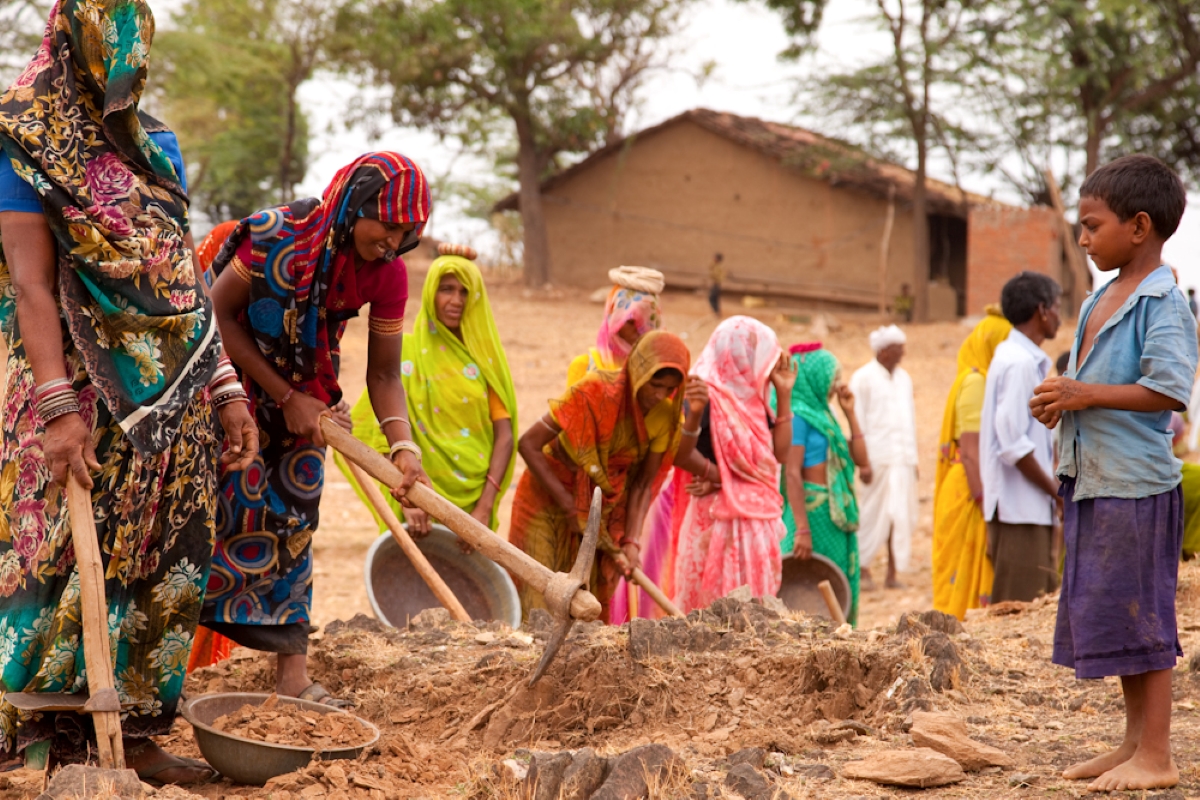
Women engaged in MGNREGA work. (Creative Commons)
Synopsis: The Karnataka government recently passed a resolution opposing VB-GRAMG and demanding the reinstatement of MGNREGA. With the state Budget approaching, Karnataka is also in a difficult position to accommodate funding for the scheme. However, apart from these, attention has now turned to what options, if any, the state has to sustain its challenge to the new legislation.
The Congress-led Karnataka government has been opposing the Union government’s Viksit Bharat – Guarantee for Rozgar and Ajeevika Mission (Gramin) (VB–GRAMG) Act on a war footing. On 4 February, it became the third state to pass a resolution in the Assembly opposing the Act and demanding the reinstatement of MGNREGA.
However, the state now faces a fresh challenge. With the budget around the corner, Karnataka is grappling with whether it will be forced to recalibrate its fiscal targets to accommodate VB-GRAMG, a scheme that significantly increases the state’s financial burden through a 60:40 cost-sharing formula.
Beyond the resolution, the Karnataka Congress has escalated its political opposition through a series of public and symbolic measures. They announced a 5-km padayatra in every constituency, against the repeal of the Mahatma Gandhi National Rural Employment Guarantee Act (MGNREGA).
The state government has also been printing front-page advertisements in newspapers over the last few days, criticising the new legislation — a move that angered the Opposition BJP during the recently-concluded joint session of the state legislature.
It also prepared a 22-page speech with 122 paragraphs, at least eight of which were devoted to the state’s opposition to the new scheme, for the Governor to read out during his customary address.
However, apart from these moves, attention has now turned to what options, if any, the state has to sustain its challenge to the new legislation.
MGNREGA activists and legal experts said that Karnataka, along with other states that are opposing VB-GRAMG, have limited options to continue their challenge.
Rajendran Narayanan, an associate professor at Azim Premji University and a researcher on MGNREGA, pointed out that Karnataka could challenge the new law in the Supreme Court.
Under Indian constitutional law, Narayanan explained, decisions taken by the Union can be examined through the lens of Article 258 of the Constitution, which deals with the Centre’s power to confer functions and impose duties on states.
“States have to be considered and consulted when such arbitrary decisions are being taken by the Centre. Since that did not happen here, it becomes a ground for legally challenging the procedure through which the law was enacted,” Narayanan told South First.
While Article 258(2) allows Parliament to confer powers and impose duties on states even in matters beyond their legislative competence, Article 258(3) introduces a crucial safeguard. It mandates that if such powers or duties result in additional administrative costs, the Union is constitutionally obliged to compensate the states. The quantum of compensation must be decided through mutual agreement, or failing that, by an arbitrator appointed by the Chief Justice of India.
According to Prasanna S, a lawyer, this safeguard lies at the heart of the constitutional challenge to VB-GRAMG. He pointed to Section 22 of the Act, which prescribes the fund-sharing pattern: 90:10 for northeastern states, Himalayan states, and certain Union territories, and 60:40 for all other states and Union territories with legislatures.
The provision also empowers the Union government to determine state-wise “normative allocations” annually, based on parameters prescribed by the Central government. Any expenditure incurred by a state beyond this allocation must be borne by the state itself, in a manner determined by the Union government.
“In effect, the Centre is legislating a 60:40 funding pattern that should have been arrived at through agreement with the states,” Prasanna told South First. “That makes the provision violative of Article 258 of the Constitution,” he added.
Earlier, during South First‘s Dakshin Dialogues, LK Atheeq, Chairman of Bengaluru Business Corridor, explained that Karnataka, which spent around ₹800 crore on MGNREGA — 10 percent of material costs on total expenditure of ₹8,000 crore — would have to spend ₹3,200 crore under VB-GRAMG.
However, questions remain over when the allocation will be made to states and when the transition from MGNREGA will be set into motion.
The Union Budget 2026-27 allocated ₹95,692.31 crore for VB-GRAMG, while cutting down allocation for MGNREGA from ₹86,000 crore in the previous year to ₹30,000 crore.
The allocation for MGNREGA is expected to be used for clearing last year’s liabilities and dues, although Finance Minister Nirmala Sitharaman did not make a reference to the new scheme and the reasons behind the funding in her budget speech.
From the date of notification of VB-GRAMG, state governments have six months to come up with their version of the scheme. For states like Karnataka, that have to present their budget soon, this uncertainty spills over into both fiscal planning and administrative preparedness.
In fact, the situation arises at a time when the state has been facing a mounting financial crunch. The commitments under its five guarantee welfare schemes, which together cost the state exchequer ₹52,000 crore annually, and the Union government’s GST rate rationalisation are some of the major impediments to the state’s financial situation.
The NREGA Sangharsh Morcha (NSM) criticised the allocation in the Union Budget. Pointing out that FY 2025-26 is on track to end with outstanding liabilities of at least ₹11,000 crore, coupled with pending liabilities owed under MGNREGA. For instance, the dues to West Bengal add up to approximately ₹15,000 crore.
“Therefore, of the ₹ 30,000 crore allocation for MGNREGA for FY 26-27, half is likely to be used for simply clearing outstanding dues,” a statement by the group read.
Stating that the Union government has given no clarity on what this allocation is intended towards, the group said, “If it is meant to be used for MGNREGA work in the first quarter, as the VB-GRAMG programme gets set up, it is woefully inadequate. According to historical trends, April to June are the heaviest months for NREGA work, before the agricultural season begins. At least 40 percent of the FY’s budget is spent in this quarter. Therefore, adjusting for outstanding liabilities, the allocation of ₹30,000 crore is significantly inadequate to provide employment during the crucial summer months.”
A crucial question in front of states is whether they can opt out of the new scheme. Experts, however, warned that doing so would involve trade-offs many states may not be prepared to absorb.
“If states choose not to put their administrative machinery behind the scheme, it (the scheme) simply will not work, since nearly 40 percent of the funding is expected to come from the state,” Narayanan said. “That is the trade-off, and it remains to be seen how states manage it if they go down that route.”
Such a move could also carry political risks. Opting out in this manner may allow the Union government to shift the narrative, portraying states as obstructing an employment programme and taking attention away from funding and federalism concerns, experts said.
Chakradhar Buddha, an expert with LibTech, pointed out that even if states technically have the option to opt out, it is workers on the ground who would bear the brunt of such a decision. “The worker will ask where they stand in all of this,” he said. “What happens to their right to work?”
For many women, the scheme became a basis of their strength as guaranteed employment had provided a critical safety net for rural households. In Karnataka, 58 percent of MGNREGA workers were women — proportionately more than their population — whilst scheduled castes comprised 28 percent of workers despite being only 18 percent of the state’s population, Dr HV Vasu, Convenor of Jagrutha Karnataka, had pointed out during Dakshin Dialogues.
Buddha further pointed out that the Union government strategically asked states to come up with their own schemes under VB-GRAMG. “If they don’t, then they are out of the programme. Either way its a win for the Union government, not the worker,” he said.
Narayanan said states could continue their resistance by forming a broader coalition. “If multiple states such as Karnataka, Kerala, Tamil Nadu, and Telangana come together to reject the legislation, it would significantly increase public pressure,” he said.
For now, Congress in Karnataka has been carrying out padayatras in several districts across the state, in a bid to demand repeal of VB-GRAMG and the reinstatement of MGNREGA. Chief Minister Siddaramaiah has vowed that they will continue protesting until the scheme is restored.
(Edited by Muhammed Fazil.)


