

Published Jul 14, 2026 | 3:17 PM ⚊ Updated Jul 14, 2026 | 3:17 PM

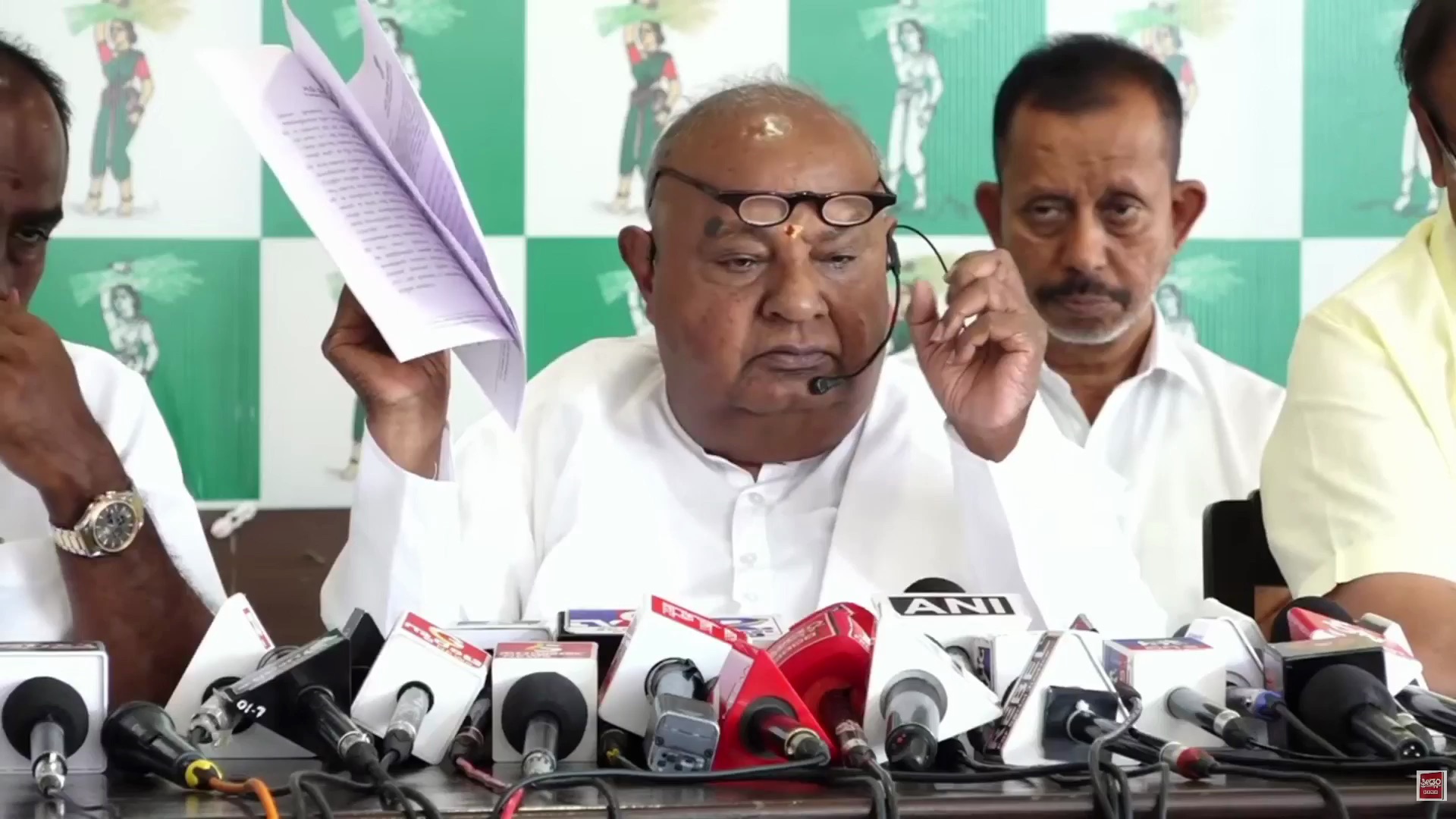
Former Prime Minister HD Deve Gowda.

Synopsis: Former Prime Minister HD Deve Gowda has urged the Karnataka government to withdraw the proposed Greater Bengaluru Bidadi Integrated Township Project, saying it would threaten the livelihoods of thousands of small farmers, harm the environment and place an unnecessary financial burden on the State. In a letter to Chief Minister DK Shivakumar, he cited long-running farmer protests, questioned the need for the project and warned that he would stage a satyagraha if the state did not heed his call.
Former Prime Minister HD Deve Gowda has urged the Karnataka government to withdraw the proposed Greater Bengaluru Bidadi Integrated Township Project, contending that it would leave thousands of small and marginal farmers without their livelihoods, impose an avoidable financial burden on the State, and add to existing environmental issues.
The Janata Dal (Secular) patriarch has also warned that if the government rejects his appeal, “and fails to respond to this earnest request”, he would “undertake a Satyagraha by sitting in protest before the statue of Mahatma Gandhi in the Vidhana Soudha premises.”
In a letter dated 25 June addressed to Chief Minister DK Shivakumar, Gowda sought the withdrawal of the project, which proposes the acquisition of 7,481 acres and 21.08 guntas of agricultural land across eight villages in Bidadi Hobli of Ramanagara Taluk and part of one village in Harohalli Hobli in Bengaluru South District.
He pointed to the sustained protests by farmers lasting nearly 500 days, and noted that the state’s own records showed that, of the 10,580 landholders affected by the project, 82 percent owned less than one acre of land.
Around 2,555 farmers, he noted, owned less than five guntas. He said that these families depended on irrigated farming, horticulture, dairy, sericulture and allied rural enterprises such as nurseries, vermicomposting and arecanut leaf plate manufacturing, and that land acquisition would jeopardise their livelihoods and increase unemployment among rural youth.
“These farmers depend on agriculture for their livelihood and also rely on allied occupations such as dairy farming, horticulture, and sericulture to support their families. Acquisition of their agricultural land will deprive them of their livelihood and displace them,” Gowda wrote.
“These villages produce an average of 50,000 litres of milk every day. Every month, about 600,000 to 700,000 litres of milk are supplied to the Bengaluru Dairy, generating approximately ₹1 crore in monthly income. Therefore, the proposed land acquisition would severely affect the dairy industry. Moreover, a majority of the members involved in this dairy activity are women.”
Also Read: SC seeks HD Revanna’s response to Karnataka’s plea against HC dropping Section 354
Deve Gowda also noted that the township project would place an even greater ecological burden on the already polluted Byramangala Lake, which continues to receive sewage inflows and industrial pollution despite projects worth about ₹300 crore undertaken for its rejuvenation.
“The lake is covered with toxic foam and weeds. As a result, residents of the surrounding villages and their livestock are suffering from severe health problems caused by environmental pollution and the foul smell of contaminated water,” he wrote.
Establishing a large township adjacent to the lake, he said, would adversely affect the surrounding environment and not serve the larger public interest.
He also alleged that the project announcement had triggered increased land purchases by real estate developers in surrounding villages.
“Thousands of acres have already been sold for real estate development, forcing many small landholding farmers to sell their only source of livelihood and leave their native villages,” he added.
Gowda also questioned the state’s rationale for the project, noting that thousands of developed residential sites in the Dr Shivarama Karanth Layout and Nadaprabhu Kempegowda Layout in Bengaluru remain vacant due to low demand.
“Thousands of residential sites in the Dr Shivarama Karanth Layout and the Nadaprabhu Kempegowda Layout developed by the Bengaluru Development Authority (BDA) remain vacant and unallotted. At the same time, the State Government proposes to develop six additional layouts over approximately 6,217 acres along the Bengaluru Business Corridor-2. Under these circumstances, there is no apparent necessity for this project,” he wrote.
Also Read: Karnataka Governor suspends KPSC Chairman over daughters’ alleged illegal appointments
Gowda also noted that comprehensive Social Impact Assessment and Environmental Impact Assessment studies should be carried out before a project of this scale under the Right to Fair Compensation and Transparency in Land Acquisition, Rehabilitation and Resettlement Act, 2013.
He asked how the government had issued the final land acquisition notification despite objections from farmers and alleged that 4,500 objections had not been heard and disposed of.
“Such assessments would also examine the consequences of cutting down nearly 200,000 trees in the project area and the resulting environmental impact on both the region and Bengaluru city. Furthermore, the State Government has not demonstrated adequate concern for the rehabilitation and resettlement of those affected by land acquisition,” he added.
Moreover, he expressed concerns over the project’s financing, noting that the State had approved borrowings of ₹12,511 crore for the township, including a government guarantee of ₹7,500 crore. The balance, he said, would be raised by the Bengaluru Metropolitan Region Development Authority through loans, while the Bengaluru Development Authority had been permitted to contribute ₹3,000 crore as equity.
“The State Government has already borrowed approximately ₹8.14 lakh crore to implement its social welfare schemes and meet other government expenditures. In such a difficult financial situation and economic crisis, taking up projects of this nature is neither prudent nor necessary,” he said.
(Edited by Dese Gowda)



