

Published Feb 07, 2026 | 10:10 AM ⚊ Updated Feb 07, 2026 | 3:09 PM

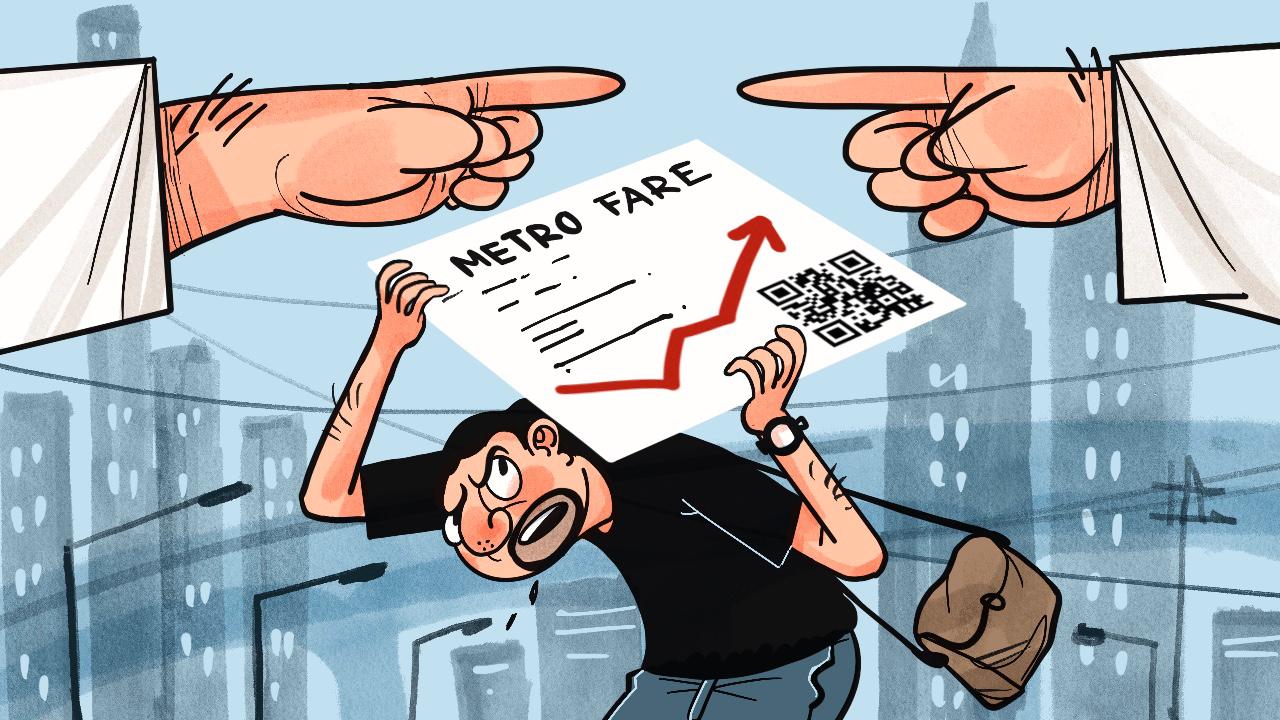
BMRCL's operations and maintenance expenditure rose by over 130 percent between 2017–18 and 2023–24.
Synopsis: The Bengaluru Metro’s announcement that it will raise fares by five percent from 9 February, just a year after a steep hike, has triggered mutual mudslinging between the ruling Congress in Karnataka and the opposition BJP. Though each has accused the other of responsibility for the hike, the Fare Fixation Committee’s report shows that it was driven more by financial necessity, as BMRCL continues to face a fiscal crunch.
The Bengaluru Metro Rail Corporation Limited (BMRCL) has announced a five percent fare increase from 9 February, a year after raising fares by 71 percent amid widespread criticism.
The operator of India’s second-largest metro network, which currently spans 96.10 km across three lines, cited binding recommendations from the first Fare Fixation Committee (FFC), submitted to the BMRCL board in December 2024, to justify the increase.
The decision has triggered a political storm in Karnataka, with the ruling Congress and the opposition BJP each trying to blame the other.
The state government has claimed the hike is entirely the BJP-led Union government’s doing, since fares are fixed by an FFC appointed at the Centre’s direction, even though BMRCL is a 50:50 joint venture between the two governments.
The BJP has, in turn, said the Centre constituted the FFC only after a formal request from the state. It has also said the Karnataka government, which has an “effective majority” on the BMRCL board, had the power to reduce or defer the hike but chose not to, and is now evading accountability.
Lost in this mutual mudslinging is a more basic question: why fares were raised at all. The FFC’s report—submitted in December 2024 and made public in late 2025—sets out a clear financial case for the fare revisions, saying BMRCL’s long-term viability cannot be sustained without them.
“The Company has been incurring losses since inception… Even after [a] quantum jump in ridership/boarding numbers, BMRCL has not been able to meet the full finance costs (interest) and depreciation,” the report reads.
Bengaluru Metro first began operations in 2011 on a 6.4 km network. Over the next 15 years, it added more than 90 km of track and over 80 stations across three lines.
Yet in that time, fares were raised only twice: once in 2017, and then in early 2025, following the FFC’s report.
Since 2017, BMRCL’s operating expenses rose across the board. Staff costs increased by about 150 percent, energy costs by over 100 percent, and maintenance costs by more than 450 percent, according to the FFC report.
Total operations and maintenance expenditure rose by over 130 percent between 2017–18 and 2023–24.
The fare freeze meant revenues did not keep pace, even though daily ridership rose, reaching an average of 5.16 lakh trips a day in 2023–24.
“Despite increase in the average ridership (except Covid period), the revenue generated by BMRCL is not commensurate with its operating expenses. This is basically due to the fact that expenses are met at current price level whereas revenue (Fare Box) is realised at 2017 price level,” the committee notes in the report.
The corporation’s audited accounts show losses every year since operations began. In 2023–24, BMRCL reported a net loss of ₹627.92 crore after depreciation, excluding non-cash adjustments.
Adding to the financial crunch is its mounting debt and the rising cost of servicing it. BMRCL has external loan liabilities of over ₹13,000 crore, apart from subordinate debt exceeding ₹21,000 crore, according to the FFC report.
Annual interest payments crossed ₹128 crore in 2023–24, while principal repayments are projected to climb substantially until 2030. Depreciation is also expected to nearly double over the same period.
The committee said that among the factors it considers when recommending fare increases is “the recovery cost of operating and maintaining the systems including servicing and repayment of the huge external loans”, alongside affordability and other considerations.
Without a fare revision, the committee states, BMRCL’s financial position would continue to deteriorate year after year.
The assessment has found support from both the state and the Centre, since BMRCL accepted its recommendations. But neither appears willing to absorb the political cost of admitting it publicly.
The first FFC was formed based on directions issued by the Union Ministry of Personnel, Public Grievances, and Pensions on 7 September 2024.
Its report, submitted on 16 December 2024, notes that the directions came after BMRCL pointed to the need for a “fare revision”.
Bengaluru Central MP and BJP leader PC Mohan alleged that the fare revision followed an “imperative” to reduce the financial burden on the Karnataka government, responding to the Congress’s claim that the hike was entirely the Centre’s doing.
In a post on X, he said the state had stopped providing BMRCL with a financial “cushion” in the form of “shadow cash support”. He said the withdrawal of this support led directly to the fare hikes.
The FFC report supports this claim. It states that the “shadow cash support” to BMRCL came through budgetary allocations in two main forms: reimbursement of operating losses and interest-free subordinate debt to help service loans “taken from the Union government and domestic financial institutions”.
Mohan also detailed purported contributions from Centre to BMRCL since 2019:
He said the fare hikes were a direct result of the state backing out of its share of the support.
In other words, the low fares were subsidised with state and Union government support.
The FFC report, meanwhile, says this arrangement is no longer sustainable, noting that “given the present financial position of the Government of Karnataka, the State Government may not continue to provide the shadow cash support”.
The Congress government has long faced a mounting financial crunch. Chief among the pressures are the commitments under its five guarantee welfare schemes, which together cost the state exchequer ₹52,000 crore annually, and the Centre’s GST rate rationalisation.
In addition, the state has accused the Union government of fiscal discrimination, particularly in tax devolution. It has said it suffered losses of up to ₹80,000 crore due to cuts in its share of the central tax pool.
Even so, the state has continued to push ahead with the tunnel road project in Bengaluru, championed by Deputy Chief Minister DK Shivakumar at a cost of over ₹17,000 crore.
The project aims to connect the city’s northern and south-western ends, despite criticism that it is unscientific, expensive, and a threat to several features of the city, including the iconic Lal Bagh.
South First previously reported that the Adani Group submitted the lowest bid for the project, which was still several thousand crore higher than the state’s initial estimate.
The original fare hike proposed by the FFC for 2025 was far higher than what BMRCL implemented.
BMRCL raised fares by 71 percent, instead of the proposed 105 percent, after Karnataka Chief Minister Siddaramaiah reportedly intervened. The report also states that its recommendations should be implemented immediately after acceptance by the BMRCL board.
Moreover, PC Mohan has claimed that the state has an “effective 5–4 voting majority” on the BMRCL board.
But a BMRCL representative told South First that the state and Union governments both have equal say in its functioning and decision-making.
BMRCL currently has 14 directors, out of a maximum of fifteen. Five are appointed by the Union government, including the chairman, Shri Srinivas Katikithala, IAS. Five more are appointed by the Karnataka government. In addition, there are four functional directors.
“The Government of India and the Government of Karnataka nominate five (5) Directors each, with the Secretary, Ministry of Housing and Urban Affairs, Government of India, appointed as the non-executive Chairman of the Company,” a BMRCL annual report states.
In its report, the Fare Fixation Committee (FFC) repeatedly says its recommendations aim to align Bengaluru’s metro with financially stable and operationally mature systems worldwide.
“The Committee has been guided by the prevailing practices followed by the Fare Fixation Committees in the case of Delhi Metro Rail Corporation… and the fare fixation methodology followed by other Asian metro rail organisations like Singapore and Hong Kong,” it notes.
This methodology rests on two core principles: regular fare revision and greater reliance on non-fare revenue.
The committee proposed reducing the number of fare slabs from 29 to 10, with fares fixed in multiples of ₹10. The minimum fare would remain ₹10, while the maximum fare across the network would be capped at ₹90.
Using changes in staff costs, energy prices, and maintenance expenses between 2017 and 2024, the report calculates a cumulative increase of about 105 percent, equivalent to roughly 14 percent a year over 7.5 years. The committee cites metro systems worldwide that revise fares transparently every year using the same criteria.
To ensure sustainability and avoid such steep hikes in future, the committee also recommended an automatic annual fare revision formula.
“If the fare is revised annually, the fare increase will be minimum, which can be acceptable to the general public. However, if the fare is revised after a gap of seven or more years, the quantum of increase will be higher and may attract public criticism,” it notes.
Under this mechanism, fares would be revised every year based on changes in consumer inflation, energy costs, and per-kilometre maintenance expenses, with an annual cap of 7 percent.
The fare hike announced by BMRCL, set to take effect from 9 February, is one such revision.
On finances, the report points to Hong Kong’s MTR as an example of a system that has achieved financial viability and even paid dividends to the government.
The report notes that MTR achieved this not through fares but through large-scale non-fare revenues from property development, station commercialisation, and advertising. It urges BMRCL to adopt a similar approach.
At present, Bengaluru Metro’s non-fare revenue is marginal. In 2023, it accounted for less than 10 percent of farebox income. BMRCL would therefore need to expand advertising, property rentals, and station naming to raise additional revenue.
In the short term, however, such measures are unlikely to offset current costs. Even optimistic projections treat non-fare revenue only as a supplement, the committee says, with fares continuing to carry most operating, interest, and depreciation costs.


