

Published Mar 09, 2026 | 2:00 PM ⚊ Updated Mar 09, 2026 | 3:11 PM

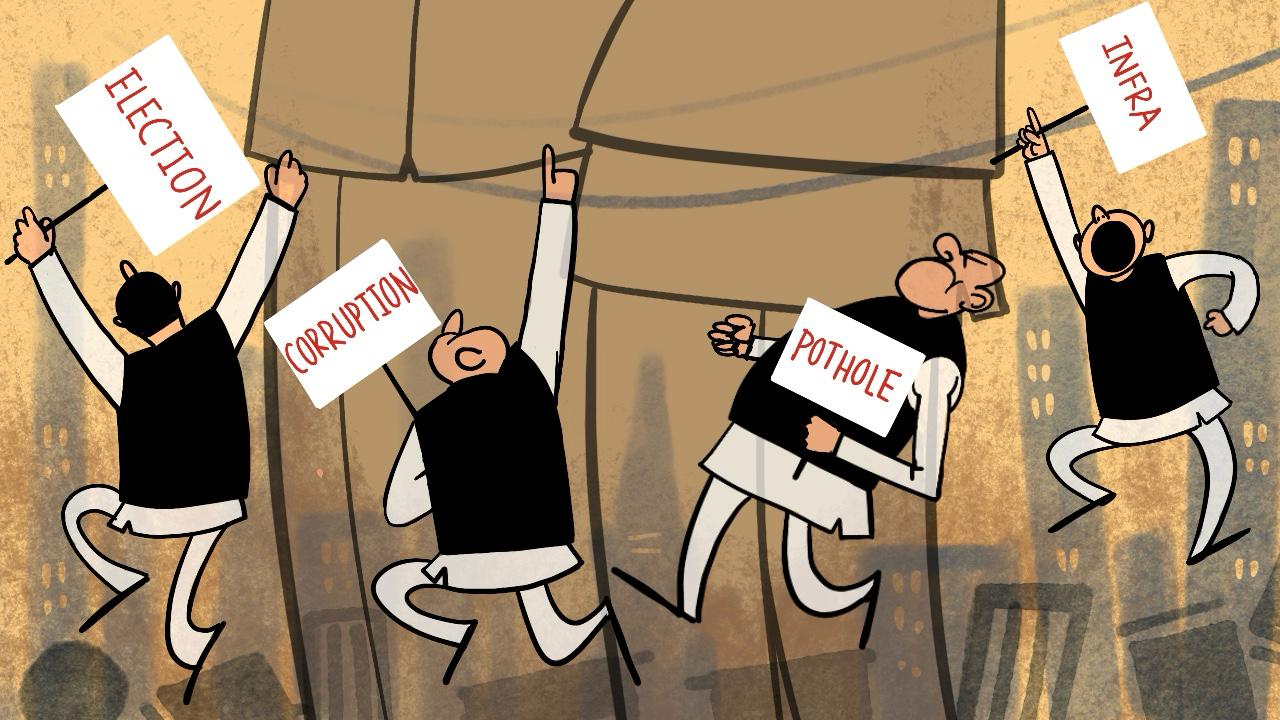
GBA election.
Synopsis: Several smaller parties such as the Bengaluru NavaNirmana Party (BNP), Karnataka Rashtra Samithi (KRS) and the Aam Aadmi Party (AAP) are hoping to challenge the dominance of the Congress, BJP and JD(S) at the long-delayed local body elections in Bengaluru, due by the end of June. Each is banking on specific local issues to make its pitch to voters. Party leaders say the new Greater Bengaluru Authority structure and an increase in wards from 198 to 369 make it easier for them to campaign locally and reach voters.
The long overdue local body elections in Bengaluru are scheduled to be held by the end of June this year. But this time, elections to the Greater Bengaluru Authority (GBA), the successor to the Bengaluru Bruhat Mahanagara Palike (BBMP), will not be a triangular contest between the Congress, Bharatiya Janata Party (BJP) and the Janata Dal (Secular) [JD(S)], the three leading parties in the state.
Instead, citizens in the city will also get to pick corporators to their wards from a range of smaller parties such as the Bengaluru NavaNirmana Party (BNP), the Karnataka Rashtra Samithi (KRS) and the Karnataka unit of the Aam Aadmi Party (AAP), each preparing to enter the fray with targeted campaigns and platforms.
The last elections to the BBMP were held more than a decade ago, in 2015. The BJP secured 100 of the 198 seats even though the Congress was in power in the state under Chief Minister Siddaramaiah. But the Congress and JD(S) later joined hands to secure the posts of Mayor and Deputy Mayor.
The term of the last elected council ended in September 2020. Since then, bureaucrats have run the civic body with the tacit support of state legislators.
After the Congress returned to power in the state in May 2023, it brought in the Greater Bengaluru Governance Act, 2024, splitting the city’s civic administration into five city corporations, with a pan-city body, the GBA, led by the Chief Minister.
The state government notified ward delimitation for 369 wards, up from 198 under the BBMP, across the five city corporations on 20 November 2025, and released the draft ward-wise reservation list on 8 January 2026.
Leaders of smaller parties say the shift from fewer, larger wards with bigger populations to a larger number of smaller wards will give lesser-known parties an advantage. Smaller wards make it easier for them to campaign and build direct connections with voters.
Earlier this year, the Supreme Court set a deadline of 30 June 2026 for the polls, stressing that no further extensions would be given.
The BNP was formed in 2019 when a group of citizens came together with the aim of improving the city’s governance.
Its motto is “nanna nagara, nanna hemme, nanna jawabdari – My City! My Pride! My Responsibility!”
Unlike traditional political parties, BNP calls itself a citizen-centric, non-personality-driven political platform.
“Civic-minded residents who care deeply about Bengaluru have come together to improve their neighbourhoods, supported by common systems, processes, and governance frameworks developed by the party,” BNP told South First.
The party focuses exclusively on Bengaluru’s civic issues and does not contest MLA or MP elections. Over the last few years, BNP has raised its voice on day-to-day civic issues such as broken footpaths, potholes, waste management and the clean-up of electoral rolls.
For the upcoming corporation polls, BNP has launched Mission 50, aiming to win at least 50 of the 369 wards. Its strategy centres on Area Sabhas, neighbourhood-level platforms where residents take part directly in addressing local issues, BNP media coordinator Nandini told South First.
Each ward is typically divided into six to eight areas, with an Area Sabha for each. These sabhas include residents representing individual layouts, apartment complexes, streets and local clusters. The groups act as neighbourhood-level problem-solving units that address everyday civic concerns such as potholes, garbage blackspots and drainage issues.
The party says more than 100 Area Sabhas are already operating across Bengaluru, even without holding power.
BNP also says it has assisted residents with more than 5,000 e-Khata applications and helped another 5,000 citizens enrol for voter ID cards through its Kevala Mathavalla camps. The party has also supported residents in accessing services such as Nimma Arogya, cyber safety assistance and ward-level grievance mechanisms.
Another relatively small entrant to the electoral fray is the Karnataka Rashtra Samithi (KRS), founded by Ravi Krishna Reddy in 2019.
Reddy had earlier contested elections as an independent, then with the Lok Satta Party, and later the Aam Aadmi Party before launching KRS as an alternative political platform. The party emerged from several office bearers of the Corruption-Free Karnataka Nirman Vedike, which Reddy founded in 2016.
Since its inception, KRS has conducted what it calls a “Corruption-Free Campaign” on the ground, carrying out social audits and sting operations to expose corruption in government offices across the state. The party says these efforts have led to the suspension of several officials and helped address grievances of citizens facing bureaucratic harassment.
In one such protest in 2021, KRS members attempted to hand undergarments to police officials after visuals surfaced of policemen accepting gifts from BJP leader Muniraju.
Although the party has contested elections before, it has not made much headway in vote share.
Joint Secretary and Media Coordinator Jeevan told South First that corruption will remain the party’s main electoral plank in the upcoming elections. “We will also raise concerns about potholes and civic infrastructure. We are also looking at the possibility of forming an alliance with another smaller party if they are also interested. We are still working on this,” Jeevan said.
The Aam Aadmi Party has built a strong presence in states such as Delhi and Punjab but has struggled in Karnataka since its debut in the 2018 Assembly polls.
Ahead of the 2023 Assembly elections, the state unit revamped its leadership. Prithvi Reddy continued as state president, while former IPS officer Bhaskar Rao became chairman of the manifesto committee and Brijesh Kalappa took charge as communications in-charge.
But the restructuring did little to improve the party’s electoral performance. NOTA received a higher vote share at 0.69 percent than the party’s 0.58 percent.
Almost three years after that defeat, the state unit of AAP is hoping to test its fortunes in the state in the GBA elections.
“When the last elections to the BBMP were announced in 2015, it was very sudden. We had no time to prepare so we decided not to contest. But this time we are fully prepared,” Sitaram Gundappa, AAP’s state working president, told South First.
In November 2025, the party announced a 27-member GBA Election Coordination Committee.
“Our primary objective is to deliver world-class public education, healthcare, and civic infrastructure to every resident through accountable governance,” AAP National Joint Secretary Prithvi Reddy had earlier told the Hindu.
Gundappa said the party plans to highlight issues such as poor road conditions during the campaign, pointing to several recent deaths linked to pothole-ridden roads.
These include the death of a 22-year-old college student in September 2025 after a tipper truck knocked her down and crushed her while she tried to avoid a pothole near Budigere Cross.
A month later, a 26-year-old woman riding pillion on her brother’s scooter was crushed by a truck after she fell. Several media reports attributed the fall to a damaged road surface that caused the scooter to skid, although police denied that potholes caused her death.
“We want to highlight these during our campaign,” Gundappa said.
Party leaders also said anti-corruption will be a key electoral plank. They pointed to the alleged corruption citizens face while obtaining caste, death or income certificates from the civic body.
In October 2025, a viral LinkedIn post by Sivakumar K, former Chief Financial Officer of Bharat Petroleum Corporation Limited, alleged a chain of exploitation involving ambulance staff, police personnel, crematorium workers and civic officials while obtaining a death certificate.
Gundappa also said the party is bolstered by a recent Delhi court verdict discharging former Delhi Chief Minister Arvind Kejriwal, his deputy Manish Sisodia and 21 others in the alleged excise policy corruption case. Kejriwal, Sisodia and AAP spokesperson Sanjay Singh were arrested in the case and held in jail for several months.
“We have done it before in Delhi and Punjab. We will do it here as well,” he added.
(Edited by Dese Gowda)


