

Published Jan 17, 2024 | 10:00 AM ⚊ Updated Jan 17, 2024 | 10:00 AM

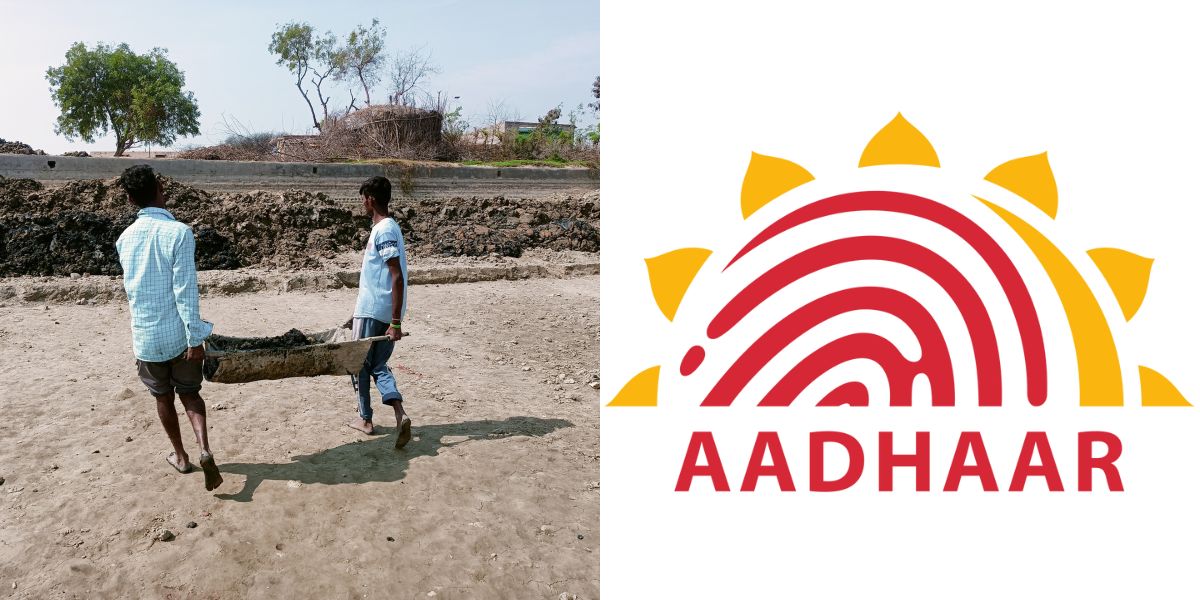
(Representational image/Creative Commons)

The Union government’s decision to make the Aadhaar-Based Payment System (ABPS) mandatory for Mahatma Gandhi National Rural Employment Guarantee Scheme (MGNREGS) workers from 1 January, has evoked mixed reactions in Karnataka.
Beneficiaries — mostly farmers who are already enrolled for the scheme — say it is a welcome development.
However, farmers’ union leaders are apprehensive: Will gram-panchayat level members, panchayat development officers (PDOs), or the elected president of the gram panchayat facilitate the ABPS so easily without expecting any benefit for themselves?
“All this while, gram-panchayat members, PDOs and the elected representatives would facilitate job cards for their own kith and kin, friends and relatives, and would always sideline people who questioned them or agitated for their rights,” Shivaputragouda, a farmers’ union president from the Lingasugur town in the Raichur district, told South First.
He added that until now, even he had no details about his job card or its number. He had applied for the MGNREGS along with his daughter-in-law. They have no idea about what happened to her job card either.
Shivaputragouda explained the MGNREG scheme operational at his village in brief, citing the example of a small pond project for which a billing of ₹19,000 was made.
“We had to grease the palms of everyone — from ₹500 to the computer operator, to another ₹500 to the gram panchayat member, ₹1,000 to the PDO, and ₹1,000 to the gram panchayat president,” he alleged.
“Other lower-ranking gram-panchayat workers also have to be kept ‘happy’. A job card holder who will also be a contractor will have to forego nearly ₹4,000 for every project worth ₹20,000,” Shivaputragouda told South First.
The Mahatma Gandhi National Rural Employment Guarantee Act was passed on 23 August, 2005.
It was officially launched on 2 February, 2006, as the National Rural Employment Guarantee Act (NREGA) in 200 chosen backward districts of India.
As of April 1, 2007, it had been extended to an additional 130 districts. Later, beginning 1 April, 2008, coverage began for the remaining 285 districts.
NREGA was renamed MGNREGA by the National Rural Employment Guarantee (Amendment) Act of 2009. The work is usually on projects to build durable assets like roads, canals, ponds, and wells.
MGNREGA was conceived and implemented as a labour law that would guarantee the “right to work” for the unemployed and underprivileged sections of society in the country.
The scheme provides employment opportunities to agricultural labourers during the lean season — especially drought conditions. It also aims to help alleviate poverty and enhance livelihood security in rural areas.
It provides for a legal guarantee of at least 100 days of unskilled-wage employment in a financial year to rural households whose adult members are willing to engage in unskilled manual work at a predetermined minimum wage rate.
The objectives of the scheme are to enhance the livelihood security of the rural poor by generating wage employment opportunities and to create a rural asset base that would enhance productive ways of employment.
The Union Ministry of Rural Development (MRD) has been monitoring the entire implementation of this scheme in association with state governments.
Adults in rural households provide the gram panchayat with their name, age, address, and photo. Following inquiries, the gram panchayat registers homes and provides an employment card.
The information about an enrolled adult member, including his or her picture, is on the job card.
The registered person may write to the panchayat or the programme officer (PO) to request employment — for at least 14 days of continuous work.
The panchayat or PO will accept a legitimate application and issue a dated receipt of it. A letter outlining the applicant’s duties will be delivered to them as well as displayed in the panchayat office.
Employment will be offered within a 5 km radius of the job site. If it is farther than that, extra pay will be given.
Abhay Kumar, a leader of the community-based agriculture workers’ organisation Grameena Kooli Kaarmikara Sanghatane (GRAKOOS), told South First that a large number of MGNREGS workers were going to lose out on this scheme if the linking of their Aadhaar cards was made mandatory.
“In Karnataka, the government has to be more lenient towards farmers this year as the state is reeling under drought. One has to root out corruption, but you cannot root out corruption just by linking the beneficiaries’ Aadhaar cards,” he said.
“The main issue here is that the MGNREGS has to be implemented with a budget allocation of ₹1.8 lakh crore. This budgetary figure was arrived at after thoroughly calculating the rural population and the unemployment rate prevalent in more than 330 districts in the country. The government’s own agency conducted an economic survey and the report stated that the MGNREGS would require at least ₹1.1-1.2 lakh crore budgetary allocation, he noted.
“However, the Union finance minister declared in the previous Union budget only ₹60,000 crore for the scheme for which we all sat for a protest at Jantar Mantar in New Delhi, after which another ₹27,000 crore was approved,” Abhay Kumar told South First.
“When unemployed rural people tell the government that they would need three rotis to fill their stomach, the present government offers only one,” he alleged.
As for the new rule, he noted: “It all depends on the state government. In South and West India, around 10-15 percent of MGNREGS beneficiaries would be losing out on getting money from this scheme with the linking of Aadhaar cards being made mandatory. A large number of MGNREGS-enrolled people — around 40-50 percent — will lose out in eastern and the northern parts of India.”
Pavan Kumar Malapati is the commissioner for Rural Development (MGNREGS) at Karnataka’s Rural Development and Panchayati Raj (RDPR) Department.
He told South First that Aadhaar-linking being made mandatory for MGNREGS workers would not affect Karnataka’s MGNREGS workers as 99 percent of seeding had already been completed.
The validation and confirmation processes were pending for only around 20,000-30,000 job cards, and these would also be completed soon, he added.
“According to the data available with the RDPR Department, more than 80 lakh active job card holders have been ABPS-enabled and around 20,000 job cards are pending with issues of account mismatch or duplication of accounts,” he confirmed.
“In case of duplication, deletion is being done and the validation and confirmation processes are also being carried out for the already-seeded job card accounts,” Malapati told South First.



