

Published Nov 12, 2022 | 6:03 PM ⚊ Updated Nov 12, 2022 | 6:47 PM

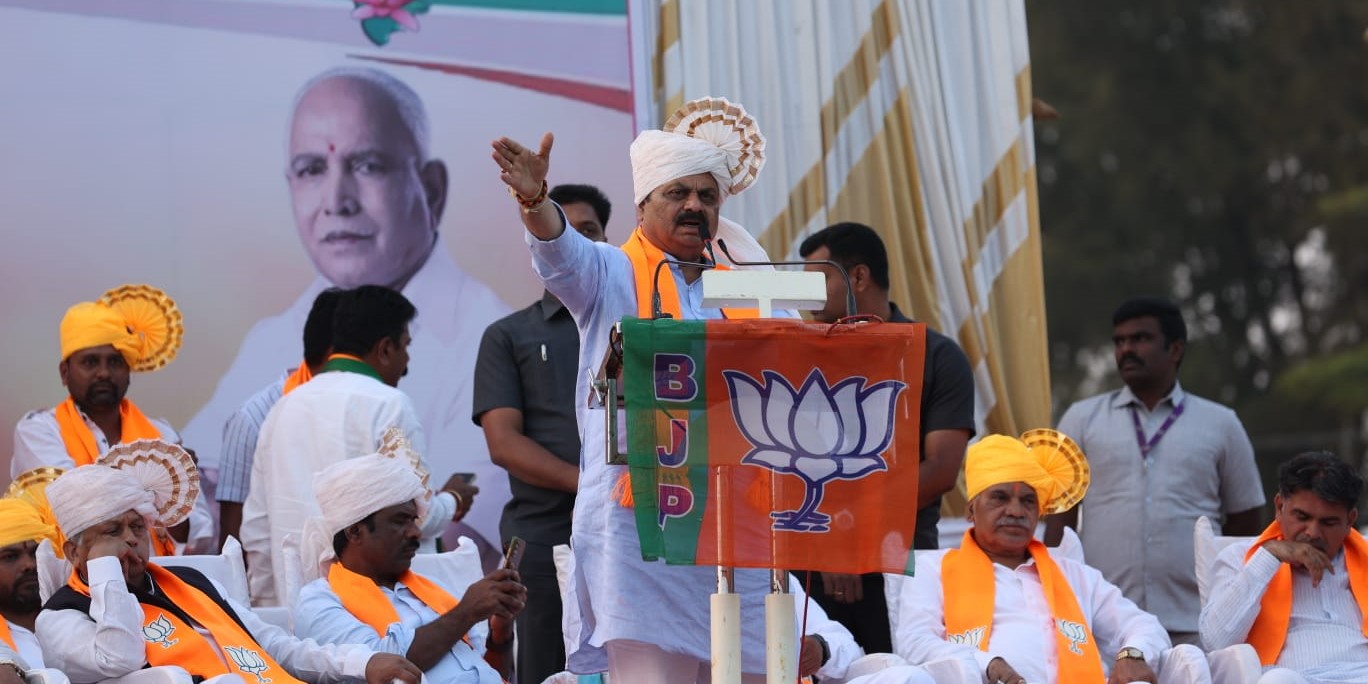
Karnataka Chief Minister Basavaraj Bommai at a Jana Sankalpa Yatra event in the Belagavi district on Wednesday, 9 November, 2022. (BSBommai/Twitter)

The ruling BJP’s Jana Sankalpa Yatra, which started on 11 October, just before the Dasara festivities, has as of now covered around 53 constituencies — out of the target of 150 — among the total 224 in Karnataka.
With a special focus on Dalits and Other Backward Classes (OBCs), especially after a show of strength at Congress leader Siddaramaiah’s 75th birthday celebrations, the BJP has enhanced its outreach programme ahead of the Assembly elections in Karnataka next year.
By the end of January next year, the three core teams of the BJP — including the ones led by Chief Minister Basavaraj Bommai and veteran BS Yediyurappa — are hopeful of completing the Jana Sankalpa Yatra in the other constituencies.
The focus is largely on 150 seats where the party believes it needs more strength at the grassroots level.
“Our team led by Arun Singh, national general secretary in charge of Karnataka, has covered eight districts so far. We have visited 16 constituencies,” said Karnataka BJP general secretary Siddaraju.
The team led by Bommai and BJP Parliamentary Board member Yediyurappa has covered 15 constituencies in the state.
The team led by Karnataka BJP president Nalin Kumar Kateel, supervised by state BJP general secretary Mahesh Tenginkai, has so far covered around 22 constituencies.
While party leaders insist that they aren’t appealing to any specific section of society, special rallies focusing on OBCs and photo-ops of BJP leaders visiting Dalit homes to share a meal suggest otherwise.
“We don’t have to woo anyone in particular, but the target is to strengthen our position in seats where we lost the last election,” Siddarajau said.
“We are more focused on conducting meetings with the booth-level officers, booth presidents, mandal committee members, and others like pancharatnas, shakti kendras and mahashakti kendras,” he added.
Other than special rallies, the party is also going door to door to distribute a booklet of Central and state schemes. “We are also holding rallies and meet-ups with beneficiaries of our welfare schemes,” Siddaraju said.
“We organised the Bommai government’s first-year anniversary celebrations in Chikkaballapur, a seat where the BJP doesn’t have a lot of cadres. A second major programme was the OBC Convention that happened in Kalaburagi on 30 October,” Karnataka BJP general secretary Ravi Kumar told South First.
“We focused on constituencies like rural Kalaburagi, Shorapur, Aurad, Hoovina Hadagali, Shiralakoppa, and Kushtagi,” he added.
The party plans a few more major programmes. “The Scheduled Tribes’ (ST) Convention in Ballari will be held on 20 November, and the Scheduled Castes’ Convention has been slated for 30 November in Mysuru. The focus of these conventions is to reach out to the most backward classes and marginalised classes, like the Koli community. Other outreach programmes of the Jana Sankalpa Yatra will be held in December and January ahead of the elections,” Ravi Kumar told South First.
Incidentally, Ballari and Mysuru are also the districts where the Congress’ Bharat Jodo Yatra, led by Rahul Gandhi, saw huge success.
The BJP’s yatra hopes to mobilise 10 lakh people for the ST Convention in Ballari. Despite the Congress’ jibes that chairs were empty in the OBC convention in Kalaburagi, the BJP anticipates 5 lakh footfalls.

Karnataka Chief Minister Basavaraj Bommai and BJP veteran BS Yediyurappa at a Dalit family’s house in the Vijayapura district on 12 October, 2022. (Supplied)
While BJP is showcasing its leaders visiting Dalit homes with much pomp, Dalit activists are not on the same page.
Dalit rights activist Mariswamy told South First that there should be a scientific study or a survey at least to determine whether governmental schemes genuinely reached the target beneficiaries.
“Whether it is the BJP, the Congress or any party, those visiting Dalit homes ahead of elections are only demeaning us by showcasing us like props. They do not realise that the families sometimes feel more insulted after the politicians’ visits, which become the talk in their village,” said Y Mariswamy, a Bengaluru-based Dalit rights activist and state general secretary of the Samajikka Parivarthana Janandhona (People’s Movement for Social Transformation).
“A good idea would be for these politicians to actually invite Dalit families to their plush homes, feed them, and interact with them about their well-being,” he explained.
“One other real concern is that the caste crimes or atrocities against SC/ST communities are not decreasing. They continue to happen at the same rate, and sexual crimes against Dalit women are on the rise,” said Mariswamy.
“If a government is serious about caste crimes and atrocities, it should have its administration, the police, and the judiciary look into such cases and take stringent action against the convicts, which is not happening,” he added.
Political scientist, analyst, and observer Sandeep Shastri told South First that Dalits, SCs, STs, and OBCs have been a regular target of not only the BJP, but every party in their election campaigns.
“This is because their votes can make a major difference in the way an election swings. The question is whether the BJP as a ruling party would be evaluated in terms of its performance by the voters,” said Shastri.
“Usually, the trend is that the Dalit Left supports the BJP and the Dalit Right supports the Congress,” he explained.
While the BJP is hopeful that beneficiaries of Central and state schemes introduced by its governments would show their electoral support to the party, political analysts warn it may not be as simple.
“A Sindagi, Hubballi, or a Hassan Dalit family becoming beneficiaries of multiple governmental schemes can only be an exception and not an example,” said Shastri.
In the run-up to the Assembly elections, the ruling BJP is leaving no stone unturned to tap into all sections of the electorate, but it remains to be seen if the ruling party can project its achievements as a ticket to win the polls, especially given the popular “PayCM” and “40% commission government” campaigns run by the Congress highlighting the Karnataka regime’s failures.



