

Published Oct 11, 2026 | 5:46 PM ⚊ Updated Oct 11, 2026 | 5:46 PM

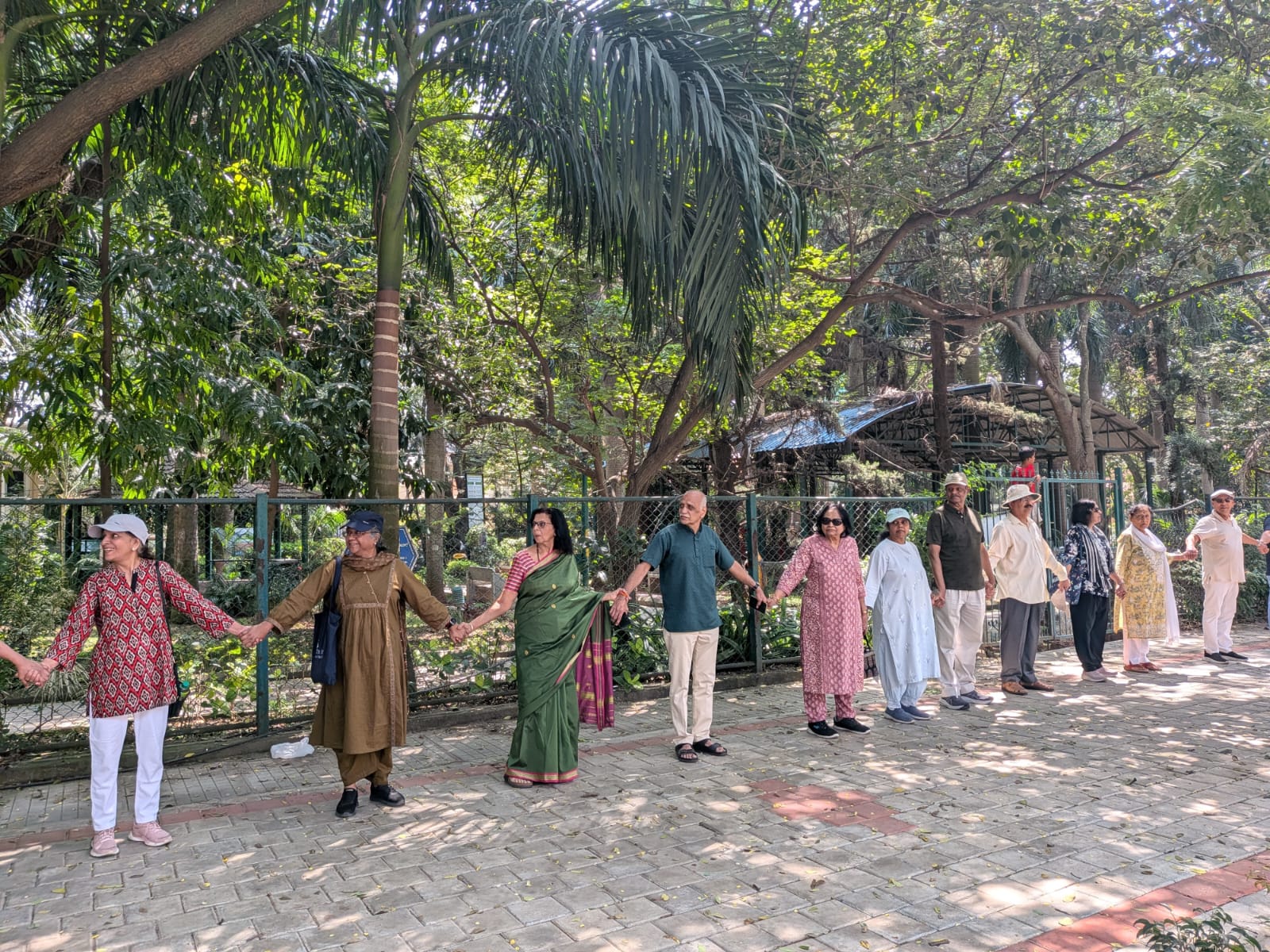
Participants included residents of Vaishnavi Paradise, Adarsh Residency and Adarsh Gardens, along with other concerned citizens.

Synopsis: Over 100 residents formed a human chain near Rose Garden Junction on Sunday, October 11, opposing the proposed 17.08-km elevated corridor. They raised concerns over land acquisition, access to apartment complexes, risks to water pipelines and loss of green cover, while urging authorities to prioritise public transport and last-mile Metro connectivity.
On a cool Sunday morning in Bengaluru, more than 100 people formed a human chain near Rose Garden Junction, close to RV Road Metro station, demanding that the proposed Ragigudda–Thalaghattapura Elevated Corridor be scrapped.
The protest took place around 11 am on October 11. Participants included residents of Vaishnavi Paradise, Adarsh Residency and Adarsh Gardens, along with other concerned citizens.
“Pillars on the Pipeline? Risky Plan,” read one placard. Another read: “Concrete above, crisis below. Let’s not gamble with Bengaluru’s water.”
The proposed corridor, being planned by Bengaluru Smart Infrastructure Limited (B-SMILE), would connect Marenahalli Main Road at Ragigudda to Kanakapura Road near Thalaghattapura NICE Road, running along the Bangalore Water Supply and Sewerage Board (BWSSB) pipeline corridor.
This comes amid wider opposition to B-SMILE’s proposed elevated corridors across Bengaluru.
Indiranagar witnessed similar protests on Sunday, with residents and activists forming a human chain along 100 Feet Road and CMH Road to demand the cancellation of the proposed Old Madras Road–Silk Board elevated corridor.
According to the detailed project report (DPR) accessed by South First, the proposed elevated corridor spans approximately 17.08 km, including entry and exit ramps, and passes through eight major junctions, including Rose Garden, ISKCON and Gubbalala.
The DPR estimates Rs 489.4 crore for land and structure acquisition. The proposed road is aimed at easing traffic congestion along the Kanakapura Road between the Silk Board side and NICE Road junction.
However, the DPR also acknowledges that inadequate public transport and mass rapid transit facilities are among the factors that have contributed to Bengaluru’s growing traffic congestion.
It projects peak-hour traffic at Rose Garden Junction to rise from 6,169 Passenger Car Units (PCUs) in 2025 to 11,599 by 2035.
Rupa Rangaswamy, a resident of Vaishnavi Paradise, expressed concern that the proposed corridor would affect access to her apartment complex, claiming that its alignment passed directly through the driveway.
“It goes right through our driveway. So I don’t know if they’re even thinking, how will we go to our basements?” she asked.
Describing Jayanagar as one of Bengaluru’s well-planned residential neighbourhoods, Rangaswamy said its tree-lined streets, parks and open spaces formed the heart and soul of the city. She feared these would be lost to the project.
“I think they are killing the heart and soul of the whole thing that they’ve taken effort to build, and hundreds of trees could be lost,” she said. However, the DPR estimates that around 75 trees would be felled.
She also highlighted poor last-mile Metro connectivity to JP Nagar and surrounding areas, which she said discouraged residents from relying on public transport.
Guruprasad D N, one of the protest organisers, questioned the rationale behind constructing an elevated corridor parallel to the Metro’s Green Line.
“Why do you need a corridor parallel to a green line that is already there?” he asked.
Guruprasad also raised concerns about the proposed alignment along the BWSSB pipeline corridor, claiming that construction could affect major Cauvery water pipelines supplying south Bengaluru. The DPR itself identifies major water supply pipelines along the proposed alignment.
Residents also feared that the corridor would threaten parks and green spaces along the pipeline road, including Rose Garden and green areas towards Thalaghattapura.
Emphasising that residents were not opposed to development, Guruprasad called for strengthening public transport instead of constructing additional elevated roads.
“We are not against development. We are telling the government to strengthen public transport. Because this is not a long-term solution. You are going to create another problem for us in the next five years,” he said.
Prithvi B, another resident, said the project could affect land belonging to three apartment complexes comprising around 500 flats.
He alleged that affected residents had not been adequately consulted and said they had approached BBMP and B-SMILE officials but had not received sufficient clarity on the project’s implications for their properties.
“Whoever is affected, they should bring them into the conversation,” Prithvi said, adding that residents were not opposed to development but wanted authorities to consider its impact on their lives and surroundings.
“If our concerns are not addressed, we will have to take the legal route and weigh our options,” he said.
Guruprasad said the residents planned to submit a formal representation to B-SMILE within the next two weeks, after consulting experts and examining the project’s impact.
(Edited by Fayisa CA)



