

Published Sep 15, 2026 | 3:30 PM ⚊ Updated Sep 16, 2026 | 8:14 AM

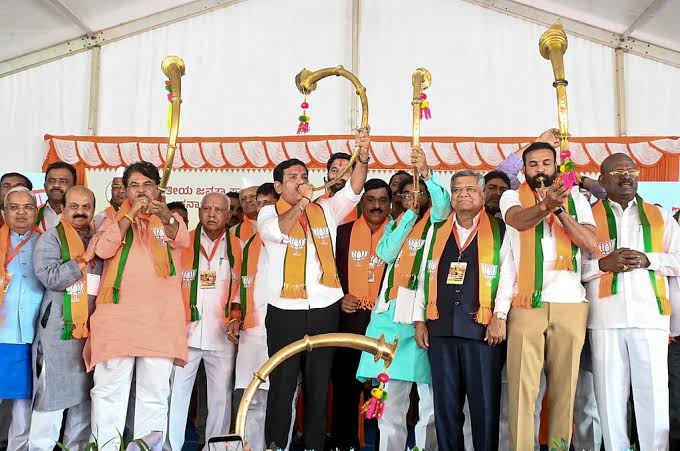
BJP leaders buried their differences and came together as the Ballari Chalo rally concluded.

Synopsis: The nearly 200-km Ballari Chalo padayatra gave Karnataka BJP president BY Vijayendra a chance to mobilise the cadre, bring senior leaders onto a common platform, and strengthen his leadership credentials. But questions over his dependence on BS Yediyurappa’s political influence, unresolved differences within the BJP and weak coordination with alliance partner JD(S) continue to test his position ahead of future elections.
The recently concluded Ballari Chalo padayatra (foot march) has helped the BJP, rocked by internal squabbles, present a united front under its Karnataka unit president BY Vijayendra.
However, the nearly 200-km rally also laid bare fissures in the BJP-JD(S) coalition, with the latter staying away from the 10-day event that concluded on 10 September.
At the padayatra‘s conclusion, the party’s senior leaders and former chief ministers, BS Yediyurappa and Basavaraj Bommai, the Leader of the Opposition R Ashoka, and the Opposition Leader in the Council, Chalavadi Narayanaswamy, shared the dais with Vijayendra.
The BJP rally was in protest against the alleged irregularities in the Valmiki Corporation and Karnataka Public Service Commission-organised recruitment exams, and the atrocities against SC/ST communities.
Also Read: Karnataka Minister Nagendra steps down ahead of BJP march
Since becoming the BJP’s state president in November 2023, Vijayendra has faced opposition from leaders including Basanagouda Patil Yatnal and KS Eshwarappa. They criticised dynastic politics and accused the leadership of sidelining senior figures.
Vijayendra is the son of senior party leader Yediyurappa.
Political analyst Harisha R said the march was as much about projecting unity within BJP—affected by leadership differences—as it was about attacking the Congress.
He felt the march allowed Vijayendra to mobilise the party cadre, increase his visibility and demonstrate his organisational ability ahead of the upcoming local body and 2028 Assembly elections.
Karnataka BJP chief spokesperson Ashwath Narayan Gowda acknowledged that differences among senior leaders had earlier affected organisational coordination. He said the Assembly session and Ballari Chalo had helped bring the leaders together and increased confidence in Vijayendra’s leadership.
Gowda cited Jagadish Shettar’s participation at the launch and Ananth Kumar Hegde’s at the concluding programme as evidence that senior leaders had rallied behind the campaign. Their presence, he said, “sent a message of unity to party workers, the BJP’s central leadership and the public”.
However, Harisha said the senior leaders’ participation was not sufficient to establish Vijayendra as an independent leader.
“Vijayendra, in my opinion, has not yet established himself as an independent leader and still benefits significantly from his father’s influence. The real success of the yatra should be measured by the votes gained, not by the number of leaders who joined,” he said.
He added that the BJP continued to face structural difficulties in rural areas and regions where the Congress and JD(S) remained stronger. The political value of Ballari Chalo, he said, would depend on whether its mobilisation translated into electoral gains
Harisha added that the choice of Ballari also carried regional and electoral significance. Four of the district’s five Assembly constituencies are reserved for Scheduled Tribes, while the BJP is seeking to expand its presence across Kalyana Karnataka.
Speaking on Vijayendra’s organisational and coordination within the party, Gowda said, “Vijayendra has adopted the organisational methods associated with his father Yediyurappa’s leadership, including padayatras, protests and cadre mobilisation.”
“Over the past six months, he has also improved coordination with senior leaders, district presidents and the party’s organisational team,” he added.
Gowda also acknowledged differences involving Leader of the Opposition Ashoka. He attributed these partly to competing leadership ambitions. Ashoka has recently expressed his ambition to become Chief Minister.
He said the BJP’s central leadership—not individual state leaders—is responsible for appointing the party’s leaders.
Harisha said the differences between Vijayendra and other leaders had been temporarily set aside for the party’s interests.
Gowda claimed that Vijayendra’s repeated visits and focus on regional issues had improved his visibility in Kalyana Karnataka. He said Vijayendra already had a stronger base in the Malnad region, including Shivamogga and Davanagere, as well as committed workers in parts of the Old Mysuru region.
“Vijayendra needs to sustain his leadership and effectively challenge the Congress government.“ If he does this well, combined with his personal appeal and his father’s support, he could also become a candidate for the chief minister post,” Harsha said.
Also Read: Vijayendra targets Congress over ‘five guarantees’
The padayatra also exposed continuing coordination issues between the BJP and its alliance partner, the JD(S), which had little visible participation in the march.
JD(S) MLC TA Sharavana said the party and its leader HD Kumaraswamy were not informed about the padayatra before the BJP proceeded with its preparations.
“We also did not receive any direction from the JD(S) leadership to participate in the final leg of the yatra,” he said.
While acknowledging a lack of coordination between the alliance partners, Sharavana said the BJP would require the JD(S)’s support in areas where it has a strong presence, particularly the Old Mysuru region.
Gowda admitted that neither party had designated a leader to maintain regular communication with the other. He said this absence contributed to the JD(S)’s absence from Ballari Chalo.
Harisha described the alliance as one of “political convenience”, arguing that the two parties did not necessarily depend on each other to achieve all their political objectives in Karnataka.
As the BJP prepares for another padayatra, this time against the Karnataka government’s directive restricting the rendition of Vande Mataram to its first two stanzas, the party is seeking to sustain the momentum generated by its recently concluded Ballari Chalo march. In contrast, Vijayendra seeks to consolidate his position within the party.



