


Published Jan 03, 2026 | 12:58 PM ⚊ Updated Jan 03, 2026 | 1:01 PM

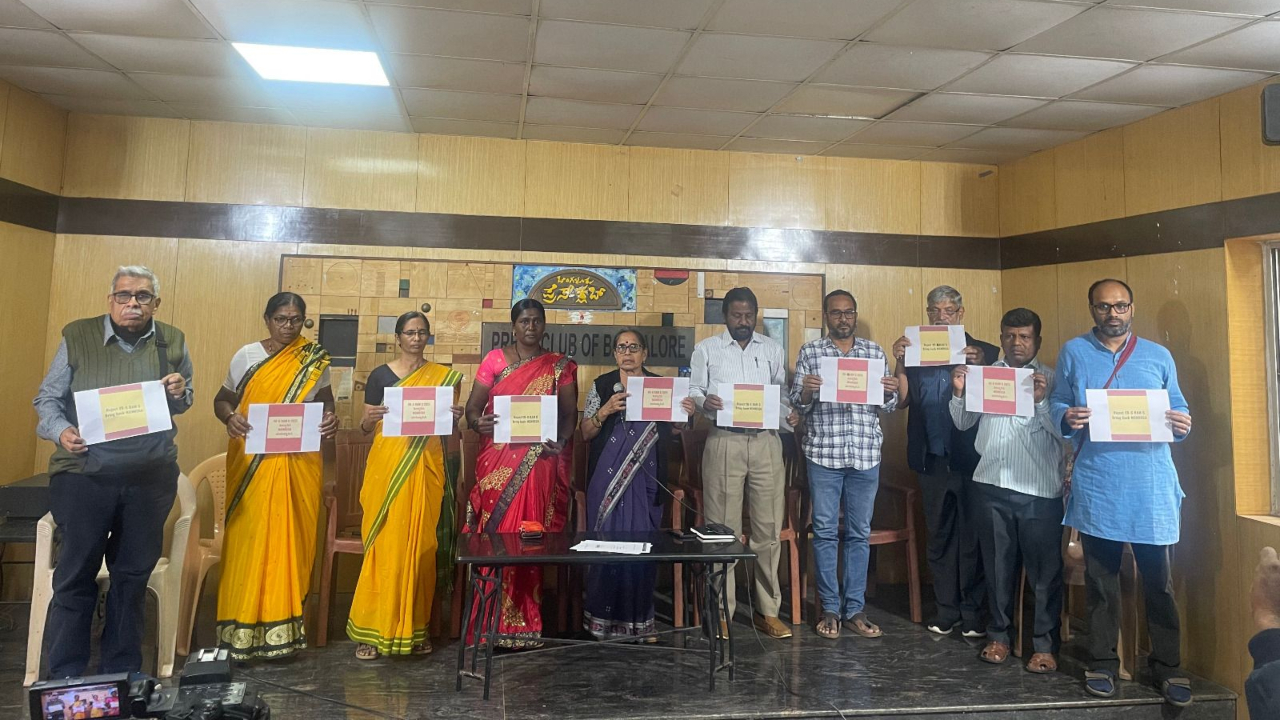
Speakers repeatedly described MGNREGA as a "right to survival," reiterating that guaranteed employment had provided a critical safety net for rural households. Credit: Anisha Reddy/South First
Synopsis: Workers and activists in Karnataka opposed the proposed VB–G RAM G Bill, warning it would repeal MGNREGA’s rights-based framework and burden states with a 60:40 funding model. They stressed MGNREGA’s role in empowering women, ensuring survival, and supporting households during crises. Critics said the new scheme increases exclusion, undermines federalism, and could force states to cut welfare guarantees.
“So many of us, especially unmarried women and widows, are able to find work because of MGNREGA. It allowed us to educate our children and survive as families,” said Guthamma, a MGNREGA worker from Haveri district in Karnataka.
Guthamma was among several workers, activists, and advocates who gathered at the Bengaluru Press Club on Friday, 2 January, to oppose the proposed Viksit Bharat Guarantee for Rozgar and Ajeevika Mission (Gramin) (VB–G RAM G) Bill and defend the Mahatma Gandhi National Rural Employment Guarantee Act (MGNREGA), 2005.
“It became the basis of our strength,” Guthamma said, explaining how MGNREGA empowered women by recognising work as a right. She warned that the proposed legislation would undermine this principle by stripping the scheme of its demand-driven nature, effectively weakening women’s right to employment.
On 15 December, with no prior consultation, the central government scheduled the introduction of the VB-G RAM G Bill, 2025 to repeal the MGNREGA. Although the bill proposes to increase the number of employment days from 100 to 125, it poses a higher financial burden on states — except Northeastern states, Himalayan states and Union Territories — with a 60:40 share of the fund allocation.
At the press conference, workers, activists and lawyers demanded the immediate withdrawal of the VB–G RAM G Bill, restoration of MGNREGA, and upholding federalism by ensuring states are not burdened with financial mandates without consent.
Speakers repeatedly described MGNREGA as a “right to survival,” reiterating that guaranteed employment had provided a critical safety net for rural households.
“It was like a weapon for us,” said Suvarna Kuthale of Jarutha Mahila Okkutta, Belagavi district. “Gram Sabhas came alive because of MGNREGA. The VB–G RAM G Act will kill that spirit.”
Mahantesh, a member of the Grameena Kooli Karmikara Sangha (GRAKOOS), highlighted how the scheme enabled rural workers across social and economic backgrounds to come together for equal work and wages. “During the COVID-19 pandemic, it was MGNREGA that acted as our saviour,” he said.
Empirical evidence supports these claims. A 2022 study by Azim Premji University, conducted in partnership with the National Consortium of Civil Society Organisations on MGNREGA and the Collaborative Research and Dissemination (CORD) network, observed that earnings from scheme compensated between 20 percent and 80 percent of income losses suffered by the most vulnerable households during this period.
Mahantesh, however, warned that the growing reliance on technology within the scheme had already begun to exclude workers.
“I was a migrant worker myself. Until 2014, we were able to access 100 days of work. Since then, technologies such as the NMMS attendance app, Aadhaar-based payments, face authentication and e-KYC have led to denial of both work and wages,” he said.
“Under the new scheme, these technological requirements will only increase, resulting in even greater exclusion,” he added.
Relaying these concerns, Nikhil Dey, founder of the Mazdoor Kisan Shakti Sangathan (MKSS) stated that the new Act is an assault on right to work. “It is an assault on their wages and makes cheap labour available like it was done in feudal times. People had to do whatever work they were asked to do in rural areas.”
Reiterating the collective demand for scrapping the proposed legislation, Guthamma said, “We want 200 days of work a year under MGNREGA, with daily wages of ₹500.”
When the MGNREGA, 2005 was introduced, every provision was debated in detail with workers, states and other stakeholders, said advocate Clifton D’Rozario at the press conference. In contrast, he alleged, the new VB–G RAM G Bill had been “bulldozed through” without consultation.
Rozario also flagged the significantly higher financial burden the new scheme would place on states. Under MGNREGA, expenditure followed a largely Centre-driven funding model: the Union government fully funded wage costs, bore a portion of administrative expenses, and covered 75 percent of material costs, with states contributing the remainder.
The new Bill changes this arrangement by introducing a 60:40 cost-sharing formula, requiring states to finance 40 percent of all expenditures.
“Under the new framework, the Centre will decide the state-wise normative allocations each financial year and even determine the villages where the scheme will be implemented,” Rozario said. The states will have virtually no authority, except the obligation to pay more, he added.
Experts also expressed concerns over increasing burden on the states at a time when they have very little leeway to raise their own revenue. “It (state’s revenue) is dependent upon what comes to it in the form of share of taxes, GST, and whatever transfer the Centre chooses to do,” said Vinod Vyasulu, an economist.
The NREGA Sangharsh Morcha provided a detailed breakdown of how much the state would have paid to run VB–G RAM G in Financial Year 2024-25, considering MGNREGA trends.
In FY24-25, only 36 percent of total registered households in Karnataka availed work, generating 13.12 crore person days. On an average, only 45 days of work were provided per active household. The state spent ₹573 crore for the scheme during that year.
If the state generated the same employment under the new Act, the state expenses would add up to ₹2729 crore, which is over four times higher than the expenditure under the original scheme.
“Even to maintain the same amount of work as was done in 2024-25, the Karnataka government would have had to find more money to do that. This places a lot of burden on the state,” Vyasulu said.
Considering that a significant portion of the state’s expenditure goes towards funding its flagship guarantee schemes, Vyasulu warned that the state could be asked to stop the guarantee schemes altogether and divert those funds towards the VB–G RAM G instead.
(Edited by Amit Vasudev)


