

Published Apr 07, 2026 | 8:00 AM ⚊ Updated Apr 07, 2026 | 8:00 AM

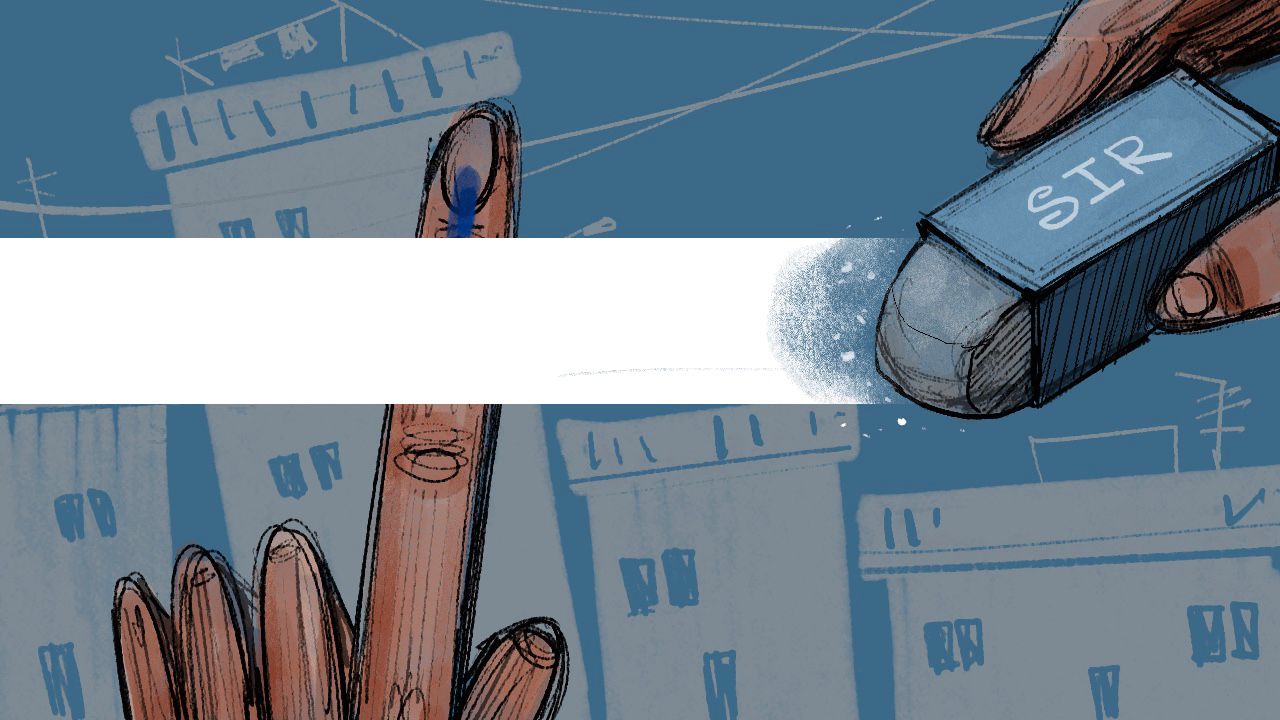
SIR Karnataka.
Synopsis: A pre-mapping exercise ahead of the yet-to-be-announced Special Intensive Revision of voter rolls in Karnataka has raised concerns among residents, particularly vulnerable groups, that they could be excluded due to missing records and, at times, lack of documents. Activists say documentary requirements may disproportionately affect women, especially those in inter-caste or inter-religion marriages. At the same time, the exercise, coming on the heels of back-to-back surveys in the state, is expected to take a heavy toll on frontline workers.
Even though the Special Intensive Revision (SIR) has not yet been formally announced in Karnataka, the ongoing pre-mapping exercise has sparked anxiety among several vulnerable communities, who fear the risk of being excluded.
Of the 5.57 crore electors in Karnataka, 4.46 crore have already been mapped as part of the ongoing voter roll mapping, Chief Electoral Officer Karnataka V Anbukumar told members of the coalition ‘My Vote, My Right’ recently.
The tabletop process involves verifying the details of existing voters against electoral rolls from 2002 to 2004, when the SIR was last carried out nationwide.
However, complaints have begun to surface from across the state, with many residents saying they could not find their names in the earlier rolls, often because they have since moved. One such area where these concerns have been flagged is Subhash Nagar in the Bengaluru South Assembly constituency.
In the locality, hundreds of voters listed across 10 booths in the 2025 electoral roll are now allegedly at risk of being deleted once the SIR is implemented.
Many of them, largely from low-income backgrounds, moved into the area after 2002, making it difficult for Booth Level Officers (BLOs) to map them against the older rolls.
“All of us live in rented homes and often, we are required to shift houses every few years. Most of the members of the community are also low-literate, and are finding it difficult to navigate through the voter rolls on the website on our own,” members of Domestic Workers’ Rights Union said in a complaint to the CEO Karnataka.
Most of the residents in the area work as domestic workers, garment workers, street vendors and construction workers.
At least 100 residents currently living in the area moved there from other parts of the city only after 2002, according to activists from the union and the ‘My Vote, My Right’ coalition, comprising several activists who have been opposing the proposed SIR exercise in the state.
They were also informed that voters who remain unmapped will be issued notices and required to produce one of the 11 documents listed in the SIR booklet issued by the CEO, Karnataka. These include passport, birth certificate, matriculation or educational certificate, identity cards, pension payment order issued to a regular employee or pensioner of any central government, state government or PSU, and any identity cards, certificates or documents issued by the Indian government, banks, local authorities or PCU, among others.
However, many residents in Subhash Nagar do not possess even one of the 11 documents accepted as proof of citizenship.
“Out of the 11, the only document most of them are likely to have is Aadhaar,” said Geeta Menon from the Domestic Workers’ Rights Union.
The Supreme Court on 8 September, 2025 had directed the ECI to accept Aadhaar, in addition to the 11 other documents specified under the SIR rules, as proof of identity of a person to enable him to file for inclusion in the electoral rolls of Bihar.
For SIR in Karnataka as well, Aadhaar will only be accepted and utilised as proof of identity and not as proof of citizenship. The voter will have to furnish another proof of citizenship from the 11 documents mentioned.
One of the voters from the area said they feared being quietly removed from the rolls, with little accountability, given their socio-economic status.
“If we are erased, no one will even notice or care because we are just wage workers. But we want our right to vote,” the voter said, on condition of anonymity.
She moved into the area ahead of the 2024 Lok Sabha elections in the state and had voted in that election as well.
“My name is there in the latest voter list. That is proof that I live here,” she said.
Another form of mapping that the ECI is relying on is ‘progeny mapping’, wherein BLOs check whether a voter’s (whose name does not appear in the 2002 list) parents’ or grandparents’ names appear in the 2002 voter list.
However, the app used by BLOs to carry out the mapping reportedly displays an error if a person is above the age of 40 years. This has led to the assumption that progeny mapping is only allowed for voters between the ages of 18 and 39 years, though no such age restriction is specified in official guidelines.
Activists who are part of the coalition pointed out that this kind of mapping becomes a major “exclusionary model” for women who have married against their family’s wishes, specifically in inter-caste and inter-religion marriages.
“For married women, they are required to produce details of their own entry in the 2002 voter lists or that of their parents/grandparents/siblings and demonstrate that they are that same person given the change in name post marriage,” the group said, adding that this requires coordination and assistance from their parents, who, in most cases, are also unable to navigate this system to get these details.
For now, help desks are being set up in such areas by activists to facilitate communication between BLOs and residents. BLOs plan to take concerns of voters to the State Election Commission, which had earlier said that it would examine such issues on a case-by-case basis.
Even as residents struggle with documentation and verification, the burden of implementing the exercise is falling heavily on frontline workers.
The exercise comes on the heels of back-to-back government surveys in the state, with anganwadi and ASHA workers deployed as BLOs.
Already underpaid and overburdened, these workers have been tasked with repeated door-to-door visits, explaining the survey process, guiding residents through questionnaires, and carrying out enumeration.
The ongoing mapping exercise for SIR has significantly added to their workload. They were instructed only in the first week of January to begin mapping and have been facing immense pressure from their supervisors to meet a target of mapping 1,200 to 1,500 households in 30 days, Menon told SouthFirst.
Additionally, all instructions have been given only via messages on WhatsApp groups.
In a letter to CEO Karnataka, the coalition ‘My Vote, My Right’ had raised this specific concern — how BLOs have received no written instructions, special training, guidelines or circulars specifying how the mapping of voter rolls must be done.
“We learnt that the only communication they were given were instructional videos shared in WhatsApp groups made for the coordination between BLOs,” the group said.
Targets have been set at around 80 percent completion in urban areas and 100 percent in rural regions. Several BLOs who have not met 30 percent of the target have reportedly received notices warning of termination from their regular roles.
Further, BLOs are expected to use their personal smartphones to carry out the mapping via an app. Many have said their devices lack the storage capacity or technical capability required to support such heavy work.
Sujatha, an anganwadi worker in Bengaluru, who was earlier deployed for Karnataka’s socio-economic and educational survey, Devadasi survey and another exercise to determine the number of gender minorities in the state last year, explained that the back-to-back exercises have kept them away from performing their regular duties.
“I haven’t been able to help the anganwadi centre with work related to the Integrated Child Development Services (ICDS) scheme for several days at a stretch,” she said.
Some of her core responsibilities on an average day are tracking pregnancies and ensuring women receive antenatal and postnatal care, running early childhood education activities for children, and providing supplementary nutrition to children.
Meanwhile, workers have also been called upon for the national census exercise. Some are afraid that their duties for SIR and the national census exercise could overlap. Despite this expanding workload, the compensation remains as low as Rs 7,000, often paid irregularly and in instalments, the union alleged.
While in some areas BLOs are going door-to-door to explain the SIR process and its implications to residents, Menon noted that they are expected to carry out these responsibilities flawlessly despite low pay and intense pressure. “So if there is a communication gap between the residents and BLOs about the process, the onus cannot be on the BLOs alone,” she pointed out.
Across the country, several instances of suicides by BLOs have been reported. A report by the SPECT Foundation, a non-profit research organisation, in December 2025, noted that at least 33 BLOs died by suicide or due to medical emergencies in six states. The report documented suicide notes and statements from families alleging that the deaths are linked to pressures faced by BLOs during SIR.
(Edited by Dese Gowda)


