

Published Mar 03, 2026 | 11:23 AM ⚊ Updated Mar 03, 2026 | 11:23 AM

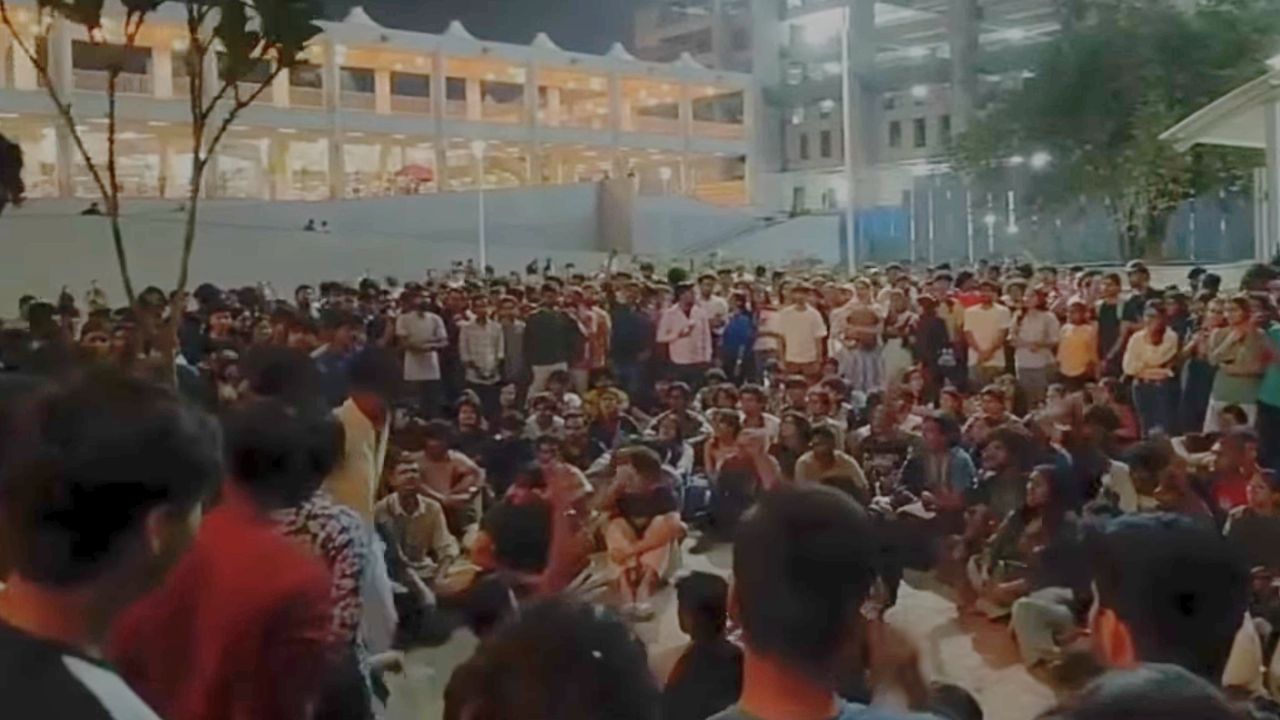
Azim Premji University students protested against the ABVP attack.
Synopsis: Azim Premji University in Bengaluru recently filed a police complaint against its own students for organising a discussion without the administration’s approval. The university’s complaint follows an incident of vandalism and an attack on a student, allegedly by the members of the ABVP, over a planned discussion on the campus. Students and activists condemned the university’s decision to file an FIR against its own students.
Azim Premji University in Bengaluru recently filed a police complaint against its own students for organising a discussion without the administration’s approval, although it had earlier claimed that such an event did not take place.
The university’s complaint follows an incident of vandalism and an attack on a student, allegedly by the members of the Akhil Bharatiya Vidyarthi Parishad (ABVP), over the event, a discussion on the alleged Kunan-Poshpora mass rape incident of 1991 in Kashmir.
Even though cases were registered against ABVP members as well, the charges against them are bailable, and those invoked against the students are of a serious nature.
In 2020, at the height of nationwide resistance against the Citizenship Amendment Act and National Register of Citizens (CAA-NRC), at least 100 persons, including students and teachers at the university, held a protest condemning the law and the violence unleashed on students of JNU and Jamia Millia Islamia.
University faculty had also released a detailed statement, criticising the “unconstitutional” provisions and standing in solidarity with all those peaceful protestors who are exercising their constitutional right to dissent.
However, six years later, the university administration filed an FIR against its own students for a similar form of dissent.
On 24 February, the All India Student Association (AISA) backed Spark Reading Circle had planned a discussion on “violence by the Indian State in Kashmir” at 6 pm on the university campus and invited people through its Instagram page.
On that day, ABVP members barged into the campus, vandalised and damaged property in an attempt to silence the discussion, and beat up a student as well.
While ABVP members were detained and charged with bailable offences by the Bengaluru police, the university, in a rare move, filed an FIR against its own students who were part of the circle, claiming that no permission had been sought or granted for any such event.
However, just days before initiating this criminal action, the university, in its statement, had condemned the violence unleashed on its students and stated that the concerned event did not take place.
“We acknowledge that organising a campus event without prior administrative approval may constitute a breach of University protocol. However, the Student Council is of the view that such a breach is best addressed through the University’s own internal mechanisms, such as the Disciplinary Committee, rather than through an FIR,” the Student Council of the university said in a statement.
The University, in its police complaint, sought to distance itself from the Spark Reading Circle, claiming that the group was not registered with the institution.
They alleged that unknown individuals had created the account and misused the university’s name to circulate content that could incite enmity and hatred between groups. The complaint, filed by University Registrar Rishikesh BS, further claimed that the social media handle had previously posted content allegedly defaming the university and harming its reputation.
The university also alleged that the group had not taken permission from the authorities concerned before holding the event. “I asked our academic staff if they had knowledge of any such event, because such programmes need to have written permission from us, but no one asked for it, and we never gave it,” the registrar stated.
When contacted, Azim Premji University authorities told South First, “The university has processes to engage directly with students in these matters. We will continue to do that. We have nothing more to add.”
The escalation to criminal action against its students marked a departure from its initial statement soon after violence was unleashed on campus. “This event, which was allegedly planned by a small group of students, did not happen at all. We strongly condemn the ruckus and violence that was unleashed on our campus by this external group of people,” the statement had said.
The university did not specifically respond to South First‘s query about why criminal action was initiated when they claimed that the event had not taken place.
The FIR, which doesn’t list the students by name, but instead refers broadly to the Spark Reading Circle, invokes Sections 299 (deliberate and malicious acts intended to outrage religious feelings of any class by insulting its religion or beliefs) of the Bharatiya Nyaya Sanhita (BNS), 66e (violation of privacy by intentionally capturing, publishing, or transmitting images of a person’s private areas without their consent), and 67 ( publishing or transmitting obscene material in electronic form) of IT Act.
Azim Premji University students have raised concerns that the manner in which the FIR has been drafted leaves room for sweeping police action. Since the complaint names the entire Reading Circle rather than specific individuals, they fear it could expose multiple students to investigation or arrest.
Students of Azim Premji University, along with activists and civil rights groups, strongly condemned the university’s decision to file an FIR, calling it an “asymmetry” in outcomes that have followed the events over the past few days.
“Those who entered this campus uninvited, caused physical harm to members of our community, and damaged university property have been granted bail and face bailable charges. Meanwhile, our students who organised a peaceful gathering, whatever the procedural lapses, are now subject to a non-bailable offence under Section 299,” a statement from the student council said.
Echoing these concerns, Bahutva Karnataka, a civil society group and citizens’ rights forum, alleged that the university’s actions amounted to equating vandalism perpetuated on students, employees and premises to the initiative taken by students to organise an internal meeting to discuss “critical ideas and issues”.
Across multiple statements, student bodies and civil society groups acknowledged that not seeking official permission from the event might have constituted a procedural lapse, but it does not amount to a criminal charge. “As noted by your University’s Student Council, punishment should be proportionate to the action that we understand was merely a procedural lapse, while the vandalism was clearly a criminal violation,” Bahutva Karnataka said.
AISA Bengaluru General Secretary Aratrika told South First that even registered clubs find it difficult to secure permission from faculty in-charges for “minimally controversial” events. “Spark Reading Circle is not a registered club at APU. All the studies and events happen without prior permission,” she said.
Aratrika also pointed out that this is not the first time that the University has created obstacles for students who were seeking to organise events. The first such “summons”, she recalled, was in 2023 when the Reading Circle planned to organise a march and candlelight vigil remembering slain journalist Gauri Lankesh.
“They particularly objected to the use of the Azim Premji University’s name, so students removed that and went ahead with the event,” she said.
Students pointed out that the university, through its academic courses, actively encourages critical engagement with history, politics, and social justice. In the past, students have openly expressed their political positions on campus.
For example, in October 2025, the graduating batch of APU, at their convocation, wore stickers calling for an end to the ties between Wipro and Tel Aviv. The symbolic protest referred to the university’s alleged collaboration with Tel Aviv University, and to business links between Israel and Wipro, the multinational firm founded and run by Azim Premji and his family.
In an Instagram post at the time, the Reading Circle claimed that the display of the stickers was opposed by certain faculty members. Despite this, the group said students remained “staunch” in expressing their solidarity
“We are taught to ask hard questions, and have considered the university to be a safe space for open discussions. For the administration to respond to students doing exactly that with a criminal FIR undermines the very intellectual freedom this institution is founded on,” the student council said.
The incident at Azim Premji University and the subsequent criminal action follow a larger pattern across universities in the country. In fact, it has now been over a decade since several students from JNU were charged with sedition and arrested after holding a rally against the hanging of Mohammed Afzal Guru, a Kashmiri separatist convicted over the 2001 attack on India’s parliament. The trial for the case has still not begun.
In 2024, several students who protested at Banaras Hindu University over the alleged gang-rape of an IIT-BHU student were suspended for disturbing the “academic ambience.”
In 2025, five students from Ambedkar University Delhi were suspended by the university administration following protests in connection with an alleged ragging incident. They were accused of “indiscipline” and “disrupting university functioning.”
Incidentally, a day ahead of clashes at Azim Premji University, Jawaharlal Nehru University (JNU) in Delhi witnessed similar clashes on 22 February between Left-backed unions and ABVP.
The Jawaharlal Nehru University Students’ Union (JNUSU) had called for an “Equality March” seeking the resignation of the Vice-Chancellor over what they described as “casteist” remarks made during a podcast. While both sides have engaged in a blame game, the attacks left several students injured.
(Edited by Muhammed Fazil.)


