
Published Nov 20, 2026 | 7:00 AM ⚊ Updated Nov 20, 2026 | 7:00 AM

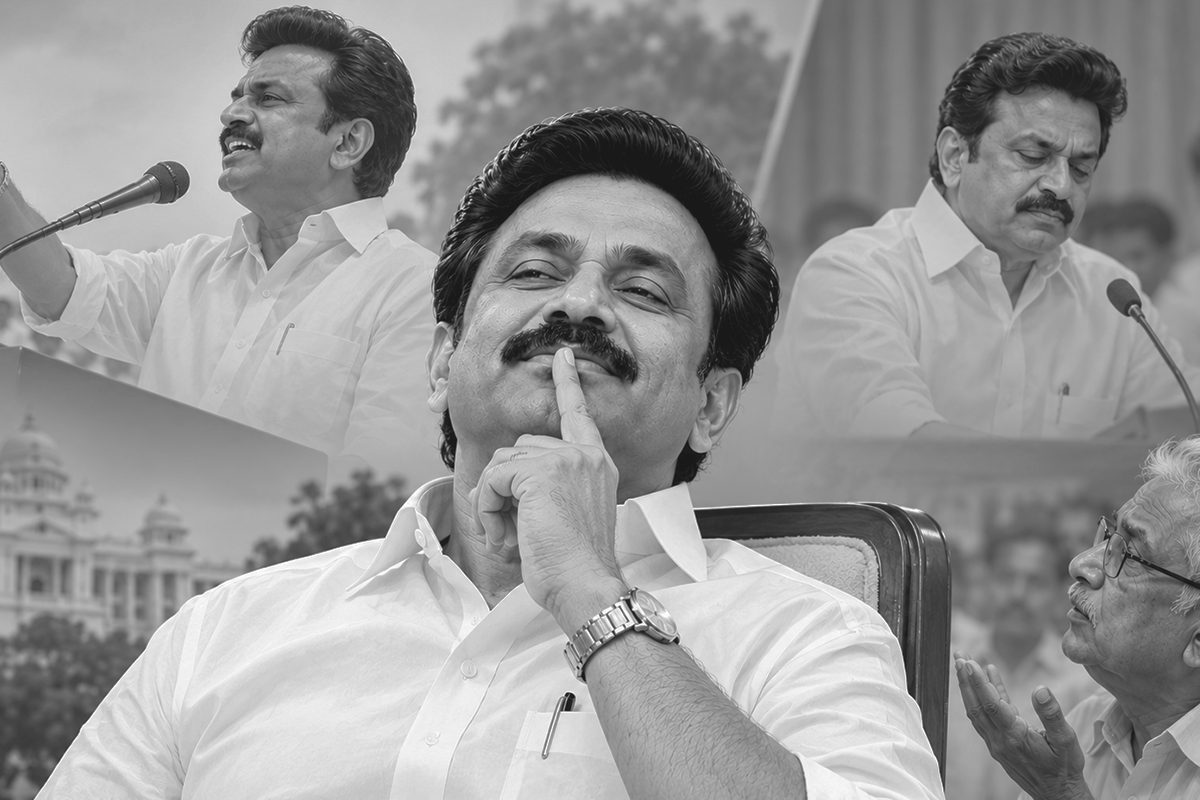
Image used for representational purpose. (Ai generated image)

There was once a Chief Minister who discovered a revolutionary method of governance. He called it Mouna Dharma, the art of ruling without speaking. His admirers called him Mouna Guru. His critics called him many other things, but most had learnt that criticism was unlikely to produce a response.
Mouna Guru was, however, not a man of few words. Far from it.
At public meetings, he could speak with the passion of a poet, the authority of a philosopher and the confidence of a man who had never encountered an inconvenient question. He could deliver lengthy lectures on social justice, democracy, women’s safety and good governance. His hands moved dramatically, his voice rose and fell, and his audience applauded enthusiastically.
He was particularly impressive when speaking about what his government intended to do. His eloquence, however, deserted him when his government had to answer for something.
A party functionary was caught doing something he shouldn’t have. Silence.
A legislator’s name surfaced in an unsavoury controversy. Silence.
Another cadre was accused of intimidating people, grabbing property or interfering with the law. Silence again.
‘
Before long, the public began to wonder whether the ruling party had two sets of rules: one for ordinary citizens and another for those who wore its colours.
The police, meanwhile, appeared to have acquired a special talent for discovering explanations rather than answers. When crimes made headlines, the government was quick to remind everyone that the Opposition was exaggerating, the media was sensationalising, and the previous regime was responsible for the legacy.
If none of these explanations worked, there was always an alleged conspiracy to destabilise and topple the government. Mouna Guru was particularly fond of this last explanation. It saved him the trouble of explaining anything himself.
His ministers had also perfected the art of answering questions without answering them. A journalist asking about rising crime rates might receive a lecture on the state’s glorious development and its achievements.
A question about women’s safety could produce a list of welfare schemes, regardless of the question. Ask about a party legislator facing allegations, and the response might concern the Opposition’s moral character. The question would remain unanswered, but the press conference would conclude ‘successfully’.
In the Assembly, however, Mouna Guru underwent a remarkable transformation. He was no longer silent. He could rise dramatically, gesture with theatrical precision and deliver a stinging retort to the Opposition.
Sometimes he appeared so animated that one wondered whether the Mouna Guru had temporarily misplaced his vow of silence. His performances were worthy of a standing ovation, although the problems outside the Assembly continued to stand very much where they were.
Of course, his ardent followers defended this peculiar arrangement. They explained that the Chief Minister was a man of restraint, that he did not believe in reacting to every provocation and that leadership required patience. One particularly enthusiastic supporter suggested that silence was actually a higher form of communication.
“Then why doesn’t he communicate with the public?” someone asked.
The supporter looked offended. “You don’t understand the philosophy. Silence is not the absence of an answer. It is the answer.”
This interpretation soon became official wisdom. Whenever citizens demanded an explanation, they were advised to appreciate the Chief Minister’s contemplative temperament. Whenever the Opposition demanded accountability, it was accused of disturbing the peace. And whenever a controversy became embarrassing, the administration simply waited for people to forget it and move on to the next one.
The Chief Minister’s office even considered introducing a new performance indicator for governance: the number of days without an official response to a serious public issue. Departments were encouraged to compete. The Home Department, held by the Chief Minister himself, was naturally the frontrunner.
There was, of course, one small difficulty with this philosophy. A government cannot remain silent indefinitely and still claim to be governing. Crime does not disappear because the Chief Minister refuses to discuss it. Party misconduct does not become less serious because the accused happens to belong to the ruling establishment. And public anxiety does not vanish simply because ministers find more convenient subjects to discuss.
One day, an elderly citizen approached the Chief Minister after a public meeting.
“Sir, we have heard your speeches. We have seen your gestures. We have applauded your promises. But when will you speak about what is happening around us?”
Mouna Guru smiled benevolently.
“Everything is under control,” he said.
The old man persisted. “Then why does everything appear to be out of control?”
For the first time in months, the Chief Minister appeared genuinely uncomfortable. He looked towards his advisers, who looked towards the bureaucrats, who looked towards the police, who looked towards the sky.
Nobody spoke.
Mouna Guru was delighted. At last, he had achieved collective silence.
And so the state continued to be governed, or at least administered, according to the sacred principles of Mouna Dharma. The Chief Minister spoke when applause was assured, performed when cameras were rolling, and maintained a dignified silence when answers were expected.
His greatest political achievement, perhaps, was not that he had mastered the art of speaking to the people. It was that he had persuaded his government to believe that speaking to the people was entirely optional.
Thus, in the kingdom of Mouna Guru, silence had become golden. Unfortunately, accountability had become invisible.
(P John J Kennedy, educator, columnist, and political analyst.)
InJest is a satirical column from South First. Names, places, and situations referred to in the satirical piece are fictitious. The column is meant to be taken with a pinch of salt and a whole lot of laughs.



