

Published Nov 07, 2026 | 7:00 AM ⚊ Updated Nov 07, 2026 | 7:00 AM

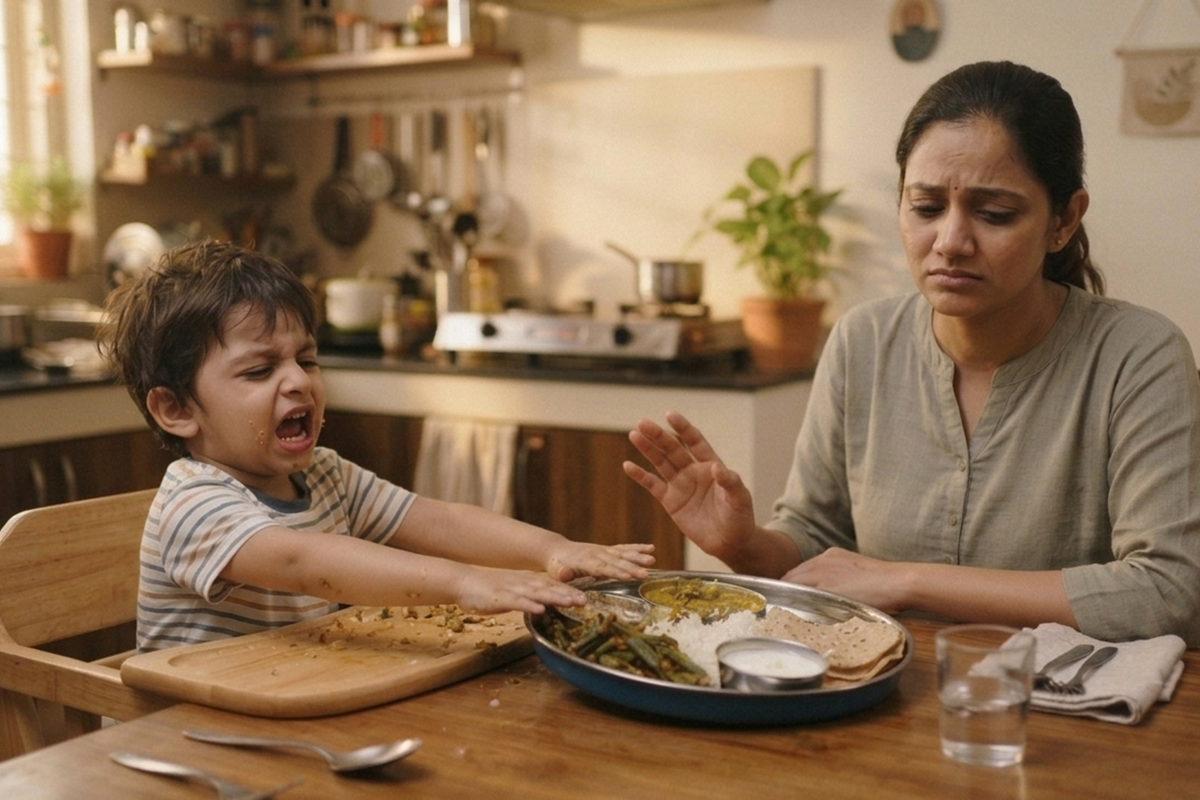
Researchers drew on earlier studies to explain how parental responses could shape children's willingness to experiment with food. (AI image)

Synopsis: A Hyderabad study by ICMR-NIN found that nearly nine in 10 children aged 2–7 showed reluctance to try unfamiliar foods. Researchers linked food neophobia to wasting and maternal feeding practices, highlighting the need for pressure-free feeding, repeated food exposure and stronger behavioural nutrition counselling through government programmes.
A child pushes the plate away, the parent pushes it back: A familiar scene in Indian households. However, researchers in Hyderabad say how parents respond to that refusal could influence whether children become more resistant to unfamiliar foods.
A study by researchers at the Indian Council of Medical Research-National Institute of Nutrition (ICMR-NIN), Hyderabad, has found an association between children’s reluctance to try unfamiliar foods, maternal feeding practices and nutritional status. Nearly nine in 10 children aged between two and seven years in the study showed moderate to high levels of food ‘neophobia’, a behavioural tendency to avoid or refuse unfamiliar foods.
The researchers studied 150 mother-child pairs in Addagutta, an urban neighbourhood in Hyderabad, between August and October 2025. The findings were published in the Journal of Nutritional Science in 2026.
Using a nine-item Child Food Neophobia Scale (CFNS), the researchers assessed children’s willingness to try different foods. The average score was 27.4 on a scale ranging from 9 to 45, with higher scores indicating greater reluctance to try unfamiliar foods.
Based on the average score and standard deviation within the study population, 76.7% of children fell into the moderate category, 11.3% into the high category and 12% into the low category. These classifications reflect differences within the sample and are not clinical diagnostic thresholds.
The researchers examined maternal knowledge, attitudes and practices (KAP) concerning child feeding to understand how caregivers respond when children refuse food.
They found that children of mothers with low KAP scores had an average food neophobia score of 30.2. This declined to 26.5 among children whose mothers had moderate KAP scores and 25.9 among those whose mothers had high scores.
The researchers said parents sometimes interpret food refusal as fussiness or disobedience rather than recognising it as a normal developmental behaviour.
“When this happens, they may respond by forcing the child to eat, showing frustration or tightly controlling what and how much the child consumes,” said the authors.
“These reactions, though often well-intentioned, can actually make children more resistant to trying diverse foods and may gradually reduce the variety and quality of their overall diet,” they added.
The researchers also drew on earlier studies to explain how parental responses could shape children’s willingness to experiment with food.
“Studies found that when parents apply excessive pressure or strict control during mealtimes, children are more likely to reject unfamiliar foods. On the other hand, mothers who approach feeding with patience, provide positive encouragement and regularly introduce diverse foods often have children who are more open to trying them,” said the authors.
The association between maternal feeding practices and food neophobia was also evident in the statistical analysis. After adjusting for the child’s age, sex and birth order; maternal education, occupation and family income, children of mothers with moderate KAP scores had food neophobia scores 2.87 points lower than children of mothers with low KAP scores.
However, the relationship was not entirely linear. High food neophobia was observed in 17.1% of children whose mothers had low KAP scores, compared with 3.8% among those with moderate scores and 11.3% among those with high scores. The adjusted difference between the high and low KAP groups was not statistically significant.
Also Read: Ignored causes: Why are experts riled up over India’s double-fortified salt plan to fight anaemia?
Children with wasting, a measure of acute undernutrition, averaged 32.7 on the scale. Children without wasting averaged 26.7.
Among children with wasting, 33.3% showed high food neophobia, meaning they were more reluctant to try unfamiliar foods, while none fell in the low category, indicating relatively greater willingness to try different foods. Among children without wasting, 8.4% were in the high category, while 13.5% showed low food neophobia.
Wasting predicted a rise of 5.81 points on the scale after adjustment. Stunting, underweight and thinness showed no link to food refusal.
Wasting affected 8.6% of children aged two to five, so the finding rests on a count of children the paper does not state. The width of the confidence interval reflects that.
The authors offered two routes between refusal and undernutrition: “Children who are hesitant to try diverse foods tend to eat only a narrow range of familiar items, which can limit their nutrient intake and increase the risk of acute malnutrition. Conversely, chronic undernutrition could also heighten food avoidance due to altered appetite or reduced taste sensitivity.”
The design cannot say which route holds. The authors framed the result as a call to act on feeding behaviour.
“The observed association between food neophobia and wasting highlights the behavioural component of undernutrition in children. These findings point to the need for incorporating behavioural nutrition counselling into routine maternal and child health services,” said the authors.
Also Read: In Andhra’s tribal belt, ICMR sanctions Rs 76 lakh to study meropenem resistance
The study names two national programmes that reach mothers: the Integrated Child Development Services (ICDS) and POSHAN Abhiyaan. Both include nutrition counselling. The authors said the counselling leaves a gap.
“Existing national programmes include maternal nutrition counselling components, but behaviour change communication on feeding practices is inconsistently delivered, and neither programme specifically addresses food neophobia. Programmes that aim to strengthen both the knowledge and everyday feeding practices of caregivers may help lessen the negative effects of food neophobia on children’s nutrition and growth,” they said.
ICMR-NIN Director Bharati Kulkarni said the findings give an opening to strengthen behavioural feeding counselling through these programmes.
The researchers want Anganwadi and ASHA workers to teach caregivers to treat refusal as a stage of development and to offer foods again without force or punishment. They also want programmes to widen access to varied foods in low-income households.
“Programmes that emphasise repeated and gentle exposure to a variety of foods, positive parental role modelling and non-pressuring feeding approaches should be strengthened within national initiatives such as ICDS and POSHAN Abhiyaan. Strengthening maternal education and feeding competence can play a pivotal role in improving dietary diversity and preventing early nutritional deficits,” said the authors.
The study was limited to a single neighbourhood at one point in time. Additionally, it relied on data from the mothers rather than directly tracking what the children ate.
(Edited by Fayisa CA)



