

Published Jun 13, 2026 | 7:00 AM ⚊ Updated Jun 13, 2026 | 9:30 AM

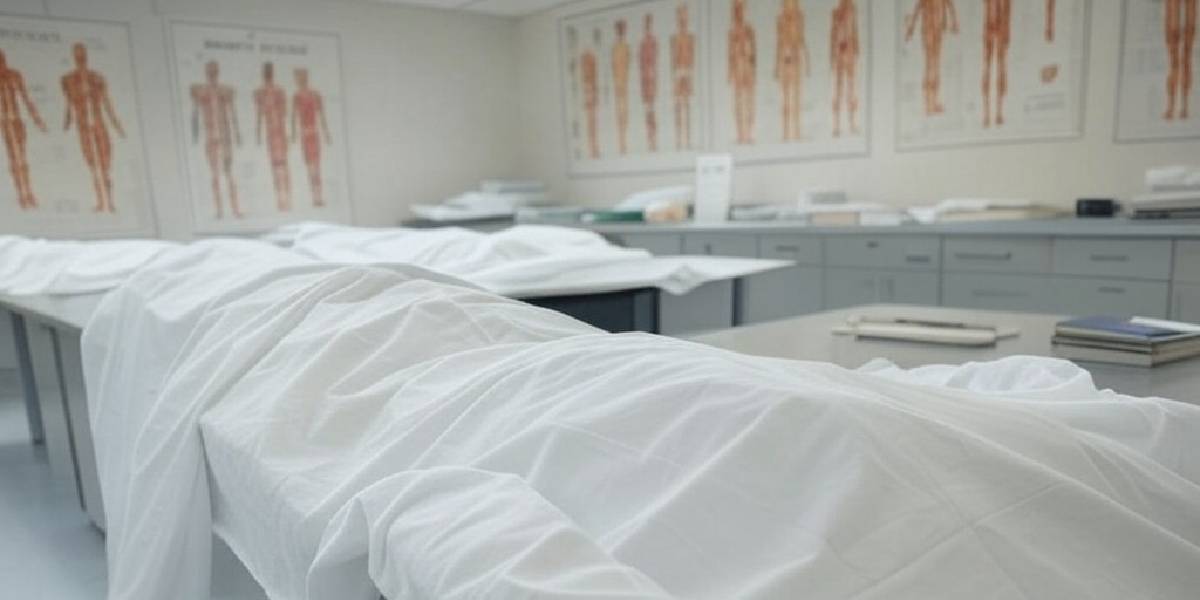
Cadavar shortage forces large groups of students to crowd around one body, sharing notes from previous batches instead of direct observation.

Synopsis: Amid outrage over a viral cadaver joke by a medical student, the deeper crisis goes unnoticed: India’s severe shortage of cadavers for anatomy training. Telangana data shows colleges meet under 30% of requirements. Experts say dignity in handling donated bodies is essential to sustain trust, donations and medical education itself.
A viral clip from comedian Pranit More’s show set off a fresh round of outrage this week.
Medical student Dr Sejal Pawar joked about the size of a male cadaver’s genitals during an audience interaction. The clip, recorded three months ago, resurfaced on 10 June and spread fast.
Pawar apologised, calling herself “naive”. Both she and More deactivated their Instagram accounts. KEM Hospital, where she studies, ordered an internal inquiry. Doctors and students condemned the remarks as a violation of cadaveric ethics.
But the debate over one joke misses a larger crisis. India’s medical colleges face a severe cadaver shortage, and that shortage shapes everything from how students learn anatomy to how donor families decide whether to trust medical institutions at all.
In Telangana alone, the gap is stark. Under National Medical Commission norms, colleges must provide at least one cadaver for every 10 students. Telangana’s 35 government medical colleges, with 4,165 MBBS seats, should have at least 417 cadavers for first-year anatomy training.
As reported earlier, data accessed by South First from 25 colleges put the actual number at 98, against a requirement of 343. That works out to under 30% of what’s needed. Two newly established colleges, in Nirmal and Medak, had none at all. Karimnagar’s medical college, with 100 students, had a single cadaver.
This shortage forces large groups of students to crowd around one body, sharing notes from previous batches instead of direct observation. Doctors said no simulation, however advanced, replicates the experience of dissecting a real human body, with its natural variations, anomalies and textures.
Also Read: Does religion stop people from donating organs?
Dr V Janaki, an anatomy professor, framed body donation as an investment that multiplies far beyond the donor.
A single cadaver may teach hundreds of students over its time in an anatomy department. Those students go on to become surgeons, obstetricians, neurosurgeons and emergency physicians, treating thousands of patients across their careers.
“Every cadaver becomes a teacher,” Janaki said. “In that sense, the impact of one body donor extends far beyond the walls of a medical college.”
Yet, getting people to register as donors remains hard. Families face cultural, religious and emotional barriers at a moment of grief. As MBBS seats expand faster than donation rates, the gap keeps widening.
A 2024 study from Assam Medical College, Dibrugarh, surveyed 161 first-year MBBS students and ran focus groups with 23 registered body donors. The findings cut against assumptions about awareness campaigns alone solving the problem.
Among students, 80.1% said they were unwilling to donate their own bodies for dissection. Emotional attachment to themselves or family members topped the list of reasons, followed by religious beliefs and preferences for cremation or burial.
Notably, 86 of the 129 unwilling students said attending dissection classes hadn’t changed their attitude either way.
Several students described discomfort with how cadavers get handled. They spoke of bodies being treated disrespectfully, dissection resembling “a meat shop”, and a disconnect from the donor’s family, who remain unaware of what happens to their loved one’s remains.
Registered donors, by contrast, cited altruism as their main motivation, often reinforced by NGO awareness camps. But their core expectation was uniform: respect during handling. One donor recalled being impressed by a ceremonial reception for a donated body and said they expected that standard “every time”.
Also Read: Harsh realities of Kerala’s organ transplant system
This is where the joke and the data intersect. Dr Janaki’s argument is that body donation programmes survive on trust. Donors and families need confidence that a loved one’s final act will be treated with dignity, not turned into material for an audience’s laughter.
“If we fail to uphold that trust, society may become less willing to donate, and ultimately it is future generations of doctors and patients who will suffer,” she said.
The Assam study pointed toward what builds that trust. Taiwan’s “silent mentor” programme has students meet donor families before dissection begins, treating the donor as a teacher throughout, with a formal send-off ceremony afterward.
The approach has lifted donation numbers in Taiwan, Malaysia and Myanmar, and helped Singapore’s National University reintroduce cadaveric dissection after years of cadaver scarcity had forced it to stop.
Thailand’s Wai Khru Yai ceremony follows a similar logic. Students are introduced to the donor’s family before dissection and pay respects throughout the process. After dissection, remains are cremated in a ceremony involving monks and a royal representative, with ashes returned to families. The practice has boosted registrations in northern Thailand.
India has its own version of this ritual: a cadaveric oath, introduced under the NMC’s competency-based curriculum, in which first-year students pledge respect for the donor as their “first teacher” before dissection begins. It’s part of the mandatory AETCOM module on attitude, ethics and communication.
But a pledge taken once at the start of training does little if classroom culture, online behaviour and informal jokes don’t reinforce it. Physiology professor Dr Satendra Singh pointed out that this is not a new problem.
He recalled how, in 2010, a Stony Brook University medical student faced global scrutiny after a photo surfaced on Facebook showing a classmate giving a “thumbs up” beside an exposed cadaver, an incident that forced medical schools worldwide to introduce strict social media and anatomy lab ethics policies.
“Coming back to the Insta generation, just go to YouTube and search cadaver, and one would see students in aprons posing unprofessionally, some posing kisses, some using half-cut skin as a queen’s crown,” Singh said.
He added that most institutions have no social media policy and take no punitive action, even as students with large YouTube followings continue to upload such content.
The Pranit More controversy will fade once apologies are issued and accounts reactivated. The cadaver shortage won’t. Until medical education builds the kind of structured respect that Taiwan and Thailand have institutionalised, and until India closes the gap between the cadavers it needs and the cadavers it has, every viral clip like this one chips away at a donation pipeline the country can’t afford to lose.



