

Published Aug 03, 2026 | 7:00 AM ⚊ Updated Aug 03, 2026 | 7:00 AM

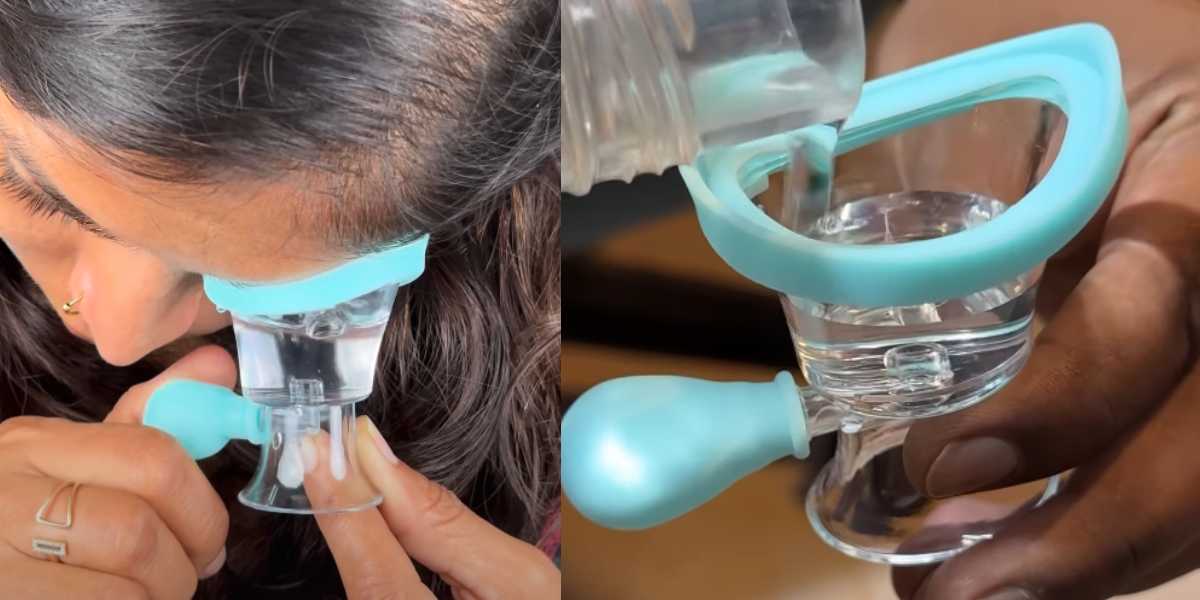

Synopsis: Viral Instagram reels are promoting silicone eye wash cups as a daily solution to remove dust, pollution and hidden debris from the eyes. However, ophthalmologists told South First that healthy eyes already have an efficient self-cleaning system through tears and blinking, making routine use of such gadgets unnecessary. While eye irrigation may be useful in emergencies such as chemical exposure or when a foreign body enters the eye, doctors caution against relying on viral social media claims without scientific evidence.
If you’ve scrolled through Instagram recently, chances are you’ve come across videos promoting silicone eye wash cups. The reels, many of which have garnered thousands of views, claim the small cup can remove dust, pollution, insects and “hidden dirt” from the eyes after a bike ride or a day outdoors.
In the videos, creators fill the cup with water, place it over one eye and repeatedly squeeze or pump it. They often claim the device leaves the eyes feeling “clean”, “relaxed” and “refreshed”, while encouraging viewers to buy the product through shopping links.
However, ophthalmologists say many of these claims are exaggerated and are not supported by scientific evidence.
Also Read: DENV-2 dominates South India as nationwide study finds multiple dengue strains circulating
According to Dr Premanjan Bhattacharjee, Consultant, Ophthalmology, Narayana Multispeciality Hospital, Howrah, the human eye is equipped with its own defence system that removes small particles without the need for additional gadgets.
“The environment in which we are currently staying is dusty and polluted. But in places where pollution is not excessive, you don’t need extra eye wash cups because our body already produces a tear film, and blinking takes care of these problems,” he told South First.
He explained that the tear film, produced by the lacrimal glands, forms a protective layer over the eye and continuously washes away small dust particles and pollutants.
“Blinking spreads the tear film across the entire ocular surface. This is the eye’s normal protective mechanism,” he added.
Dr Sharon D’Souza, Consultant Ophthalmologist, Cornea, Cataract and Refractive Surgeon at Apollo Hospitals, Bannerghatta, Bengaluru, echoed the same view.
“Our eyes are already equipped with a pretty good defence system through tears. Every time we blink, tears wash away small dust, debris and mucus that enter the eye. If something gets into the eye, it starts watering immediately. That’s the eye’s own way of flushing it out,” she told South First.
Because this process occurs naturally throughout the day, she said healthy individuals do not require routine eye washing.
Many social media videos suggest eye wash cups should be used daily, particularly after riding motorcycles, commuting through polluted areas or returning home from work.
Dr D’Souza said there is no scientific evidence supporting such routine use.
“From an ophthalmologist’s perspective, I do not recommend using eye wash cups. There is no scientific evidence supporting their use for routine eye cleansing or treatment,” she said.
Her opinion aligns with that of ophthalmologist Dr Gunjan Deshpande, who previously wrote on X that the eyes already possess their own cleaning system.
“The eyes have their own cleaning system. Every time one blinks, dust, germs and foreign bodies are washed away. The composition of normal tears is completely different from tap water. You do not need to wash your eyes using an eye cup. Do not do your eyes a disservice,” Dr Deshpande wrote.
The eyes have their own cleaning system. Everyone one blinks, the dust and germs and foreign bodies are washed away. The composition of the normal tears is completely different from tap water.
You do not need to wash your eyes using an eye cup.
Do not do your eyes a… https://t.co/bHJ2agcSlr
— Dr Gunjan Deshpande MRCSEd, FICO (UK), FAICO, DNB (@drgunjand) July 10, 2026
One area where experts expressed slightly different views was the use of tap water.
Dr Premanjan Bhattacharjee said clean tap water is generally acceptable for rinsing the eyes when necessary, provided it is not contaminated with sewage or excessive chlorine.
“We have been washing our eyes with tap water for years. If the water is clean, it can be used. For people travelling by bike, wearing glasses or a helmet provides adequate protection. There is no need to wash your eyes after every ride unless dust has actually entered the eye,” he said.
Dr Sharon D’Souza, however, advised against making it a routine habit.
“For routine eye hygiene, it is not recommended to wash the eyes using tap water in these silicone cups. Tap water itself can be contaminated and increase the risk of infection. More importantly, this daily practice is simply not required,” she said.
While doctors discourage routine use, they agree that washing the eye is appropriate in specific situations.
“If there is a particle in the eye causing continuous irritation, the first response is to wash it with water. Using an eye wash cup is acceptable in that situation. But if the irritation continues, the person should see an eye specialist who can examine the eye under a slit-lamp microscope,” Dr Premanjan Bhattacharjee said.
Dr Sharon D’Souza said immediate irrigation is especially important following chemical exposure.
“In a chemical injury, washing the eye immediately is absolutely essential because prompt irrigation limits the extent of damage. You shouldn’t wait for sterile water. Use whatever clean water is available and flush the eye immediately,” she said.
She added that splashing water into the eye can also help dislodge a foreign body during an emergency.
Doctors also cautioned against accepting health advice from viral videos without medical evidence.
“Eye is a very sensitive organ. Experimenting on it with gadgets can create problems that may even be irreversible,” Dr Premanjan Bhattacharjee said. He added that products such as eye massagers, which apply pressure to the eyeball, should also be avoided because they may injure the cornea.
Dr Sharon D’Souza urged people to verify social media claims before trying viral products.
“A lot of information goes viral because it looks sensational or interesting, but that doesn’t mean it is medically accurate. Before trying any such gadget, check with a medical professional. You may end up doing more harm than good, especially if you wear contact lenses or already have an eye condition,” she said.
While eye wash cups may help rinse the eye when a foreign body enters or after accidental chemical exposure, ophthalmologists say they should not be viewed as an everyday hygiene tool. For most healthy people, tears and blinking continue to be the eye’s most effective and scientifically proven cleaning system.



