

Published Oct 04, 2026 | 7:00 AM ⚊ Updated Oct 04, 2026 | 7:00 AM

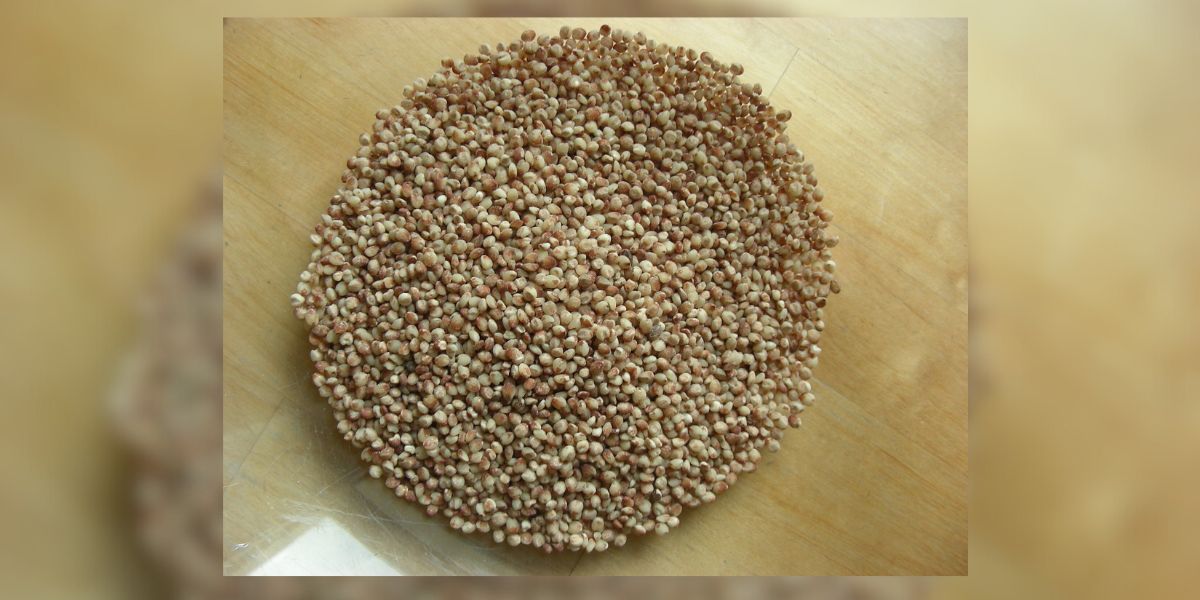
A substantial share of minor millets sold in the South Indian market are polished. They come without parts of the grain that carry main nutrients.

Synopsis: Researchers from MDRF, ICAR-IIMR and ICMR-NIN warn that polishing millets removes fibre, minerals, protein and other nutrients. While whole grains offer nutritional advantages, evidence linking polished millets to higher glycaemic responses remains limited. The researchers call for clearer labelling, greater consumer awareness, and stronger promotion of unpolished millets.
A packet of foxtail millet often comes with claims meant to attract health-conscious customers. It may say “whole grain” and “diabetes friendly”. It looks like an easy choice for someone trying to eat better and healthier.
But are the claims true? Researchers now want consumers to ask that question.
Millets have increasingly been promoted in India as “nutri-cereals”. But a substantial share of minor millets sold in the South Indian market are polished. Researchers have now warned that the polishing removes parts of the grain that carry important nutrients.
Five researchers from the Madras Diabetes Research Foundation (MDRF), ICAR-Indian Institute of Millets Research (ICAR-IIMR) and ICMR-National Institute of Nutrition (ICMR-NIN) have published their viewpoint in the Indian Journal of Medical Research.
Their message was simple: polishing makes millets easier to eat, but it takes away some of their nutritional value.
The authors — Shanmugam Shobana, Ranjit Mohan Anjana and Viswanathan Mohan of MDRF in Chennai; Chellapilla Tara Satyavathi of ICAR-IIMR and Bharati Kulkarni of ICMR-NIN in Hyderabad — raised a second concern. Polished millets may produce a higher glycaemic response than unpolished varieties, although direct evidence remains limited.
“From the brown rice experience, India must promote unpolished millets before consumers get habituated to polished millets,” the authors wrote.
Also Read: Kerala records lowest protein intake, Karnataka high in millets
Consider a grain of millet as a small, multi-layered package.
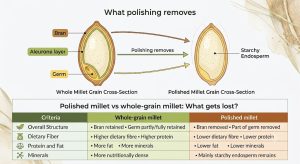
Polishing removes the bran, the aleurone layer and part of the germ, leaving behind the starchy endosperm. “Polishing removes the health-beneficial bran and germ constituents in the millets, leaving behind the starchy endosperm,” the authors noted.
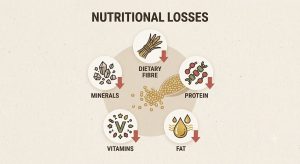
Studies cited in the article said that polishing reduces protein, fat, dietary fibre and minerals. Work by MDRF and ICAR-IIMR on foxtail, little, kodo, barnyard and proso millets found similar losses.
Whole-grain millets contain more dietary fibre and support satiety and gut health. But polished grain has practical advantages. It looks whiter, has a softer texture, cooks faster and has a longer shelf life.
“Polished millets have better sensory appeal (whiter, softer texture, quicker cooking), have an extended shelf life, but at the expense of nutrition,” the researchers said.
Also Read: A diet without rice or roti?
The MDRF survey cited found that most barnyard, little, kodo, foxtail and proso millets available in the South Indian market were sold in polished forms.
Some products carried claims such as “whole grain”, “rich in dietary fibre” and “diabetes friendly”. The researchers described such claims as a public health concern and wanted consumers to distinguish polished from unpolished millet.
They wanted the Food Safety and Standards Authority of India (FSSAI) to introduce stricter labelling rules, which they described as “essential to prevent misleading claims”.
“Labels should declare the proportion of millets used in the product,” they wrote.
They also called for awareness campaigns to help consumers recognise unpolished millets and understand their nutritional characteristics.
The authors wrote that India “currently has 101 million people with type 2 diabetes mellitus”.
They pointed to diets high in refined grains as one contributor. The ICMR-INDIAB study found that almost 62.3% of energy from carbohydrates came from refined grains, milled whole grains, and added sugar. The ICMR-NIN report, What India Eats, found that cereals and millets contribute more than 70% of total carbohydrate intake.
The paper also noted that cereals contribute more dietary energy than the ICMR-NIN recommendation of less than 45%.
The dietary guidelines for Indians recommend 250 grams of cereals and millets a day, with half coming from whole grains and 30-40% potentially coming from whole-grain millets.
Also Read: The perfect diabetic diet chart for Indians
Polishing brown rice into white rice removes dietary fibre, vitamins, minerals and phytochemicals while increasing the proportion of readily available carbohydrates.
The researchers cited their study comparing brown rice, white rice and brown rice with legumes. Brown rice-based diets produced lower postprandial glucose and insulin responses than similar white-rice diets. The effect was greater when brown rice was combined with whole-grain legumes.
Even a small amount of polishing made a difference. “Even minimal polishing of rice (2.3% degree of polish, 3.4 g% dietary fibre) resulted in a higher glycaemic response as compared to brown rice (5.3 g% dietary fibre),” the authors wrote.
Another study found that replacing white rice with brown rice improved glycated haemoglobin and cardiometabolic risk factors among Asian Indians with metabolic syndrome.
“If lessons learnt from rice are not applied to millets, the latter may follow the same path as rice, transitioning from nutritious whole grains to polished, high-glycaemic staples that may contribute to NCDs,” they wrote.
Also Read: Looks like nutrition, smells like an experiment
Choosing an unpolished millet does not automatically mean a low glycaemic response. The glycaemic index (GI) depends on fibre, starch digestibility, processing, cooking method and the physical form of the food.
MDRF studies recorded high GI values for finger millet flakes, plain cooked unpolished foxtail and little millet, finger millet balls, and sorghum (Indian millet) and pearl millet roti. Sorghum idli recorded a medium GI.
“These findings emphasise that whole-grain status alone does not necessarily guarantee a low GI,” the authors wrote.
The researchers said much of the fibre in millet is insoluble, while soluble fibre plays a greater role in moderating postprandial glucose responses. Flour-based preparations can also be more easily digested because milling reduces particle size and makes starch more accessible to digestive enzymes.
The authors said whole-grain millet foods are nutritionally superior to comparable white-rice preparations.
Also Read: Nutritionist explains effective weight loss methods
This is the crucial caveat. “Studies on the GI of polished millets are lacking,” the researchers wrote. They reported a high GI for upma made from polished finger millet and cited studies showing greater carbohydrate digestibility in polished millets.
Based on this evidence, they suggested a possibility rather than claiming a proven effect. “Polished millets might elicit very high glycaemic responses as compared to unpolished millet preparations,” the authors wrote.
The evidence showed that polishing removes parts of the grain and reduces several nutrients. But more research directly comparing polished and unpolished millet preparations is needed.
A bowl of millet rarely arrives at the table alone. Millet preparations are commonly eaten with pulses and vegetables, and the researchers said such accompaniments can lower the overall postprandial glycaemic response while improving nutritional quality.
A randomised controlled trial compared finger millet diets with similar white-rice diets. The 24-hour glycaemic responses did not differ significantly, but plasma insulin levels were about 18% lower on the finger millet diets.
Those diets included both polished and whole-grain finger millet preparations.
The researchers interpreted this as lower insulin demand for comparable glycaemia, which they described as desirable in diabetes prevention.
The researchers wanted clearer definitions of “whole grain” millets and stricter labelling of polished and unpolished varieties.
They also called for consumer education, research into consumer preferences, convenient whole-grain millet foods, and better storage and packaging. Unpolished millets can be more vulnerable to rancidity and insect infestation after primary processing.
Their sharpest criticism was how the market presents millets to consumers.
“The health benefits assured for the ‘nutri-cereals’ are unlikely to occur while the market is permitted to promote polished millets,” they wrote.
“Millets must be consumed in their whole-grain form if they are to play a meaningful role in combating India’s diabetes and NCD burden,” they stated.
(Edited by Majnu Babu).



