


Published Jan 18, 2026 | 7:00 AM ⚊ Updated Jan 18, 2026 | 7:00 AM

Representational image.
Synopsis: An investment pitch by an influencer and founder of a wellness brand on the business reality show Shark Tank India has brought to national attention a long-running struggle by India’s medical community against the use of the prefix ‘Dr’ by unqualified, medicine-adjacent professionals and social media influencers. Each year, lakhs of Indians continue to fall for unqualified medical advice peddled by quacks and influencers, despite known risks, driven by a growing distrust of modern medicine. Social media has become a hotbed for such practitioners, who exploit a legal grey area to great effect.
When the founder of a self described ‘holistic wellness brand’ walked onto the Shark Tank India stage last year, he sought a whopping ₹1 crore for just 1 percent equity in his skincare and haircare startup.
Still, he was perhaps quite confident of coming away with an investment. After all, he is popular on social media, with over 37 lakh subscribers on YouTube and 6,00,000 on Instagram.
But what Manoj Das did not expect, however, was a grilling by the “sharks” (investors) on his use of the prefix “Dr”.
The aromatherapist and naturopath did not have any conventional medical qualifications, instead holding a bachelor’s degree in aromatherapy and a diploma in naturopathy and yogic science.
“Can you legally write ‘Doctor’ with that?” asked Anupam Mittal, one of the sharks. “Because we do a bachelor’s degree in aromatherapy and science,” came Das’ reply.
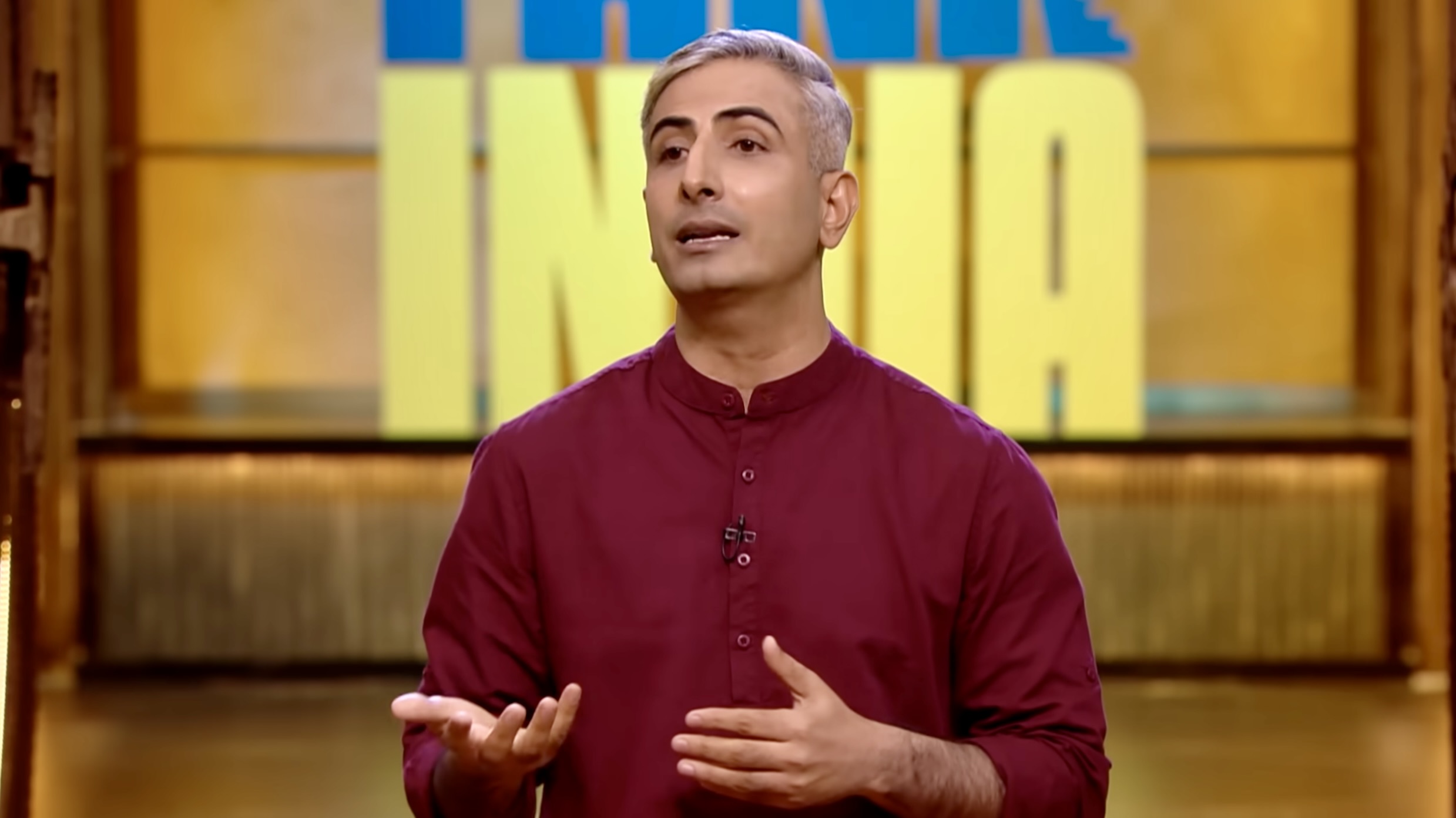
Manoj Das on Shark Tank. (Courtesy Sony Entertainment Television)
“So you can write ‘Doctor’? If doing a bachelor’s degree allows someone to write ‘Doctor’, then I will change my name,” Mittal pressed, visibly unimpressed. “You will get caught in due diligence.”
His fellow shark, Aman Gupta, was more direct: “This is not about due diligence. This is a fraud case. You cannot write ‘Doctor’.”
Over the next few minutes, the sharks grilled Das on the products his brand sold and their reception by consumers. It did not impress them and thus ended Das’ pitch.
And when the episode finally aired last week, the interaction promptly went viral, bringing wider public attention to a contentious debate that has been raging for years: who should really be allowed to call themselves a “doctor”.
The scale of the problem is staggering. According to the Telangana State Medical Council, at least 35 individuals posing as doctors and offering treatment for obesity, diabetes, hypertension and infertility on social media are currently under investigation.
Several command followings ranging from one lakh to three lakh followers.
“They claim expertise in treating obesity, diabetes, hypertension, infertility and sexual health issues. Many of them post videos wearing stethoscopes, talk about ‘diabetes reversal’, ‘pancreas detox’, or hormone correction, and prescribe medicines or supplements despite having no recognised qualifications,” said Dr Naresh Kumar, an anti-quackery member of the Telangana Medical Council, told South First.
He added that such practitioners operate both online and in physical establishments.
“Some operate from small or mid-sized hospitals, while others come from entirely unrelated backgrounds such as hospitality, cosmetics or personal care. In one case, a person posing as an ICU emergency specialist did not even have a paramedical qualification,” he explained.
“Another individual under investigation identified as a cosmetic specialist but regularly issued prescriptions for obesity, skin disorders and sexual health problems.”
For Dr Karthik Nagula, president of the Hyderabad Resident Doctors Association, the Shark Tank moment was deeply satisfying.
“I saw the clip on the day it went viral, and it was clear how people were reacting. There is no way many social media users can distinguish between qualified medical professionals and those who are not,” he told South First.
“Medical influencers who lack proper qualifications still give casual advice, suggesting things that no certified doctor would ever say, often implying that doctors withhold treatments for their own benefit.”
The fundamental challenge facing patients is simple: how do you verify if someone claiming to be a doctor on social media is actually qualified?
“The real problem begins when someone puts on a doctor’s coat, wears a stethoscope, adds the ‘Dr’ prefix to their name, and starts dispensing advice on social media,” a member of Telangana Medical Council who did not wished to be named told South First.
“For an ordinary user, there is no reliable way to identify whether that person is actually a qualified doctor. Social media platforms provide no verification mechanism to establish medical credentials.”
Dr Sudhir Kumar, a neurologist, explained the practical impossibility of public verification.
“When I write my name as Dr Sudhir Kumar, my qualifications are often not mentioned. Even when they are, the public may not understand what they signify. In cases like this, someone might list a bachelor’s or master’s degree in aromatherapy, but the average person cannot judge whether that qualifies them as a real doctor,” he told South First.
“The public does not have the tools or knowledge to make that distinction, and that is how people who are not doctors end up being perceived as real doctors.”
The problem extends beyond aromatherapists and naturopaths. One Instagram video by Dr Raghupathi Jadhav, a physiotherapist, has garnered over eight million views. The video shows Jadhav cracking people’s bones, with sharp cracking sounds designed to hold viewers’ attention.
His profile lists an “Award of Excellence in Physiotherapy” and a “Best Doctor Award 2018”, and describes him as having eight years of experience in assessment, diagnosis and management of various conditions.
Even so, medical bodies have started to fight back. In November, the Kerala High Court issued an interim order restraining physiotherapists and occupational therapists from using the “Dr” title without recognised medical qualifications.
Justice VG Arun observed that allowing non-medical professionals to independently diagnose patients could pose risks to public health. Yet that has not stopped Jadhav from continuing to use ‘Dr’ on his Instagram profile.
During Manoj Das’s pitch on Shark Tank, one of the sharks, Anupam Mittal, identified the strength of content creators of his calibre.
“Your magic is your content creation. You have made provocative reels. Your reels have gone viral, and your business has grown because of that. Can you show those reels once?” he asked.
“We have 5.89 lakh followers,” Das replied. “And the views run into millions, 8.5 million, 5 million, 3.1 million.”
But Mittal was not impressed and proceeded to offer a straightforward breakdown of what makes such content go viral.
“I have understood one thing. You are making very big claims which are completely baseless. You are provoking users. The desire to look good, lose weight, or stop hair fall runs so deep that people are ready to believe anything if it is said with conviction and credibility,” he said.
Another of Mittal’s fellow sharks was even more blunt. “You are creating clickbait content by exploiting users’ insecurities. You are selling a non-scientific and less transparent product while using the credibility of a doctor. That is incorrect and unethical.”
The Telangana Medical Council member described how this exploitation operates systematically.
“There is another layer to this problem. Practitioners from AYUSH systems and BDS-qualified dentists are legally allowed to use the ‘Dr’ prefix. However, many of them also exploit public fear and insecurity,” he told South First.
“For instance, certain brands that sell hair-loss products deliberately make people believe they are losing hair even when they are not by showcasing different stages of hair loss. Through influencer doctors, they amplify this fear, create anxiety about appearance, and then trigger a sense of urgency or fear of missing out.”
Dr Naresh said that once insecurity sets in, people are pushed towards buying products they may not actually need.
“This is how several wellness and personal care brands are using non-modern medicine practitioners as marketing tools, blurring the line between medical advice and commercial promotion,” he added.
The predatory algorithms and dark patterns employed by social media platforms only amplify this effect. Claims about “diabetes reversal”, “pancreas detoxification” and miracle cures gain traction because they promise simple solutions to complex health problems.
The sensational claims drive engagement, which platforms reward with greater visibility, creating a feedback loop that privileges misinformation over accuracy.
Still, social media and influencers are a symptom of the problem. The fundamental issue is that medical regulations have a large grey area that allows for exploitation with little to no consequence.
“There is confusion because of ambiguity over who exactly qualifies as a doctor. There is no clear definition anywhere,” said Dr RV Asokan, former IMA president, told South First.
“There are no firm boundaries that specify who should be called a doctor, who is a medical doctor, and who is a science doctor. The term itself has multiple interpretations. Its roots lie in Latin and French, where it broadly meant a teacher or an expert. Even today, some interpret a doctor as someone who can ‘doctor’ or fix something.”
Legally, the ‘Dr’ prefix in India is reserved for those with recognised medical or doctoral qualifications: MBBS doctors registered with the National Medical Commission, AYUSH practitioners (Ayurveda, Unani, Siddha, Homeopathy, Yoga and Naturopathy) with recognised degrees, dentists with BDS or MDS, veterinary doctors, and individuals with PhDs in any discipline.
However, enforcement remains inconsistent. Dr Asokan highlighted the problem of patronage.
“Quackery thrives partly because of patronage, not only from politicians but also from sections of public health experts. Such practitioners are often described politely as ‘informal providers’. Even global bodies like the WHO count informal providers while comparing healthcare systems, which indirectly gives legitimacy and dignity to unqualified practice.”
Dr Karthik Nagula emphasised the need for central regulation.
“The NMC and the Health Ministry should issue clear advisories stating that influencers must not use the ‘Dr’ prefix or prescribe treatments on social media. Such actions should be treated as offences,” he said.
“The government should bring a law or policy to regulate this space. At present, this issue is being ignored.”
He pointed to regulatory confusion that allows misuse to continue.
“When it comes to professional practice, each regulatory authority has a defined role. The National Medical Commission looks only into allopathic practice. The AYUSH department deals exclusively with Ayurveda and related systems. The Dental Council of India regulates dental practice,” he said.
“But outside these three regulatory bodies, practitioners such as chiropractors, physiotherapists and others continue to operate. The question is, who regulates them and who monitors their practice?”
The Telangana Medical Council has been one of the few regulatory bodies taking aggressive action against quackery. In 2025, the council identified over 117 quacks using prescription tests on decoy patients, leading to hundreds of clinic closures statewide.
It raided four clinics run by five unqualified practitioners, some posing as doctors with fake credentials or misusing AYUSH qualifications to prescribe allopathic drugs such as antibiotics and steroids. By August 2025, around 500 police cases had been filed against fake doctors.
However, this aggressive enforcement appears to have triggered a political backlash. In January 2026, a government order expanded the council’s membership from 25 to 29, reducing the influence of elected doctors and sparking accusations of a “backdoor takeover” amid the anti-quackery drive.
The Telangana Medical Council member said there are also political dynamics involved in the issue.
“People are beginning to treat these practitioners as real doctors. Clarity can come only from the government, but the government has failed to act, largely due to political reasons. Recently, a large group of quacks approached the government and complained that the medical council was targeting them, raiding their clinics, and affecting their livelihoods,” he explained.
“In response, the government appointed four additional members to the medical council. This changed the balance of power from 13 elected members versus 12 nominees to 13 elected members versus 16 government-appointed members.”
All this has resulted in the council’s autonomy being diluted.
“Any regulatory decision taken by the council can now be effectively controlled or stalled by government-appointed officials, mostly IAS officers placed within the council,” he said.
“This development benefits private medical practitioners, RMPs and others who want to use the ‘Dr’ prefix without proper qualifications. It disadvantages the medical council and undermines its ability to regulate unethical practice.”
Each year, lakhs of Indians continue to fall for unqualified medical advice peddled by quacks and influencers on social media, despite known risks, because there is a growing distrust of modern medicine, said Dr Sudhir Kumar.
“One major reason is the widespread belief that modern medicine causes side effects, while anything labelled ‘natural’, ‘herbal’ or ‘traditional’ is safe. This perception has been deliberately propagated,” he explained.
“Many practitioners of alternative systems reassure patients that their treatments have no side effects, while quietly allowing them to continue modern medicines. If a patient improves, they take credit. If a side effect occurs, they blame modern medicine. This protects them either way.”
Cost is another significant factor. Unlike modern medical care, influencers often promote cost-effective, seemingly simple remedies that promise to heal complex issues.
“People believe modern medicine is expensive because it involves hospitals, investigations and tests. Alternative systems do not rely on CT scans, MRIs or detailed blood investigations. In contrast, modern medicine may require patients to consult multiple specialists for comprehensive care, which increases perceived expense,” he said.
“In homeopathy, for example, diagnosis relies largely on symptoms. If abnormal lab reports are presented, practitioners often struggle to interpret them. That is why they feel confident claiming they can treat everything. You will often hear statements like, ‘We can cure all diseases.’ No modern medicine doctor can make such a claim. Even after completing MBBS, MD in medicine and DM in neurology, I cannot say I can treat every disease. I refer patients appropriately.”
Practitioners of alternative medicine, however, have no qualms about making every claim under the sun, whether it is treating skin problems, joint pain, sexual health issues, metabolic disorders or ageing, all at once.
“One person, one solution, lower cost. In contrast, modern medicine may require patients to consult multiple specialists for comprehensive care, which increases perceived expense,” Dr Kumar said.
“Today, people are constantly consuming reels and short videos. When they repeatedly see unverified claims and no authority takes action, they start believing that such claims must be correct. It creates a false sense of legitimacy.”
One of the other fundamental issues is the legislation governing how modern medicine practitioners and alternative practitioners are regulated. Doctors and medical practitioners have a code of ethics that they are required to abide by and are not allowed to advertise or make absolute claims.
“I cannot say I will cure something 100 percent. I cannot guarantee outcomes. As a neurologist, I cannot appear in a reel and say that I guarantee stroke treatment or that I am the best. At most, I can state that I am a neurologist and that I treat a defined set of conditions. That is all,” Dr Sudhir Kumar said.
Alternative medical practitioners do not face any such barriers.
“You see people making outrageous claims. Someone says fasting for seven days will cure cancer. Someone says fasting for 24 hours will cure cancer. If a modern medicine doctor made even a single such statement, disciplinary action would follow immediately,” he added.
The lack of consequences creates a culture of impunity.
“In this case, action came only after a television programme questioned it. No official regulatory body intervened. I have heard that after the show, the person removed the ‘Dr’ prefix from his name. That itself shows he knew it was wrong. He had been using it for years because he knew there were no checks and balances and that nobody would take action,” Dr Kumar said.
“If you travel by train in places such as West Bengal, especially from Howrah to Dhanbad, you will see walls covered with advertisements for so-called ayurvedic doctors. Most of them promise cures for sexual problems, nightfall, infertility and impotence. Infertility today is an advanced field involving IVF and specialised care. How can roadside setups offer such treatment?”
Medical professionals and regulatory experts agree that meaningful change requires action at multiple levels.
Dr Sudhir Kumar proposed a practical solution to the verification problem.
“There should be a central, publicly accessible database listing all recognised doctors, their degrees and the institutions they studied at. Some patients may prefer to consult someone trained at AIIMS or CMC Vellore rather than an unfamiliar medical college,” he said.
“Others may want to know what postgraduate degree their doctor holds. This transparency is not unreasonable. It empowers patients and reduces fraud.”
Dr Karthik Nagula called for clear legal frameworks.
“The Union Health Minister should constitute a committee, frame clear regulations, and guide practitioners on what they can and cannot do. Practitioners often know what is right, but many do not follow the rules because they chase market opportunities and financial gain,” he added.
Dr Asokan demanded direct government intervention.
“Each regulator limits responsibility to its own domain. AYUSH will say it oversees only AYUSH systems. The NMC will say it regulates only modern medicine. The Dental Council of India will say it governs dental practice. But practitioners operating outside all these systems still treat patients. Who regulates them? That responsibility squarely lies with the Ministry of Health.”
(Edited by Dese Gowda)


