

Published Jun 20, 2026 | 12:48 PM ⚊ Updated Jun 20, 2026 | 12:48 PM

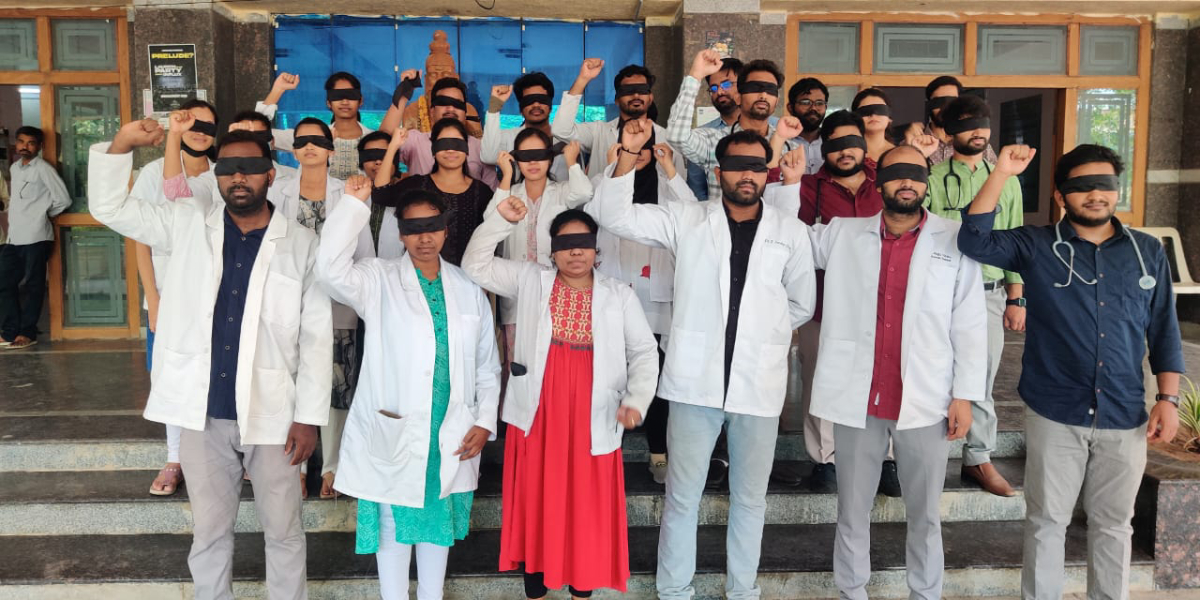
Telangana doctors during a call for an indefinite strike earlier. (Supplied)

Synopsis: Junior doctors, senior residents and young specialists across Telangana have opposed a reported proposal to raise the retirement age of government medical college faculty from 65 to 70 years. They argue the move will delay promotions, reduce recruitment opportunities and worsen career stagnation, while urging the government to fill vacancies through regular recruitment instead.
A proposal reportedly under consideration to increase the retirement age of teaching faculty in Telangana’s government medical colleges from 65 years to 70 years has triggered strong opposition from junior doctors, senior residents and young specialists, who argue that the move would block recruitment, delay promotions and worsen career prospects for the next generation of medical educators.
The debate gained momentum after a report published in a Telugu daily on Saturday 20 June suggested that efforts were underway to persuade the government to increase the retirement age of professors and senior faculty members by another five years. While the state government has not made any official announcement on the issue, multiple doctors’ associations have come out publicly against the proposal.
Among those opposing the move are the Telangana Senior Residents Doctors Association (T-SRDA), Telangana Junior Doctors Association (T-JUDA), Healthcare Reforms Doctors Association (HRDA), and members of the Federation of All India Medical Association (FAIMA).
In a statement issued on June 20, the Telangana Senior Residents Doctors Association said extending the retirement age would have “significant adverse consequences on the career progression of thousands of young doctors serving in government medical institutions.”
The association said vacancies created through retirement are essential for maintaining academic progression and creating opportunities for younger doctors.
According to T-SRDA, increasing the retirement age from 65 to 70 years would delay promotions of Assistant Professors, Associate Professors and Professors, reduce recruitment opportunities for Senior Residents and recently qualified specialists, and create long-term stagnation within medical academia.
The association also argued that Telangana has invested heavily in establishing new government medical colleges and training specialists, and that restricting faculty turnover could undermine recruitment efforts and discourage young doctors from pursuing teaching careers in government institutions.
Rather than extending the retirement age, the association suggested introducing structured mentorship programmes, advisory positions and voluntary retirement mechanisms that would allow retired professors to continue contributing to medical education without occupying regular faculty posts.
T-SRDA urged the government to focus on filling existing vacancies, creating additional teaching positions, ensuring timely promotions and providing transparent recruitment opportunities.
The association warned that if a Government Order extending the retirement age is issued, more than 1,500 Senior Residents across Telangana may launch an indefinite statewide protest and strike.
Also Read | Built without doctors: How Telangana opened 24 medical colleges and forgot the faculty
Dr Pranay, a young specialist doctor, said the proposal would directly affect the employment prospects of doctors hoping to enter government teaching service.
“Such a move will directly block recruitment of young specialists, delay promotions at every level and create long-term stagnation in medical academia,” he said.
He said thousands of postgraduate doctors and Senior Residents are waiting for academic opportunities and argued that extending the tenure of existing faculty by another five years was neither justified nor sustainable.
“We have the highest respect for our senior professors and acknowledge their immense contribution to medical education. However, preserving opportunities for the next generation of doctors is equally important. Medical education cannot progress if vacancies are not created and fresh talent is denied entry,” he said.
The Healthcare Reforms Doctors Association (HRDA) also strongly opposed any proposal to increase the retirement age beyond 65 years.
The association argued that medical education requires a balance between experience and generational renewal and warned that extending service tenure would create severe stagnation in promotions and deny opportunities to younger specialists.
HRDA further contended that Telangana’s expanding medical education infrastructure requires a continuous inflow of new faculty members.
The association also raised concerns regarding the health and well-being of senior faculty.
“Many senior doctors continue to discharge their duties despite age-related health issues and physical limitations. Further extension of service may impose additional physical and mental stress, compromising their own health and quality of life,” the association said.
Dr Karthik Nagula of HRDA said nearly 1,900 Assistant Professor posts remain vacant and argued that the solution lies in regular recruitment rather than extending the service period of existing faculty.
“Instead of increasing the retirement age from 65 to 70 years, the Government should focus on filling the huge shortage of faculty through regular recruitment. Nearly 1,900 Assistant Professor posts are still vacant. The solution to this shortage is multiple and regular recruitments, not extending the retirement age,” he said.
Also Read | Five arrests, six FIRs: How a month-long undercover operation busted Telangana’s fake eye doctor network
Doctors opposing the proposal also questioned the state’s recruitment process.
Dr Srinath of FAIMA pointed to the recent recruitment drive conducted by the Medical and Health Services Recruitment Board (MHSRB), under which 607 Assistant Professor posts were notified.
According to him, the recruitment process took nearly a year to complete, and 243 posts remained unfilled and were carried forward.
“The government’s reliance on raising the retirement age from 65 to 70 is a clear admission of administrative failure,” he said.
“According to the government’s own records, there are still 2,786 vacant faculty positions across the state. Instead of fixing a broken, slow-moving recruitment machinery, they are choosing to plug the vacancy gap by blocking the career progression of the next generation.”
He also highlighted the situation facing recently completed Senior Residents.
“We are a batch of 1,200 Senior Residents who completed our tenure in April. We are fully eligible to join as Assistant Professors, but regular recruitment is dragging on and contract jobs have been halted. At the same time, nearly 400 NEET-SS aspirants have been waiting for counselling for months. Young specialists are being pushed into financial and mental distress while discussions are taking place about increasing the retirement age,” he said.
One of the key arguments advanced by young doctors is that faculty shortages are not necessarily the result of a lack of applicants but rather shortcomings in recruitment mechanisms.
Dr Karthik Nagula said many of the 243 unfilled Assistant Professor posts were carried forward because of constitutionally mandated reservation roster points where eligible candidates were unavailable within specific categories.
“Those vacancies cannot legally be filled by candidates from other categories,” he said.
He added that lack of infrastructure, absence of incentives for peripheral institutions and personal preferences also influence recruitment outcomes.
However, he argued that these issues can be addressed through more frequent recruitment cycles and the introduction of waiting lists.
“This is not unique to Telangana. Many states issue fresh recruitment notifications quickly for carry-forward vacancies or maintain waiting lists so that the next eligible candidate can be appointed if a selected candidate does not join,” he said.
“Unfortunately, Telangana has not been following this approach. Recruitment notifications are issued only once in three to four years and there is no waiting-list mechanism. As a result, vacancies remain unfilled for long periods.”
Dr Pranay echoed the same view, claiming that the recent recruitment drive received four to five applications per post in several departments.
“Doctors are ready to fill the jobs wherever they are available, including rural and newly established colleges,” he said.
“Naturally, everyone prefers metro cities, but the trend has changed. As the number of specialists has increased, many doctors are willing to work in rural areas and new medical colleges. The answer is regular recruitment and waiting-list policies, not extending the retirement age.”
The Telangana Junior Doctors Association also issued a statement opposing any move to increase the retirement age beyond 65 years.
The association said delayed retirements would reduce recruitment opportunities for Senior Residents and postgraduate specialists, while also slowing promotions within the academic hierarchy.
T-JUDA argued that medical education is a rapidly evolving field that requires adaptation to new technologies, research methods, treatment protocols and teaching practices.
The association called for expedited recruitment, creation of additional teaching positions and development of mentorship and emeritus roles for retired professors.
It also warned that junior doctors may consider democratic forms of protest, including a statewide agitation, if the proposal is implemented.
While opposition from doctors’ associations has intensified, the Telangana government has not yet officially announced any decision regarding increasing the retirement age of medical college faculty.
The proposal has nevertheless sparked a wider debate within Telangana’s medical education sector, with young doctors arguing that faculty shortages should be addressed through faster recruitment, regular notifications, waiting-list mechanisms and creation of new posts rather than extending the service tenure of existing faculty.
For now, the issue has exposed growing concerns among young specialists and Senior Residents who fear that an extension of retirement age could delay their entry into academic medicine at a time when the state continues to expand its medical education infrastructure.
(Edited by R Rajesh Kumar.)



