


Published Apr 01, 2026 | 2:28 PM ⚊ Updated Apr 01, 2026 | 2:29 PM

GLP-1 drugs. (iStock)
Synopsis: Government releases guidance on 1 April as generic versions flood market, prices fall 85 percent. Drugs require specialist prescription. “GLP-1 drugs are prescription medications used to treat type 2 diabetes and obesity but carry serious side effects and must only be taken under the supervision of a qualified medical specialist,” the ministry stated. “The misuse of GLP-1 drugs without clinical oversight can lead to severe health complications.”
GLP-1 receptor agonist drugs carry serious side effects ranging from nausea and vomiting to pancreatitis, acute kidney injury, bowel obstruction, and medullary thyroid cancer, the Ministry of Health and Family Welfare warned on 1 April, 2026.
The ministry released comprehensive guidance on the prescription-only medications as at least six domestic pharmaceutical companies flooded the market with generic versions following patent expiry on 20 March. Monthly treatment costs fell overnight from ₹8,800-₹10,850 to as low as ₹1,300.
“GLP-1 drugs are prescription medications used to treat type 2 diabetes and obesity but carry serious side effects and must only be taken under the supervision of a qualified medical specialist,” the ministry stated. “The misuse of GLP-1 drugs without clinical oversight can lead to severe health complications.”
Common side effects include nausea, vomiting, diarrhea, constipation, and loss of appetite. These typically occur during early treatment as the body adjusts to the medication.
Severe and rare side effects requiring emergency medical attention include:
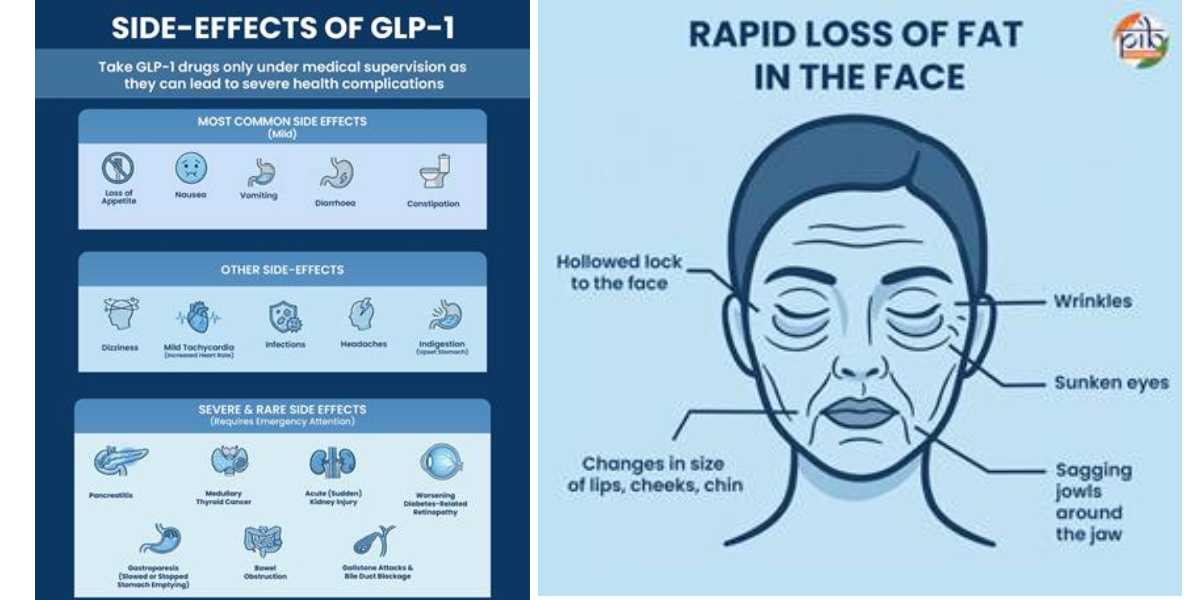
Side effects of GLP1
The drugs may also cause severe allergic reactions including shortness of breath, red rash, hives, abdominal pain, difficulty swallowing, and chest tightness.
Low blood sugar can occur when GLP-1 drugs are combined with other diabetes medications, causing shaking, sweating, dizziness, weakness, faster heart rate, and difficulty thinking.
The drugs are contraindicated in pregnant women due to risk of developmental abnormalities in the foetus. They are also contraindicated in those with personal or family history of medullary thyroid carcinoma and those with multiple endocrine neoplasia type 2.
In India, GLP-1 drugs can only be prescribed by endocrinologists, internal medicine specialists, and cardiologists. The drugs cannot be purchased over the counter. “GLP-1 drugs must be taken under medical supervision,” the ministry emphasized.
“GLP-1 drugs are prescription medications used to treat type 2 diabetes and obesity but carry serious side effects and must only be taken under the supervision of a qualified medical specialist,” the ministry stated.
The drugs work by mimicking GLP-1, a hormone the gut releases after eating that stimulates insulin release and suppresses glucagon to control blood sugar. They also slow gastric emptying, creating prolonged fullness that reduces appetite and induces weight loss.
The Drug Controller General of India, in collaboration with State Drug Controllers, audited and inspected 49 businesses across the country in recent weeks. Inspections covered online pharmacy warehouses, drug wholesalers, retailers, and weight loss clinics.
“These inspections spanned multiple regions across India and focused on identifying violations related to unauthorised sale, improper prescription practices, and misleading marketing,” stated an official release. “Notices have been issued to those found breaking the rules.”
Businesses that violate regulations will face license cancellation, fines, and legal action. Stricter inspections will continue in coming weeks.
On 21 March, Dr Reddy’s, Sun Pharma, Zydus Lifesciences, Glenmark, Alkem, and Natco launched generic semaglutide formulations. Some formats undercut the innovator price by up to 90 percent.
For a country with over 10 crore adults living with diabetes and an estimated 25 crore with obesity, the price reduction represents a significant accessibility shift, creating both opportunity and risk. Analysts project the market could expand fivefold within five years.
However, increased accessibility has raised concerns about misuse without clinical oversight.
Meanwhile, multiple variants have also entered the market, including semaglutide injection, semaglutide tablets, liraglutide, tirzepatide, dulaglutide, exenatide, and exenatide extended release. Most are administered via pre-filled injection pens, though some are available in tablet form.
The first GLP-1 medication received approval from the United States Food and Drug Administration in 2005. Recent variants have gained popularity for treating both diabetic and obese patients.
For Indian populations, obesity is defined as BMI greater than or equal to 25 kg/m², while overweight ranges from 23.00 to 24.99 kg/m². These thresholds are lower than Western standards due to higher cardiometabolic risk at lower body mass index levels in South Asian populations.
GLP-1 drugs are indicated for patients with BMI above 25 even without complications, or BMI above 23 with obesity-related conditions such as diabetes, hypertension, or fatty liver disease.
The ministry, however, emphasized that type 2 diabetes and obesity remain preventable and reversible conditions.
To prevent type 2 diabetes, people should reach and maintain healthy body weight, engage in at least 150 minutes of moderate exercise each week, eat a healthy diet avoiding sugar and saturated fats, and not smoke tobacco.
To prevent and reduce obesity, people should reduce calories consumed from fats and sugars, increase daily intake of fruit, vegetables, legumes, whole grains and nuts, and engage in regular physical activity.
“Pharmaceutical therapy, where indicated, must not be projected in a manner that undermines public health initiatives promoting diet control, physical activity, and preventive healthcare measures,” the DCGI advisory stated.
On 10 March, 2026, the DCGI issued a comprehensive advisory to all drug manufacturers ordering them to stop misleading advertisements and any promotion that could encourage people to use GLP-1 drugs without prescription.
The advisory specifically prohibits surrogate advertising disguised as disease awareness campaigns, including billboards at shopping centers, pharmacy signboards advertising availability, social media influencer endorsements, and digital campaigns that create brand recall for prescription products.
“Any promotional activity, including so-called awareness campaigns, that functions as a surrogate advertisement for prescription-only drugs shall be viewed seriously and may be treated as irrational or misleading marketing practice,” stated Dr Rajeev Singh Raghuvanshi, Drugs Controller General of India.
The ministry further requires all manufacturers, importers, and marketing authorization holders to ensure strict compliance with the Drugs and Cosmetics Act, 1940 and Rules made thereunder.
Product information leaflets must prominently display details of authorized personnel, authorized office codes, and dedicated contact numbers with complaint mechanisms for addressing consumer queries.
Firms must submit comprehensive risk management plans ensuring continued safety monitoring and implementation of appropriate risk minimization measures.
Patients and the public are strongly advised to consult qualified medical specialists before use and obtain these medications with prescription only through legitimate, regulated channels.
The ministry warned against purchasing GLP-1 drugs from unauthorized sources, using them without medical supervision, or taking them for cosmetic weight loss purposes.
“India’s regulatory authorities have taken firm steps to prevent unsupervised use and malpractices in the supply chain,” the release stated. “These drugs are not without risk.”
The Drug Controller General of India continues to monitor the situation closely as the market expands following generic entry.
(Edited by Sumavarsha)


