

Published Dec 02, 2025 | 8:00 AM ⚊ Updated Dec 02, 2025 | 8:00 AM

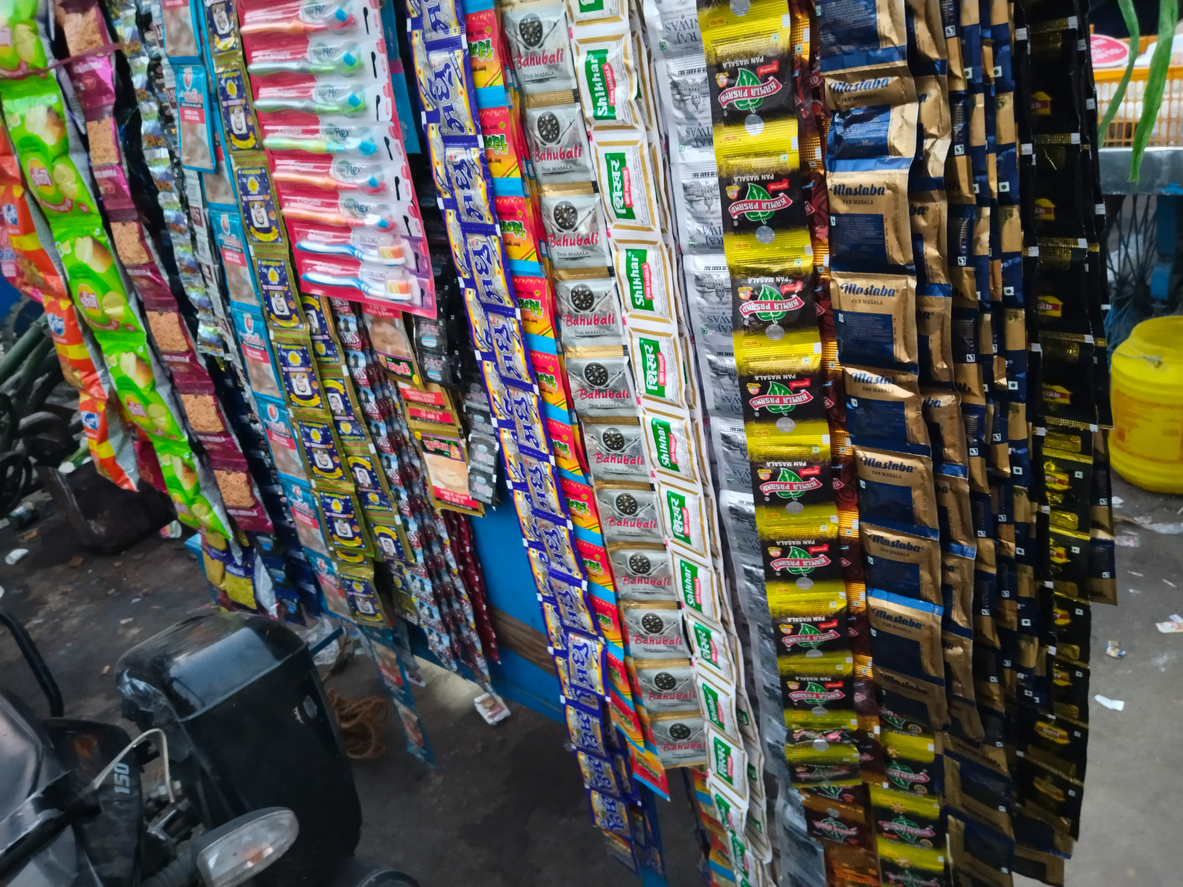
Packets of gutka and pan masala pouched displayed for sale at a tobacco shop. Credit: iStock
Synopsis: Finance Minister Nirmala Sitharaman introduced two Bills on 1 December 2025 that sharply raise excise duties on tobacco (up to 325%) and impose a new machine-capacity cess on pan masala production. The measures aim to plug the post-GST cess gap while tackling India’s oral cancer epidemic, which claims 1.35 lakh lives yearly and costs ₹1.77 lakh crore (1% of GDP).
A man slides a pouch of gutka under his lip at a brick kiln in some part of the country. The mixture dissolves into his bloodstream through the oral cavity, turning his saliva deep red. Within minutes, euphoria arrives. Hunger fades. The false sense of stamina allows him to push through another shift without food.
This scene plays out across India millions of times each day. The product costs Rs 5-10/pouch. The consequences run into lakhs in medical bills and, for many, death within five years of an oral cancer diagnosis.
Finance Minister Nirmala Sitharaman walked into the Lok Sabha on Monday, 1 December and placed two Bills on the table. One proposed to increase duties on tobacco products by margins that made industry watchers sit up. The other sought to tax the machines that churn out pan masala.
The moves mark a shift in how the Centre plans to extract revenue from products that claim 13.5 lakh lives annually in India—products that burden the health system with costs estimated at Rs 1.77 lakh crore, equivalent to 1 percent of GDP.
The Central Excise (Amendment) Bill, 2025, replaced the entire tariff table for tobacco products. Unmanufactured tobacco will now face 70 percent excise duty across nearly all categories, up from the existing 64 percent.
Cigarettes saw the steepest revisions. A non-filter variant not exceeding 65 mm in length will draw Rs 2,700/thousand—more than 13 times the earlier Rs 200. Filter cigarettes and longer variants also absorbed sharp increases, with the highest slab set at Rs 11,000/thousand for certain categories.
Chewing tobacco, zarda, and related preparations now face 100 percent duty. Smoking mixtures for pipes and cigarettes will attract 325 percent duty.
The government explained its reasoning in a statement. Tobacco remains one of the few products still covered under Central Excise after GST rolled out in July 2017. The GST Compensation Cess, expected to phase out once loan liabilities clear, will create a revenue gap. The Centre said it must regain fiscal space to maintain tax incidence on tobacco products.
The Health Security se National Security Cess Bill, 2025, introduced a levy that operates differently from conventional taxes. Instead of charging manufacturers based on how much they produce, the government will collect money based on what their machines can produce.
A factory owner who installs a high-speed packaging line will pay a fixed monthly amount. Production volume does not matter. The Bill links the cess to machine capacity, processing speed, and declared parameters.
Pan masala appears as the sole entry under Schedule I of the Bill. But a second line—”any other goods which may be notified”—grants the Centre authority to expand the list whenever it chooses. Products linked to health concerns could enter the ambit through a simple notification, without returning to Parliament.
The legislation demands registration from all taxable persons. Monthly returns become compulsory. Officers gain powers to inspect premises, verify declarations, and recalibrate capacity claims. Penalties arrive in tiers. Non-compliance attracts fines. Fraud, evasion, or falsified records can lead to imprisonment.
India accounts for over a third of all oral cancer cases globally. The nation documented 1,43,759 cases and 79,979 deaths in 2022 alone.
A study published in JAMA Network Open analysed data from over 14,000 patients. The nation’s five-year survival rate for oral cancer stands at 37.2 percent. Nearly two out of three patients do not live beyond five years.
Regional disparities run deep. In urban Ahmedabad, 58.4 percent of patients survived five years. In Manipur, the rate dropped to just 20.9 percent. The urban-rural divide cuts sharply: 48.5 percent in cities versus 34.1 percent in villages.
Timing of diagnosis makes a profound difference. Patients whose cancer was detected early had a five-year survival rate of over 70 percent. Once the disease spread to other parts of the body, survival plunged to just nine percent.
When an individual chews gutka, the mixture absorbs directly into the body through the oral cavity. Upon mixing with saliva, it turns deep red and gives an intense hit.
Dr Rajesh Sharma, Health Economist from National Institute of Technology Kurukshetra, explained what follows: “This can lead to a false sense of well-being, euphoria, a warm sensation in the body, sweating, increased salivation, palpitations, heightened alertness, tolerance to hunger, and increased capacity and stamina to work.”
He added that workers in brick kilns or similar environments consume gutka to suppress the urge to eat for hours. The product remains easily available and delivers euphoria along with hunger tolerance. Lower middle-class and lower-class people consume it most.
Dr L Rohit Reddy, Consultant Medical Oncologist at Yashoda Hospitals in Hyderabad, described the progression: “Unfortunately, individuals might tend to neglect these early signs, allowing the lesions to grow. If not addressed promptly, these ulcers can develop into more severe conditions, potentially spreading to the neck and even the lungs.”
Men who chew tobacco face more than four times the risk of impaired fertility compared to those who do not have the habit, according to a cross-sectional study published in the September 2025 issue of Oncoscience. The study examined 278 men at an infertility clinic. Tobacco chewing increased the odds of altered semen parameters by 4.22 times.
Dr Sharma pointed to another dimension of the problem: “One watches their idols, such as cricket stars and Bollywood stars promoting these gutka brands and thinks they can also consume it. That’s the aspiration of low literate, low-income people. It’s not only bringing death to the people, but also burdening the health infrastructure of the country.”
Former cricketers Virendra Sehwag, Sunil Gavaskar, and Kapil Dev, along with Bollywood stars Amitabh Bachchan, Shah Rukh Khan, Ajay Devgan, and Akshay Kumar, have appeared in advertisements for products marketed as cardamom or mouth fresheners. The brands carry the same names as gutka products sold in the market.
States in India started prohibiting gutka in 2012, and by the end of 2013, it was banned nationwide. Yet the product remains easily available in any paan shop.
The Indian Health Ministry asked the Indian Premier League (IPL) management to regulate tobacco and alcohol advertisements. Director General of Health Services Dr Atul Goel wrote to IPL Chairperson Arun Singh Dhumal, highlighting that tobacco and alcohol consumption serve as key risk factors for non-communicable diseases.
Dr Rijo M John, a Kerala-based health economist, led a study funded by the WHO that challenges the common belief that tobacco taxes hurt the economy.
The study found that a 10 percent reduction in tobacco consumption would initially reduce GDP by 0.14 percent and employment by 0.44 percent. However, these losses reverse when accounting for averted premature deaths. When factoring in increased labour force participation due to fewer tobacco-related deaths, the net impact on GDP becomes a 0.22 percent increase, with a net gain of 1.36 million jobs over five years.
India consumes tobacco through 267 million people—26.7 crore users—making it the second-largest consumer after China. The country accounts for 19 percent of the world’s adult tobacco users. The economic burden from tobacco use reaches Rs 1.77 lakh crore, or 1 percent of India’s GDP.
As per the Global Adult Tobacco Survey, 199.4 million adults in India consumed smokeless tobacco. More than 50 percent of the oral cancer burden has been attributed to smokeless tobacco, whose prevalence has grown in South Asia, including India.


