

Published Dec 13, 2025 | 3:37 PM ⚊ Updated Dec 16, 2025 | 7:48 AM

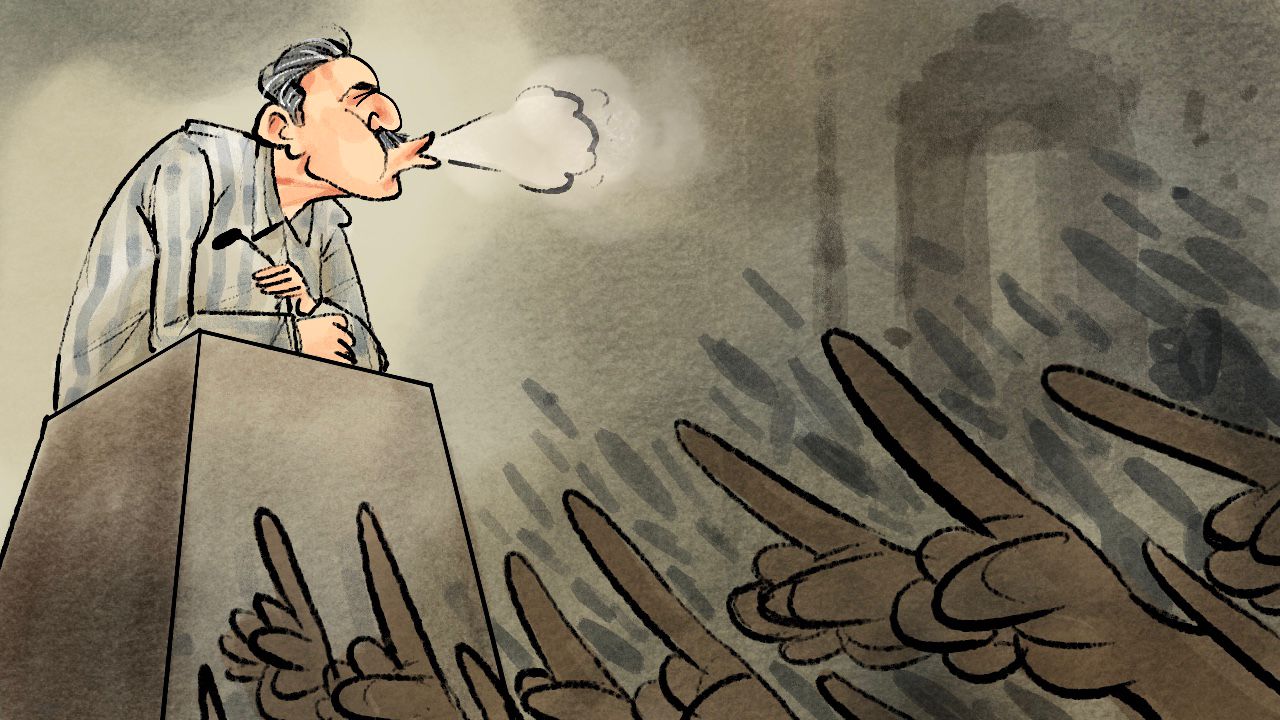
For doctors treating wheezing children, breathless young adults, and ageing lungs collapsing under the weight of smog, the government’s stance was more than a bureaucratic quibble: it amounted to a denial of suffering.
Synopsis: Union Environment Minister Kirti Vardhan Singh’s statement in the Rajya Sabha, which apparently tried to trivialise India’s air pollution, drew sharp and sarcastic remarks from concerned public health experts and citizens. Lungs do not have politics, and they do not care if it was India or the WHO that drafted the guidelines for ensuring clean air. Netizens even went to the extent of recommending that the government blame the ‘polluted’ situation on Jawaharlal Nehru.
The Union government has left health experts and citizens stumped, saying that the global air-quality rankings are “not conducted by an official authority”.
The Ministry of Environment, Forest and Climate Change (MoEF&CC) made the statement in the Rajya Sabha on Thursday, 11 December, in response to a question by CPI(M)’s V Sivadasan.
Environment Minister Kirti Vardhan Singh’s statement came even as the World Air Quality Report-2024 by IQAir, a Swiss air quality technology company, found 13 of the world’s 20 most-polluted cities in India.
The report also categorised the now-choking Delhi as the most-polluted capital city in the world in 2024.
The minister’s statement— distancing the country from international assessments that have consistently placed India among the world’s most polluted regions — triggered a wave of disbelief among public health experts, doctors and citizens.
For doctors treating wheezing children, breathless young adults, and ageing lungs collapsing under the weight of smog, the government’s stance was more than a bureaucratic quibble: it amounted to a denial of suffering.
“Lungs don’t recognise politics, they only recognise particles,” a Bengaluru-based senior pulmonologist told South First on condition of anonymity. Pulmonologists across India said the government’s attempt to downplay rankings ignored an undeniable medical truth.
“A lung in Delhi or Bengaluru or Chennai doesn’t care whether WHO drafted the guideline or the Indian government did. It reacts only to what enters it: PM (Particulate Matter) 2.5, NO2 (nitrogen dioxide), smoke, dust,” the doctor fumed.
He added that dismissing global benchmarks might help cosmetically. “But it doesn’t remove a single pollutant molecule from the air Indians breathe.”
In his question, Sivadasan sought details on India’s year-wise global rankings in major air-quality indices, the parameters these indices use for assessing pollution levels, internal reviews undertaken of the country’s performance in these international indices and steps planned to improve India’s global standing in future global pollution assessments.
The minister replied that pollution rankings worldwide were “not conducted by an official authority,” effectively sidestepping the request for India’s positions in IQAir, WHO, EPI and GBD assessments.
He further said that WHO’s air-quality guidelines were merely “recommended values” and argued that every country must set its own standards based on geography, environmental conditions, background pollution levels, socio-economic factors and national circumstances.
Instead of responding to the global metrics mentioned in the question, the reply highlighted India’s domestic National Ambient Air Quality Standards (NAAQS) and focused on MoEF&CC’s Swachh Vayu Survekshan, an annual exercise ranking 130 National Clean Air Programme (NCAP) cities on the implementation of air-quality measures, with top performers felicitated on National Swachh Vayu Diwas.
The ministry’s answer emphasised India’s own NAAQS and pointed to the Swachh Vayu Survekshan—a government-run ranking of 130 cities based on compliance with NCAP measures.
Meanwhile, pulmonologists have been witnessing a silent epidemic that the minister’s response could not hide.
Children waking up with persistent cough, office workers sustaining themselves on inhalers, elderly patients whose lungs resemble long-term smokers despite never having touched a cigarette, and increasing cases of early Chronic obstructive pulmonary disease (COPD) in non-smokers.
Speaking to South First, allergy specialist Dr Vyakaran Nageshwar from Telangana said, “The pollution problem is increasing day-by-day, but the strategies or a long-term plan are just on ledger updates.”
Dr Nageshwar, also working on an independent mission of Swaach Aakash Abhiyan, explained that there was evidence that pollution affects beyond the lungs or heart. Pollution could pass immunological diseases down to generations to come.
He urged the government to look at multi-level planning to address this issue in India.
“Pollution does not start at Parliament, and such debates on pollution do not end there! This absolutely needs strengthening of laws and making citizens responsible,” Dr Nageshwar added.
Meanwhile, it can be noted that IQAir reported that India had not met the WHO’s air-quality standards in 2024. India was the fifth most-polluted country in the world.
A Lancet Planetary Health study released in December 2014 estimated that India witnessed nearly 1.5 million more deaths annually due to prolonged exposure to polluted air—deaths that could have been prevented if the country had met the WHO-recommended safe air-quality levels.
Environmental health researchers said rejecting global comparisons prevented India from understanding the severity of its crisis.
A senior epidemiologist, who did not want to be identified, did not hide his anger. “You cannot fix what you refuse to measure. Ignoring global standards delays the acknowledgement of a public health emergency,” he said.
He explained that India’s air pollution has repeatedly been linked to premature deaths, stunted lung development in children, heart disease, and rising cancer risk. Global indices don’t invent these problems, they reveal them, he added.
Speaking to South First, Bengaluru-based public health expert Dr Sylvia Karpagam said the trend of changing standards for all concerning indicators was “extremely dangerous”.
She said standards in public health were something experts sought to improve people’s lives. “Instead of recognising problems and finding short- and long-term solutions, the government has been dismissing incriminating and concerning data,” she said.
Referring to earlier such illogical changes, Dr Karpagam questioned if the government’s next step would be to do away with the data, “as happened with the National Family Health Survey (NFHS) 6. They tried that with anaemia, with stunting, with hunger index,” she lamented.
Akhila Vasan, an activist associated with Karnataka Janaarogya Chaluvali, said the government seemed to be adept at dodging accountability.
“It (the government’s version) would have been laughable if the situation were not so dangerous. Infants are dying, and there are all possible risks of newborns suffering complications. This government’s action is truly dystopic,” she said.
The minister’s reply in the Rajya Sabha made the cyberspace reverberate with sarcasm, humour, and medical logic, calling out the government’s stand.
Vimlendu Jha, Environmentalist and Founder of Swechha, was sarcastic on X. “If you don’t pass the exam, change the pass marks to what you have scored. And you pass! So basically, European lungs work optimally at PM 2.5 levels of 15, and Indian lungs made of steel work best at PM 2.5 levels of 200!”
Another handle, @gopalganj_index, criticised the government’s attempt to change the syllabus instead of fixing the problem. The user accused the government of gaslighting the public and shifting goalposts rather than addressing toxic air that has been endangering citizens’ health.
“This is the classic ‘if you can’t pass the exam, just change the syllabus’ strategy. It is absolute cowardice. Instead of fixing the #toxic_air that is literally choking your citizens, you reject the yardstick simply because it exposes your incompetence? You cannot breathe “national circumstances, you breathe #poison! Stop #gaslighting the public by moving the goalposts just because you are failing miserably at protecting public health. If you can’t meet the standard, FIX THE #POLLUTION, don’t change the rules to make your failure look like success,” he said, adding the hashtags Delhi, AQI and Air Pollution.
An advocate with the handle @avinashmane, too, was sarcastic. “When you can’t clean the air, you just clean the definition of ‘air’. When you can’t change the numbers, you simply change the meter. When you can’t fix a city’s infrastructure, just rename the city. When you can’t improve the economy, change the GDP Calculation formula. And when you can’t answer public outcry on real issues, blame Nehru. Eleven years of the BJP’s ‘failed’ rule perfectly explained …”
Another handle, @slganesh1, commenting on the Delhi air quality and Modi government’s reply said: “Delhi’s air is so poisonous it could melt steel beams, but no tension— Modi-ji has simply upgraded the meter: 999 AQI is now officially ‘Fresh morning with mild campfire vibes.’ Was GDP contracting? Relax, they just rebranded it the ‘Viksit Bharat Prosperity Index’. Result: zero recession since 2014, only non-stop world-beating growth! Jai stats, jai optics!”
Questioning further was a handle @DrGautamGhosh_, he pointed out that the United Nations—through UNEP and the World Health Organization—sets globally accepted air-quality guidelines, tracks pollution trends, and supports member states in crafting evidence-based policies.
India, as a signatory to multiple UN environmental frameworks, including the Sustainable Development Goals and the United Nations Framework Convention (UNFCCC), has long pledged to align with these scientific thresholds for pollutants like PM2.5 and NO₂.
Users on X argued that India’s participation in platforms such as the Climate and Clean Air Coalition and the UN Global Platform on Air Quality and Health reflects a responsibility to uphold these globally accepted norms.
A user asked pointedly: “If India has already agreed to global standards, how can the government now dismiss those very benchmarks and assert its own looser definitions?”
Netizens further questioned Minister Singh’s authority to “distort” or disregard internationally accepted responsibilities.
(Edited by Majnu Babu).


