


Published Mar 01, 2026 | 7:00 AM ⚊ Updated Mar 01, 2026 | 12:22 PM

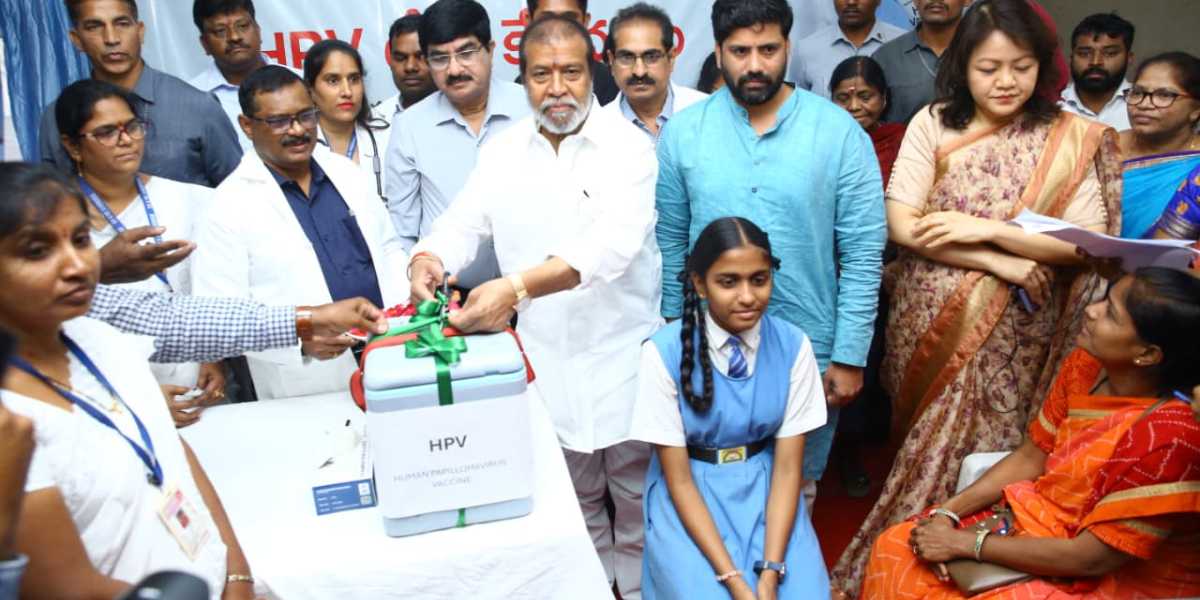
Health Minister Damodar Rajanarsimha inaugurating the vaccination drive at King Koti hospital.
Synopsis: For the first month, the vaccine will be available to girls through government general hospitals, area hospitals, and community health centres. Primary health centres enter the network after that. The campaign runs for 90 days in active mode, then shifts to routine immunisation session days.
At 11.30 in the morning, inside the District Hospital at King Koti, Hyderabad, a girl named Hemadarshini rolled up her sleeve.
She was 14. Her mother stood beside her. A health worker uncapped a syringe loaded with 0.5 ml of Gardasil 4 and administered it into Hemadarshini’s left upper arm. The process took seconds. Then, as protocol requires, she was led to a six-bed observation room and asked to wait for 30 minutes.
Around her, the hospital had transformed for the occasion. Cold chain boxes sat on designated tables. ASHAs moved between parents and registration desks. A doctor watched over the AEFI — adverse events following immunisation — room with a kit nearby, prepared for reactions that, in all probability, would not come.
By the time the morning ended, eight girls had received the vaccine at King Koti. Across the country, thousands more had lined up at government facilities from Ajmer to Aizawl.
India, finally, launched its nationwide HPV vaccination programme — 16 years after the last attempt collapsed, and a full generation after the rest of the world moved ahead without it.
The observation period after vaccination has been part of the protocol since 2009, when seven girls died following HPV vaccination in Andhra Pradesh and Gujarat, and the nation spent years debating whether the vaccine had killed them. Protocol matters more than it might anywhere else in the world.
The ICMR inquiry that followed those deaths ultimately concluded the vaccine did not cause any of them. But the programme collapsed anyway, withdrawn under the weight of social media accusations that the committee later called “totally wrong and totally unscientific.” India spent sixteen years on the sidelines while 160 countries vaccinated their daughters.
The doctor overseeing the AEFI room at King Koti on Saturday, 28 February, understood what the moment carried.
“Although the vaccine is safe,” he said, “we observe all beneficiaries for at least 30 minutes to rule out any immediate adverse reactions.”
Hemadarshini left the hospital without incident after 30 minutes.
Six hundred kilometres away, in Ajmer, Rajasthan, Prime Minister Narendra Modi addressed the nation as he launched the campaign that brought Hemadarshini to the hospital room.
He did not frame it as a medical programme alone. He framed it as an act of care.
“We all know that when a mother falls ill in the family, the house feels scattered,” he said. “If the mother is healthy, the family remains capable of facing every crisis. With this sentiment, the government has run many schemes to provide support to women.”
He traced a line from toilet construction to affordable sanitary pads to clean cooking fuel under the Pradhan Mantri Ujjwala Yojana — a deliberate argument that the HPV campaign sits inside a larger shift in how the Indian state thinks about women’s bodies. Not as afterthoughts. As policy.
In Hyderabad, Health Minister Damodar Rajanarsimha stood at the King Koti podium and translated that national moment into state-level urgency.
“Today, we have inaugurated a historic milestone in the health sector,” he said. “We have launched a massive programme to protect the health of girl children.”
He named the scale of what the state confronts: 55,000 to 60,000 cancer cases are registered in Telangana every year. Experts warn that the number will rise by ten per cent in five years. Cervical cancer alone strikes around 3,200 women in Telangana annually — nearly nine every single day.
“This is the only cancer in the world that can be prevented early,” he said. “This cancer is caused by a virus called human papillomavirus in 99.7 percent of patients. To end that virus… today, with the support of the central government, we have started a statewide HPV vaccination drive.”
He made the economics plain, too. In the private sector, one dose of Gardasil costs between ₹3,000 and ₹4,000. The government offers it at no charge.
“My appeal to all parents — if you have a 14-year-old girl at home, come forward immediately and get this vaccine.”
The target in Telangana is specific: girls who have completed their 14th birthday but not yet turned 15. The state estimates roughly three to four lakh girls fall within that window. Around 1.45 lakh doses have arrived so far, with supplies being released in phases as awareness efforts build and consent rates rise.
The word consent carries weight in this programme. Every vaccination requires a parent or guardian to be present. Consent gets recorded digitally on the U-WIN platform, the same infrastructure that tracked COVID-19 vaccinations. In areas without connectivity, a hard copy format applies.
Sangeetha Satyanarayana, Commissioner of Health and Family Welfare, told reporters the routine rollout begins on 8 March — International Women’s Day. She chose the date with purpose.
For the first month, the vaccine will be available to girls through government general hospitals, area hospitals, and community health centres. Primary health centres enter the network after that. The campaign runs for 90 days in active mode, then shifts to routine immunisation session days.
Sixty thousand personnel — medical officers, ANMs, ASHAs — have completed training. Every session site connects to a 24-hour AEFI management centre. Anaphylaxis kits sit at each vaccination point.
The programme uses Gardasil 4, a quadrivalent vaccine that protects against HPV types 6, 11, 16, and 18 — the strains responsible for the majority of cervical cancers. A single dose, the WHO determined after years of follow-up data, produces protection that lasts.
Telangana did not exist in 2009. The state carved itself out of Andhra Pradesh in 2014. But Bhadrachalam — the district where those girls lined up in the hostel in Yeragutta, where wardens signed consent forms instead of parents, where deaths went unreported for months — is now in Telangana.
The programme launched on Saturday descends from the ruins of that earlier one. The differences are structural and deliberate: parental presence mandatory, consent digital and recorded, observation rooms staffed, cold chain monitored, doses tracked to individual beneficiaries.
The Health Minister acknowledged the burden the state carries in cancer care more broadly. Chemotherapy services now reach remote districts like Mulugu and Adilabad. Day care cancer centres operate in every district. Mobile screening units move toward early detection. Arogya Mahila Clinics run tests for women. Cancer is soon to be declared a notifiable disease. Dr Nori Dattatreyudu advises the state government.
The vaccination programme slots into that infrastructure — prevention feeding into a system built for detection and treatment.
Hemadarshini sat in the AEFI observation room for 30 minutes and then walked out of King Koti Hospital with her mother and a vaccination certificate that Health Minister Rajanarsimha had handed to her earlier.
Five other girls did the same that morning.
Next week, on International Women’s Day, the system opens to the rest of the state’s four lakh eligible girls — in hospitals, in health centres, eventually in the primary care facilities that reach the districts where women have historically had the least.
The vaccine that India dropped from the programme in 2010 now moves through the same public health machinery, rebuilt with consent forms that parents sign themselves, in languages they read, in rooms where they stand beside their daughters.
Cervical cancer kills nearly 80,000 Indian women every year. The virus that causes it is preventable. The shot that prevents it costs nothing, at a government facility, for any girl who turns 14.
(Edited by Majnu Babu).


