


The bill comes after years of failed attempts. The Indian Medical Association drafted a model central law in 2017. A government committee prepared another bill in 2019 after violent attacks on doctors at a Kolkata medical college triggered nationwide strikes.

Published Dec 10, 2025 | 5:06 PM ⚊ Updated Dec 10, 2025 | 5:16 PM

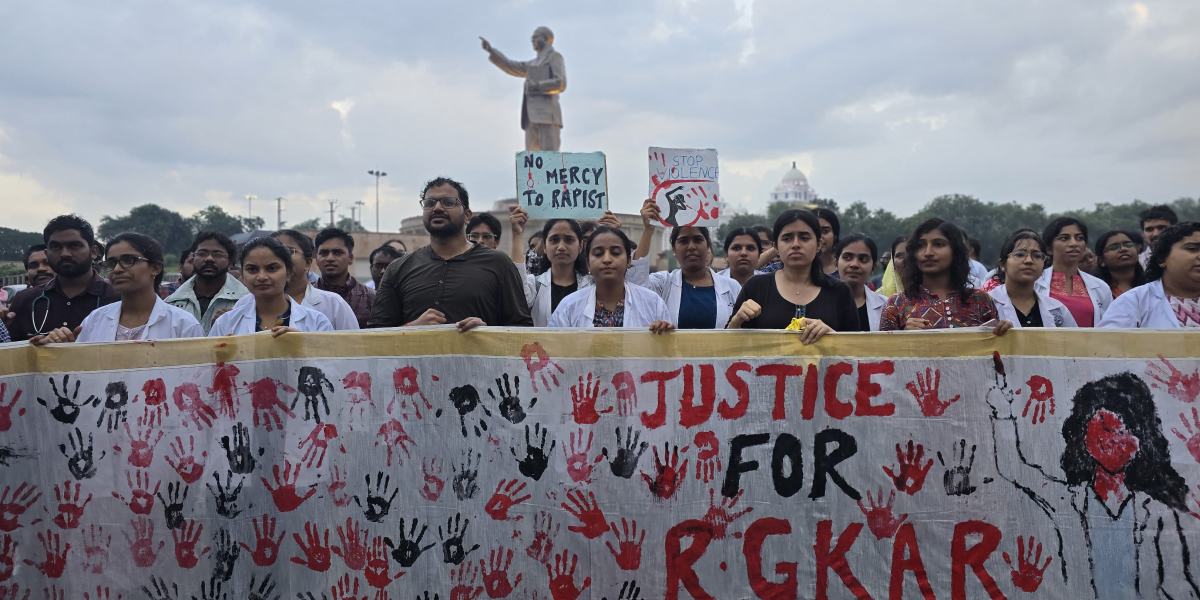
Telangana junior doctors strike in the aftermath of the rape and murder of a young doctor at RG Kar Medical College in Kolkata in August 2025.
Synopsis: A new private member’s bill introduced in the Rajya Sabha proposes prison terms of up to ten years, and heavy fines for anyone who assaults doctors or other healthcare workers, marking the strongest national attempt yet to address violence in hospitals. The draft law sets strict timelines for investigations, creates special courts, expands the definition of violence to include verbal abuse and obstruction of duty, and requires hospitals to implement extensive safety measures.
Six months in prison for a person who slaps a doctor in an emergency room. A minimum of three years behind bars for anyone who assaults a nurse. Up to a decade in jail for anyone who assaults and kills a healthcare worker…
These are the punishments proposed in a private member’s Bill tabled in the Rajya Sabha on 5 December. The Central Protection of Healthcare Workers and Medical Establishments from Violence Bill, 2025, introduced by MP Fauzia Khan, is the latest attempt to answer a demand Indian doctors have raised for three decades: a pan-India law that ensures their safety while they work.
“These very doctors and healthcare workers are being threatened, assaulted, abused, attacked, and mobbed,” Khan told the Rajya Sabha in her Zero Hour submission.
The bill comes after years of failed attempts. The Indian Medical Association drafted a model central law in 2017. A government committee prepared another bill in 2019 after violent attacks on doctors at a Kolkata medical college triggered nationwide strikes. That bill never reached Parliament. The Centre argued that existing laws and state statutes already provided adequate protection.
Doctors disagreed. They continued facing assaults. Three out of every four doctors in India have experienced violence at some point, according to an IMA survey. Around 19 states passed their own protection laws over the years, but enforcement remained weak and coverage patchy.
“This problem is not limited to any state. It is everywhere, all over the nation,” Khan said. “Repeated assaults lead to doctors being unwilling to take up emergency or trauma duties. And obviously, when doctors do not feel safe, patients ultimately pay the price.”
Khan’s bill takes a harder line than previous attempts. It creates a framework that combines swift investigation, strict punishment and mandatory compensation.
The bill casts a wide net over what counts as violence. Physical harm qualifies, whether it results in minor injury, grievous hurt or death. Psychological abuse is included. Verbal attacks that insult, humiliate or provoke a healthcare worker become criminal acts.
Any interference that stops a doctor or nurse from doing their job falls under the law. Harassment that violates dignity counts as violence. Damage to property, medical equipment or documents also triggers criminal liability.
The law treats attacks motivated by caste, gender, religion, language or place of birth as separate, specific violations.
For a standard act of violence or property damage, the bill prescribes imprisonment between six months and five years. The fine ranges from ₹50,000 to ₹5 lakh. Anyone who commits, encourages or provokes such violence faces this punishment.
The sentence rises sharply when attackers cause grievous hurt, defined under the Bharatiya Nyaya Sanhita, 2023. The minimum prison term is three years. The maximum extends to 10 years. The fine starts at ₹2 lakh and can rise to ₹10 lakh.
Beyond criminal penalties, the bill mandates compensation. A convicted attacker must pay twice the market value of any property they damaged. If they hurt a healthcare worker, they owe ₹1 lakh. If they cause grievous hurt, the amount rises to ₹5 lakh. Courts can order more if circumstances warrant it. If the convicted person refuses to pay, the government will collect the money the same way it collects land revenue.
The bill compresses the timeline for justice. When violence occurs, the head of the medical establishment must file an institutional FIR within six hours. Police must register it within one hour of receiving the complaint.
An inspector or higher-ranking officer must handle the investigation. A deputy superintendent of police or someone more senior must supervise the work. The investigation must conclude within 30 days of FIR registration.
The government must establish special courts in each district to try these cases. Once witness examination begins, trials will proceed on a day-to-day basis. Courts should finish the trial within one year of filing the charge sheet. Extensions can run up to six months at a time, but judges must record their reasons.
The bill makes these offences cognizable and non-bailable, overriding provisions in the Bharatiya Nagarik Suraksha Sanhita, 2023.
Courts receive extraordinary powers under the bill. They will presume that an accused person committed the offence unless the person proves otherwise. In cases requiring a culpable mental state, courts will presume the accused possessed that mental state. The burden shifts to the accused to prove they lacked the required intention, motive, knowledge or belief.
The bill prohibits anyone from carrying or displaying weapons inside medical establishments, even if they hold valid licences. Only law enforcement and security personnel on duty receive exemptions. Violators face one to six months in prison, or fines between ₹50,000 and ₹3 lakh, or both.
To prevent misuse, the bill punishes false and malicious complaints. If a court determines that someone filed a bogus charge, that person faces prosecution under the Bharatiya Nyaya Sanhita, 2023.
The bill does not stop at criminalising violence. It requires medical establishments to create safe working environments.
Every hospital and clinic must develop a workplace safety policy. They must install CCTV cameras in emergency rooms, operation theatres and connecting pathways. They must deploy trained security personnel. They must station quick response teams equipped with communication tools.
Hospitals must provide safe transportation for healthcare workers during night shifts. They must create secure duty and rest rooms. Female healthcare workers must have separate facilities. Access control systems must restrict unauthorised entry into ICUs, emergency wards and resting rooms.
Before starting treatment, doctors must give patients or their family members an explanatory note describing the medical condition, expected procedures, possible outcomes, recovery time, chances of failure and estimated expenses. Patients or attendants must confirm they understand.
Medical establishments must offer mental health counselling for staff who experience violence. They must maintain emergency reporting mechanisms. They must display information for patients, visitors and staff throughout the premises.
Khan pointed to structural failures that fuel violence. “Families arrive in emergency rooms, frightened, desperate, and overwhelmed. The communication in these moments can turn dangerous,” she said.
She highlighted that most delays arise from deep shortages in the public health system. Overcrowded government hospitals, lack of basic security, non-functional CCTVs and untrained security staff create conditions where violence erupts.
Establishments that violate these requirements face disciplinary action, suspension or revocation of medical practice licences. The government can seal institutions that refuse to comply.
The bill creates a State Healthcare Protection Board in each state and union territory, led by the health minister. The board will monitor compliance, coordinate with law enforcement and supervise district committees.
District Healthcare Vigilance Committees, led by district magistrates, will audit compliance in hospitals, investigate official misconduct and track violence incidents. These committees will submit reports twice a year. The state board will send an annual report to the government with recommendations.
The Central Government retains oversight powers. It can issue guidelines, demand compliance reports and conduct periodic reviews of state performance.
Doctors have pursued a central protection law since the 1990s, when assaults and litigation began rising in government hospitals.
The IMA has led repeated national campaigns. The 2019 Kolkata attacks triggered nationwide strikes and a draft bill that never reached Parliament. During Covid, the government passed a temporary ordinance protecting healthcare workers during epidemics, but doctors wanted permanent and comprehensive protection.
The rape and murder of a young doctor at RG Kar Medical College in Kolkata in August 2025 triggered fresh strikes and renewed demands for a central Act with “airport-like” security in hospitals.
Khan told the Rajya Sabha that health falls under concurrent jurisdiction, giving Parliament full authority to pass national legislation. “What we need is an effective national doctor and healthcare workers’ safety and protection act,” she said.
She emphasised that the country needs health and medical justice tribunals staffed with medical legal experts, subject experts and forensic specialists. She also called for increased health department budgets.
“The current system cannot differentiate between medical complications, adverse outcomes, and criminal negligence,” Khan said. “FIRs are often filed against doctors without expert review, and the police, without medical training, investigate complex clinical outcomes.”
The government has failed to step in with the urgency the situation demands, Khan said. Doctors and healthcare workers save lives. People place extreme faith in them, almost next to their faith in God. Yet these professionals face threats and attacks while trying to do their jobs.


