

Published Apr 17, 2026 | 7:00 AM ⚊ Updated Apr 17, 2026 | 7:00 AM

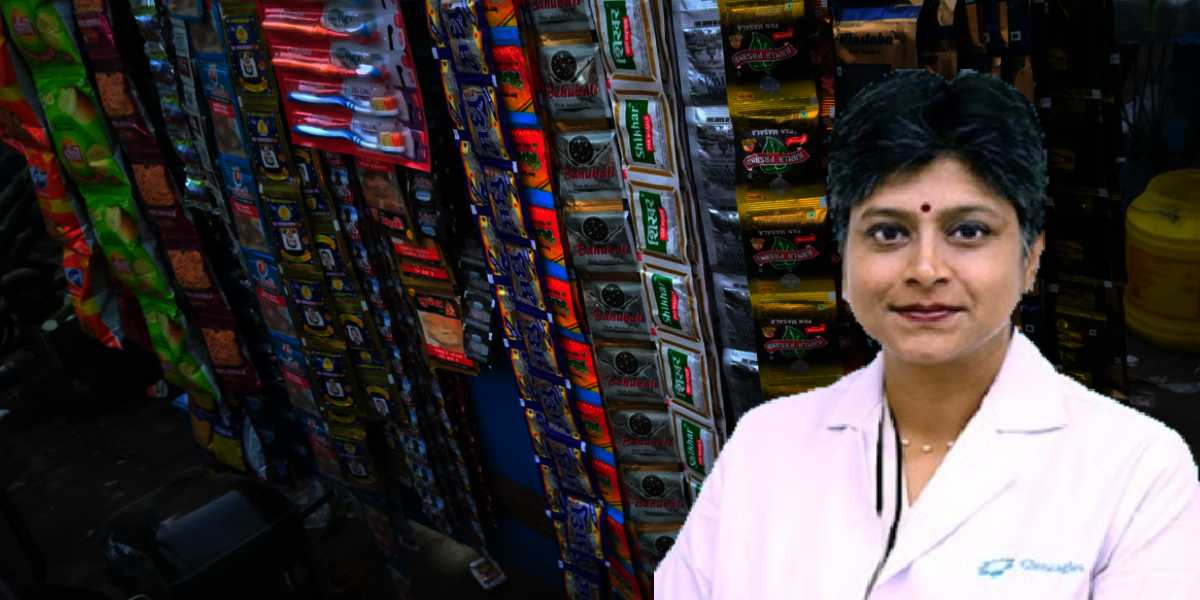
Dr Shubhra Chauhan Aramanai explains why India became the oral cancer capital of the world, why gutkha is now tearing through South India.

Synopsis: Most oral cancer patients in India are diagnosed at a late stage, even though early detection can save the majority of lives. Chewing tobacco use, delayed care and poor enforcement of bans have driven the crisis, with many patients seeking help only when the disease is advanced. In a conversation with South First, Dr Shubhra Chauhan Aramanai explains why this gap persists and what needs to change to reverse it.
India has a cancer that carries its name. Buccal gingival complex cancer, cancer of the inner cheek and gum, is so prevalent here that oncologists worldwide have an informal term for it: Indian cancer.
It is not a distinction anyone sought, but it is one India has earned through decades of unchecked tobacco use, a thriving black market for a banned product, and a healthcare system that still sees most patients only when it is almost too late.
The numbers bear this out with uncomfortable precision. India accounts for nearly a third of all oral cancer deaths globally. Over two lakh new cases are diagnosed every year. The five-year survival rate stands at just 37.2 percent, meaning nearly two in three patients do not live beyond five years after diagnosis.
Yet catch the same cancer at stage one, and 85 to 90 percent of patients survive. The difference between those two outcomes is simply time.
Dr Shubhra Chauhan Aramanai, Senior Consultant and Head and Neck Oncosurgeon at Gleneagles HealthCity, Fortis Network, Chennai, sits with that gap every day.
South First spoke to her about why India became the oral cancer capital of the world, why gutkha is now tearing through South India, what celebrity advertising is doing to a generation of teenagers, and why a cancer a doctor can detect with a torch and the naked eye is still killing lakhs of Indians every year.
Also Read: Cough syrups not for children under two, says India’s new National Formulary
Even at a corporate hospital in Chennai, an educated, financially stable patient base by any measure, Dr Chauhan estimates that 60 to 70 percent of the oral cancer patients who walk into her OPD are already at stage three or stage four.
“We want to see at least 70 to 80 percent of patients in the pre-cancer or first or second stage,” she says. “And we want that stage three and stage four percentage to go down to 20 percent, if not lower. In India, still, it is the other way around. We are seeing 60 to 70 percent of patients in stage three and stage four. The whole idea is to swap it.”
That word, pre-cancer, is important, and it is one that does not get nearly enough public attention. Oral cancer does not simply appear. It announces itself first. White or red patches in the mouth that do not rub away, a thickening of the inner cheek, a non-healing ulcer on the gum, these are the mouth’s early warning signals, the stage before cancer has actually taken hold.
“If we are able to catch those patients early, nothing like it,” Dr Chauhan says. “Either these patients will never develop cancer because they will get treated in the prior stage itself, or even if they do develop cancer, because they are under medical surveillance, the chance of their cancer developing will be at a very early stage.”
The window exists. India is simply not using it.
To understand why India bears such a disproportionate share of this burden, you have to understand one fundamental difference between tobacco use here and in the West: chewing.
“In smoking, you finish the cigarette and you push it off,” Dr Chauhan explains. “But in chewing, you tend to leave the quid in the mouth for a very long time. Some people even put it in and sleep over it.”
That seemingly small distinction has enormous biological consequences. Tobacco and areca nut release chemicals when held in the mouth, not one or two chemicals, but thousands. Among them, 60 to 70 are carcinogens, substances that directly trigger cancerous changes in tissue.
“Imagine those being released in your mouth, staying continuously, because they tend to take it sometimes 15 to 20 times a day, or even if they take it five to ten times, they leave it in the mouth for at least 18 hours in the day,” she says. “So continuously your tissue is getting exposed to that carcinogen. And that increases the risk for cancer.”
There is also a widespread and dangerous misconception that areca nut, supari, is safe because it is not tobacco. It is not.
“Anybody claiming that I don’t take chewing tobacco, I’m just eating supari or areca nut and I will not get cancer, it is highly proven to have a high risk of cancer,” Dr Chauhan says. “The difference is that it takes a little longer. But the risk is very much there.”
Also Read: Tamil Nadu sees steady rise in organ donations, but waiting list remains long
For years, South India held a kind of demographic advantage. Gutkha consumption rates in Kerala, Tamil Nadu and Karnataka were negligible, under two percent in most cases. That story is now over.
Data from the Economic Advisory Council to the Prime Minister shows that rural gutkha consumption in Karnataka has risen roughly 23 times in just over a decade. Telangana has recorded a tenfold increase. These are not remote, impoverished states, Karnataka is home to Bengaluru, one of India’s most economically dynamic cities.
Dr Chauhan’s explanation for this is specific and unsettling. It is not, she argues, simply a story of local populations discovering a product. It is a story of migration carrying habits across state lines.
“With time, movement has increased. You see a large portion of labourers, and non-labourers, even educated crowds, moving to the south. And when you move from your state to another, you tend to take the habits of that state with you. Those habits have started inculcating in the native population. They have been exposed to the habit. And now the native population of that state has started using it more.”
Tamil Nadu, she adds, is not immune. “In Tamil Nadu also, it is picking up now. There is so much population from Odisha, Bengal, so many people coming. And the habit is getting inculcated into the other native members. I can now get a lot of native Tamil population patients with a chewing habit history coming with cancer.”
The mechanism that makes this so difficult to reverse is addiction. Gutkha contains nicotine, not the carcinogen, she is careful to clarify, but the substance that makes users return to the product again and again. Once the habit takes hold, the window to intervene narrows rapidly.
“Initially when they start, it is without addiction. Once they start taking and they realise they are able to work, they get used to it. And once the nicotine has come in, even if later they realise the misuse of it, or even if they know it is not good and they should stop, by then they are addicted.”
Gutkha’s spread among low-income populations is not accidental. It is, in a blunt phrase Dr Chauhan uses without hesitation, “a poor man’s kick.”
For a labourer working a double shift at a brick kiln, unable to break for a proper meal, a gutkha sachet offers something a cigarette cannot: a long, sustained effect from a single, cheap product. It suppresses hunger. It keeps the user alert. It costs almost nothing.
“A cigarette means you have to consume many in a day, which makes the expense much higher. With gutkha, you keep it in there and it gives the effect for a very long time. That is why chewing is more common in lower socioeconomic groups, they feel it helps them stay alert and awake for long work.”
By the time these users understand the risk they are carrying, many are already addicted. And by the time they seek medical help, many are already at stage three or four.
Also Read: Long hours, tired hands: India’s resident doctors are working shifts that lead to fatal mistakes
The delay between first symptom and first consultation is one of the central tragedies of India’s oral cancer story. Dr Chauhan identifies three distinct reasons for it, and they compound each other.
The first is pain, or rather, its absence. Oral cancer is frequently painless in its early stages. Patients manage the discomfort with home remedies, attribute it to a tooth problem or an infection, and keep going.
The second is fear, specifically, fear of what treatment will look like. “At least 80 to 90 percent of people who are using tobacco substances know that the treatment is surgical,” she says. “And when it deals with the face, what they feel is, my God, if I go now, they will cut a portion of my tongue or my cheek or my jaw. That thought itself is scary, which makes them keep pulling it.”
So they wait. They wait until the pain becomes unbearable, until the lesion begins to smell, until a fistula, a hole through the cheek, makes concealment impossible. By then, it is stage three or stage four.
The third reason is neglect. Elderly patients with longstanding habits are sometimes not taken to hospital promptly even when they raise concerns. “Though the percentage is maybe 15 to 20 percent, it is still another percentage of people who get delayed for that reason.”
Gutkha has been banned in India since 2013. It is available in virtually every pan shop in the country.
Its brands appear on hoardings at cricket grounds, positioned deliberately to catch the sweep of television cameras. When a young batter hits a celebrated six in Visakhapatnam and the slow-motion replay rolls, gutkha brands are in the frame behind him. Some of India’s most recognisable cricketers and Bollywood stars front campaigns for products nominally described as cardamom or mouth freshener, under brand names identical to the gutkha sachets sold a few feet away at the nearest shop.
Dr Chauhan does not mince her words about the impact of this on the patients she treats.
“Tobacco is a multi-millionaire business. When a business is giving so much financial impact, you can understand how much impact it will have on policymaking.”
She traces the cultural shift precisely. “There was a time when only the villain smoked in films. Smoking was associated with the negative character. Now even the protagonist smokes. Smoking has become a style statement.”
The audience most affected, she says, is not college students. It is school children. “From class eight or nine, because those movies are not adult movies. It has a very high influence on the teenage population.”
The peer pressure mechanism does the rest. By the time these teenagers enter the workforce and have money to spend, many are already addicted. The advertising worked years earlier.
Also Read: How Telangana scan centre’s reports sent patients down wrong path
E-cigarettes are banned in India. They are also readily available, regularly seized in police raids across major cities, and increasingly marketed to urban youth as the sophisticated, safer alternative to smoking.
Dr Chauhan is unequivocal: there is no safe alternative.
“There was a time when there was confusion about whether vaping causes cancer. But now, including a review article published in 2026 in the Carcinogens journal, it is well proven that e-cigarettes and vapes contain enough carcinogens to cause oral cancer changes.”
The specific compounds she lists, lead, nickel, diacetyl, formaldehyde, acrolein, are not trace elements. They are present in the aerosol that users inhale directly into the oral cavity and lungs.
There is a further irony in the assumption that finer, more filtered smoke means less harm. “The finer you go, the more carcinogens actually reach the lung,” she says. “Some people feel that high-cost, ultra-filtered cigarettes reduce their exposure. I will say a total no. If the carcinogens are there, you are still smoking them. And being fine, you are actually exposing more carcinogens to the lung, not less.”
For anyone who has switched to vaping believing they have reduced their cancer risk, her message is direct: “If they are claiming it is a way to stop cancer risk, that is a total no. There is still a higher risk of cancer with that.”
The single most powerful barrier to early treatment is the belief that surgery means disfigurement, a hollowed cheek, a missing jaw, a face that will never look the same.
That belief is, by now, substantially outdated. But it is still costing lives.
“In cancer treatment, unlike before where they were only looking at survival, we now look at quality of life,” Dr Chauhan explains. “We work towards making the patient’s face and function as near normal as possible.”
For early-stage patients, the equation is straightforward. Smaller tumour means smaller surgery. Smaller surgery means less tissue removed, less reconstruction needed, faster return to normal life. Many stage one and stage two patients need only a single treatment modality, surgery alone, or radiotherapy alone.
“When you come in early, the treatment is smaller. You may not need all modalities. Which makes your treatment smaller, your deficit smaller, and your recovery faster.”
Stage four is not the end of the road either. “Unlike that old idea that stage four means no treatment and the patient is going, it is not like that. Stage four is divided into multiple sub-stages. Stage four A, and some stage four B patients, are treatable. They have not yet spread the cancer in the body. Though the percentage is 50-50, we have to give every eligible patient that chance.”
Also Read: Buying eye drops without prescription? Hyderabad scientists flag superbug crisis
The solutions are not mysterious. They are simply unapplied.
Screening coverage for oral cancer in India stands at below two percent of the adult population, for a cancer that a trained community health worker can detect with a torch and a gloved finger. A pre-cancer lesion caught in a village health centre costs almost nothing to treat. The same patient arriving at a tertiary hospital in stage four costs the public health system enormously, and still has only a coin-toss chance of surviving five years.
The gutkha ban exists on paper and nowhere else. The surrogate advertising machine runs at full power through every IPL broadcast and every Bollywood release. Taxation on smokeless tobacco remains inadequate.
And every day, patients who noticed something in their mouth weeks ago are still waiting, still afraid, still hoping it will go away on its own.
Dr Chauhan’s closing point is the same one she makes to every patient who sits across from her OPD desk, and the same one she would make to anyone reading this.
“Early detection is the key. If you come in early, you can be treated with much less deficit. The treatment is smaller, the recovery is faster, and the chance of living a normal life after cancer is real. You lose nothing by getting an evaluation. Nothing at all.”



