

Published Jan 25, 2026 | 9:48 AM ⚊ Updated Jan 25, 2026 | 9:48 AM

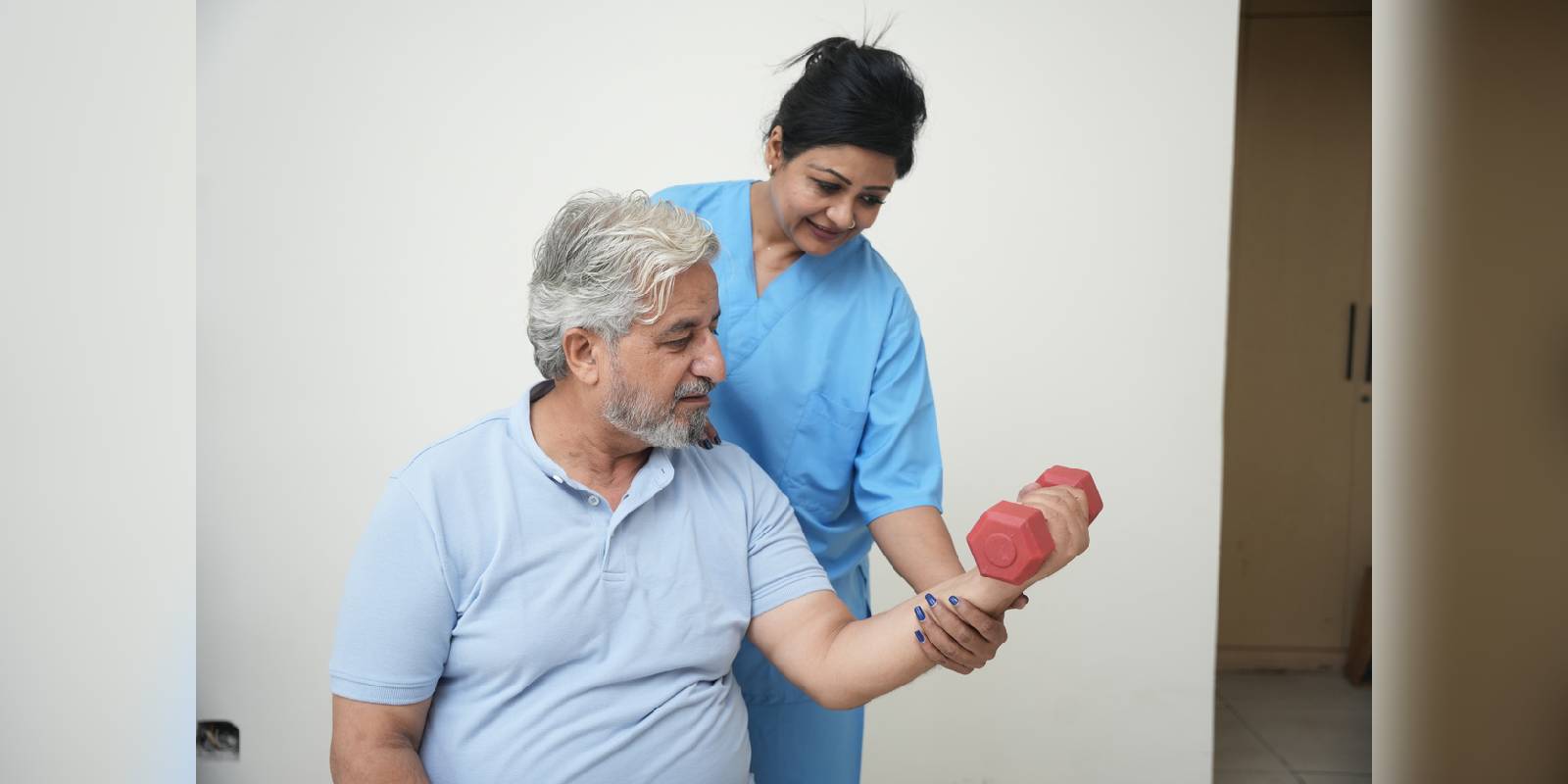
Physiotherapists. (Representative image/ iStock)
Synopsis: The Kerala High Court ruled that physiotherapists and occupational therapists can legally use the prefix “Dr” with their names, dismissing petitions filed by medical doctors who claimed exclusive rights to the title. The court’s final verdict comprehensively addressing the legal and historical foundations of the title “Doctor”.
In a significant reversal of its earlier position, the Kerala High Court ruled that physiotherapists and occupational therapists can legally use the prefix “Dr” with their names, dismissing petitions filed by medical doctors who claimed exclusive rights to the title.
The judgement, delivered by Justice VG Arun on 22 January, marks a comprehensive shift from the court’s interim order issued in November 2025, which had temporarily restrained physiotherapists and occupational therapists from using the “Dr” title without recognised medical qualifications.
In November, Justice Arun had expressed concerns about public health risks, observing that allowing non-medical professionals to independently diagnose patients could pose dangers to public safety. The interim order reflected apprehensions that patients might be misled into believing they were consulting allopathic doctors.
However, after detailed examination of statutory provisions, etymological evidence, and parliamentary intent, the court’s final verdict took a markedly different stance, comprehensively addressing the legal and historical foundations of the title “Doctor”.
The court delved extensively into the origins of the word to address claims of exclusivity by medical professionals. “The term ‘Doctor’ originated from the Latin word ‘Doctor’, which means teacher or instructor,” Justice Arun noted in the judgement.
He explained that around the 13th century, the term evolved into an academic title in European universities, used for “someone who had achieved the highest level of learning and had received a licence to teach in fields like theology, law and philosophy.”
The judgement stated: “Thus, the term Doctor originally meant a learned person qualified to teach. Gradually, with the advancement of medical science, University trained Physicians (holders of degrees in medicine) began to be called Doctors.”
Tracing the historical evolution further, Justice Arun observed: “The usage became much more common for physicians by the nineteenth century, as medical education formalised and the public increasingly associated the title with healers.”
Addressing the petitioners’ core argument directly, he concluded: “Therefore, the contention that the title ‘Doctor’ exclusively belongs to medical professionals is a misconception since even now, like in the olden times, persons with higher educational qualifications like a PhD are entitled to use the title ‘Doctor’.”
A crucial aspect of the ruling centred on the absence of legal provisions granting medical doctors exclusive rights to the title. The court conducted a thorough examination of the National Medical Commission Act, 2019, which governs medical practice in India.
“The NMC Act does not contain any provision for conferring the title Doctor on qualified medical professionals,” Justice Arun observed, adding that the statute “merely entitles qualified medical practitioners to have their names entered in the State Register.”
The judgement further clarified: “The expression title used in Section 40 of the Kerala State Medical Practitioners Act cannot therefore be understood as statutorily entitling the qualified medical professionals to prefix ‘Dr’ to their names.”
Drawing the logical conclusion, Justice Arun stated: “In the absence of such provision, the petitioners cannot claim exclusive right to use the prefix ‘Dr’.”
The court upheld the National Commission for Allied and Healthcare Profession Act, 2021, which provides comprehensive recognition to healthcare professionals, including physiotherapists and occupational therapists.
According to Section 2(j) of the Act, cited in the judgement, healthcare professionals include those who “studies, advises, researches, supervises or provides preventive, curative, rehabilitative, therapeutic or promotional health services” and who have “obtained any qualification of degree under this Act, the duration of which shall not be less than three thousand six hundred hours spread over a period of three years to six years divided into specific semesters.”
The court noted the rigorous nature of this training: “Healthcare professionals are conferred the qualification of degree under the NCAHP Act after undergoing extensive study of not less than three thousand six hundred hours spread over a period of three years to six years, divided into specific semesters.”
Justice Arun emphasised that whilst these professionals provide substantial healthcare services, their role remains distinct from allopathic medicine. “Even though healthcare professionals can provide preventive, curative, rehabilitative, therapeutic and promotional health services, they cannot prescribe medicines or provide allopathic treatment,” the judgement stated.
The ruling recognised that “the services provided by a healthcare professional and a medical professional are distinct, though, at times, a healthcare professional will also be playing a supporting role during allopathic treatment of patients.”
The court placed significant weight on the NCAHP Act’s status as a subsequent parliamentary enactment with overriding provisions. Section 64 of the Act provides for its overriding effect over other laws.
“The NCAHP Act, being the subsequent enactment, its provisions will prevail over the NMC Act,” the judgement noted, citing arguments from the respondents’ counsel.
Justice Arun emphasised the thorough legislative process behind the Act: “The NCAHP Act was enacted by the Parliament after due deliberation and based on the recommendations of the Parliamentary Committee, after hearing all stakeholders.”
Crucially, the court noted that the National Medical Commission itself had been consulted: “The Parliamentary Committee had made its recommendations, after hearing the National Medical Commission also.”
Additionally, the judgement pointed out that “the representative of the National Medical Commission is a member of the National Commission for Allied and Healthcare Professions,” suggesting institutional acceptance of the framework.
The court declined to interfere with parliamentary policy decisions, invoking principles of judicial restraint. Justice Arun stated: “In such circumstances, it will be inappropriate for this Court to tinker with the policy of the Government or read down the provisions of the Act or the Curriculum at the instance of a few medical professionals.”
The judgement noted that whilst courts possess the power to read down statutory provisions in appropriate cases, “this Court is unable to find any compelling reason to read down the provisions of the NCAHP Act, so as to confine the scope of discharge of professional services by Physiotherapists and Occupational Therapists as a supporting group for the qualified medical professionals registered under the NMC Act.”
The case was initiated by the Kerala branch of the Indian Medical Association, the Indian Association of Physical Medicine and Rehabilitation, and several individual doctors. They contended that only those with an MBBS degree—defined as a “recognised medical qualification” under the National Medical Commission Act, 2019—are entitled to practise modern medicine and use the title of doctor.
The petitioners argued that the NCAHP Act and the Competency-Based Curriculum for Physiotherapy and Occupational Therapy “run counter to the provisions of the National Medical Commission Act.”
They maintained that physiotherapists “only extend supporting service, and do not have the qualification or entitlement to extend their services as first-hand healthcare professionals,” and that their qualifications “can at best enable them to undertake administration of physiotherapy under the instructions of a qualified Medical Practitioner.”
The petitioners expressed particular concern about public confusion: “Use of the prefix ‘Dr’ by such persons will lead to disastrous results as patients may approach them for treatment, which can only be provided by qualified medical practitioners.”
Senior advocates appearing for the petitioners cited multiple precedents and argued that “in common parlance, the prefix ‘Dr’ is associated with a medical practitioner, and if a Physiotherapist prefixes his name with ‘Dr’, the general public would naturally assume him to be a qualified allopathic doctor.”
Senior counsel representing physiotherapists and occupational therapists raised preliminary objections about maintainability, arguing that an association of doctors lacked standing when the regulatory body — the National Medical Commission — had not objected.
They submitted that “the physiotherapy profession constitutes an independent and distinct branch of health science, forming part of the Allied Health and Rehabilitation Services.”
The Competency Based Curriculum, they argued, “Expressly recognises these professionals as first contact health providers within their domain, having autonomy to assess, plan and implement rehabilitative and therapeutic interventions.”
Counsel emphasised that the Allied Health Commission performs “a role analogous to that of the National Medical Commission in relation to medical practitioners.”
They argued that the petitioners’ attempt was “to curtail and diminish the professional status, competency and scope of practice of an entire class of recognised health professionals,” which the court should not permit under its writ jurisdiction.
The judgement contextualised the NCAHP Act within broader healthcare policy evolution. Justice Arun explained that traditionally, “the health force in the Indian scenario had focused mainly on a few cadres such as qualified modern medicine practitioners, nurses and front-line workers, while the professionals belonging to the healthcare sector were generally termed as para-medical professionals.”
However, “the advancement in the health sector and the changing preferences of consumers and service providers warranted a fresh vision of healthcare delivery with a patient-centric approach and focus on moving to a multi-disciplinary team-based care.”
This policy shift led to the introduction of the Allied and Healthcare Professions Bill in 2018, its referral to a Parliamentary Standing Committee, and ultimately the enactment of the NCAHP Act in 2021 after thorough deliberations.
The Act is “intended to provide for regulation and maintenance of standards of education and services by allied and healthcare professionals, assessment of institutions, maintenance of a Central Register and State Register, creation of a system to improve access, research and development, adoption of the latest scientific advancement and for matters connected therewith or incidental thereto.”
The petitioners had relied on several Supreme Court decisions to support their claim of exclusivity. However, Justice Arun found these precedents distinguishable: “The decisions relied on by the Senior Counsel for the petitioners are all rendered prior to or without reference to the NCAHP Act and are therefore not applicable to the cases under consideration.”
This observation was crucial, as it established that the legal landscape had fundamentally changed with the enactment of the NCAHP Act, rendering earlier judgements on medical practice inapplicable to the current statutory framework.
The judgement affirms the legal status of physiotherapists and occupational therapists as independent healthcare professionals within their scope of practice. It recognises their role as first-contact healthcare providers whilst maintaining clear boundaries — they cannot prescribe allopathic medicines or provide allopathic treatment.
The ruling validates the professional identity of thousands of healthcare professionals who have undergone extensive training and represents a significant shift in how allied health professions are recognised in India’s healthcare ecosystem.
By refusing to read down the provisions of the NCAHP Act, the court has upheld Parliament’s vision of a multi-disciplinary, patient-centric healthcare system where different professionals work within their domains of expertise, sometimes independently and sometimes collaboratively with medical doctors.
The comprehensive nature of the final judgement, which examined historical, statutory, and policy dimensions, suggests a thorough reconsideration of the concerns raised in the interim order, ultimately favouring professional recognition over exclusivity claims.
(Edited by Muhammed Fazil.)


