

Published Mar 18, 2026 | 7:00 AM ⚊ Updated Mar 18, 2026 | 7:00 AM

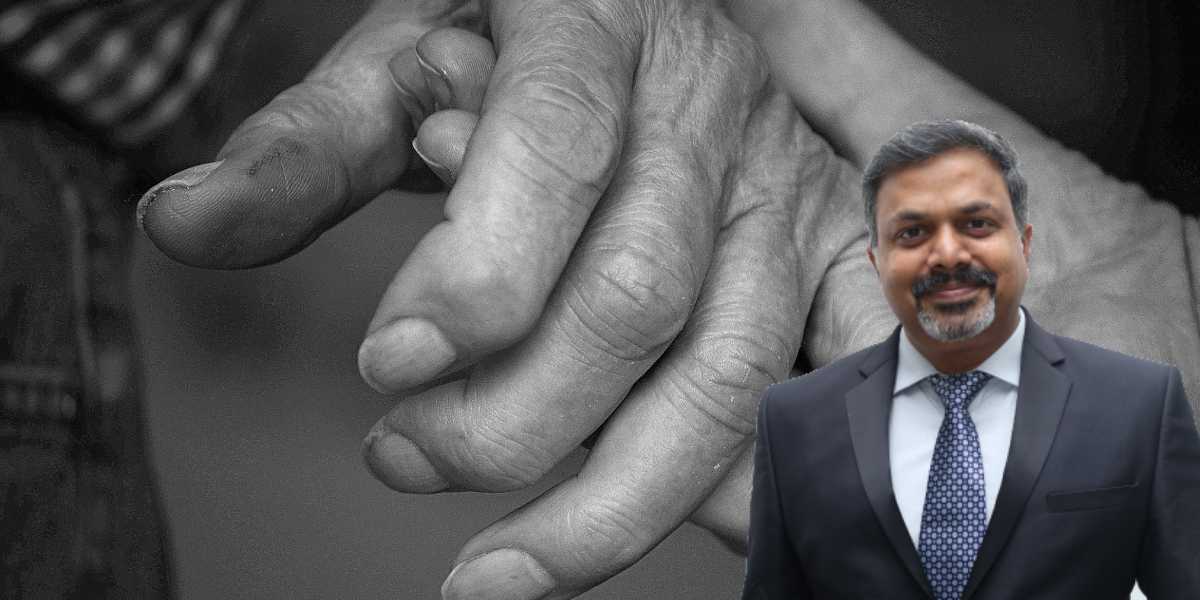
Synopsis: The Andhra Pradesh government’s recent focus on falling birth rates looks at only part of a rapidly changing demographic in the country. With lower birth rates, India is also seeing a growing elderly population, with those above 60 expected to reach 34 crore by 2050. In a conversation with South First, Prashanth Reddy, founder of Anvayaa, a technology-first elder care service, explains how changing family structures, migration and rising loneliness are reshaping elder care needs, and argues that India must urgently build systems, services and policy frameworks to support ageing citizens beyond healthcare alone.
On 5 March, Andhra Pradesh Chief Minister N Chandrababu Naidu stood in the state assembly and announced ₹25,000 for every family that has two or more children. The reason he cited: falling birth rates.
He was looking at one side of the coin.
The other side is India’s elderly population. While the fertility rate falls, the geriatric population keeps climbing. The number of those above 60 has crossed 14 crore. By 2050, that number will touch 34 crore.
What’s more, these elderly are being left to fend for themselves by children already leaving for other cities in the country such as Bengaluru, and elsewhere across the world such as Dubai or San Francisco.
Prashanth Reddy saw it coming in 2015. He left a career in technology leadership spanning 34 years, including as CEO of AP Online, and founded Anvayaa. The name means family in Sanskrit.
The platform is a one-stop service that covers the elderly’s daily needs—companionship, 24×7 medical assistance, emergency response and more—helping seniors live independently while giving their families peace of mind.
Today, Anvayaa operates across 38 cities, serves over one lakh seniors, covers 10,000 locations, and represents elder care at the United Nations, the only Indian organisation to do so.
South First sat down with Reddy to understand what India’s ageing crisis looks like on the ground, what technology can and cannot do, and why the country’s policy conversation on demographics is missing half the picture.
Edited excerpts follow.
Q: You spent decades in technology, including as CEO of AP Online. What made someone with that career walk away to build an elder care platform?
Reddy: It started from my own personal experience. I was in the US for most of my career. Being an only child, I decided to come back rather than pursue a career overseas, to be with my parents. At that point, I thought simply being there was enough.
But I was surrounded by people like me who couldn’t come back. Their parents were here in India, depending on friends and neighbours who had their own lives and families. That created misunderstandings, gaps and unmet needs. I started asking: why can’t this be done better?
That question led me to build a platform. And once I started looking at it seriously, I realised elder care had to be a true one-stop solution, not just health. People assume elder care means health care. We don’t. Our own research shows that only 30 percent of what elderly people actually need is health-related. The rest is companionship, managing loneliness, getting everyday things done, and having the assurance that someone will respond in an emergency. That is what we set out to build.
Only 30 percent of what elderly people need is health-related. The rest is companionship, loneliness, getting everyday things done.
Q: What does Anvayaa actually do for a senior, day to day?
Reddy: Everything. From 24×7 emergency response to something as simple as accompanying someone for a morning walk. If a member wants to attend a wedding, go to a film, or visit a temple, our care managers are there. Centrally, we track every need: groceries, plumbing, electricians, travel, ticketing, passport and visa assistance. If someone needs a priest at home for a ceremony, we arrange that too.
The way I describe it is: we become an extension of their family. Anvayaa means family in Sanskrit, and that is exactly what we try to be.
Q: You started in 2016. How different does India look in terms of elder care now, ten years on?
Reddy: When we started, we were pioneers. Nobody had thought about doing it this way. The early adopters were almost entirely NRIs, people living abroad who felt guilty about not being there and needed a trusted organisation to fill the gap.
But the picture has changed significantly. Indian families themselves are now highly nuclear. People migrate from villages to towns, towns to cities, and cities to other countries. Even within a single city, which today might be the size of 20 district headquarters combined, getting from one point to another is a challenge. The nuclearisation of the family is accelerating.
What I also notice is that elderly people themselves are changing. They want independence. They do not want to be branded as dependent. That shift in attitude is real, and it is bringing more Indian families to us, not just those living abroad.
The other major development is corporate India. Two years ago, we proposed elder care as an employee benefit, the argument being that caregiver absenteeism is a significant cost for companies, and supporting employees who are also caring for parents makes sound business sense. We were the first to do this. Today, companies like Wipro, Tata Steel, Accenture, and others have integrated our services into their employee benefit programmes. That adoption is growing fast.
Q: The policy conversation on demographics has focused almost entirely on falling birth rates. Is the ageing population receiving equivalent attention from government?
Reddy: It is not, and that is a serious gap. By 2050, roughly 20 percent of India’s population will be senior citizens, around 350 million people. By 2030, senior citizens may actually outnumber children under 15. That is four years away.
The central government does have a small focus area under the Ministry of Social Justice, a programme called SAGE, but it is not nearly enough given the scale of what is coming. The infrastructure piece is almost entirely missing. We talk about smart cities, but we are not building cities that elderly people can navigate. Most commercial buildings and malls do not even have proper ramps. These are basic things.
My view is that elder care needs to be recognised as an independent ministry, not bundled in with child welfare and women’s issues. Separate focus, separate policy frameworks, separate budget. Only then will the infrastructure and services catch up with the need.
I’d also say this: senior citizens are the largest voting bloc in the country. They vote in higher numbers than almost any other group. There is a political case for paying attention to them that is being almost entirely ignored.
By 2030, senior citizens may outnumber children under 15.
Q: Hyderabad, the city we are both based in, has only two government institutions with geriatric care as a specialisation, Gandhi Medical College and NIMS, serving a senior population that is roughly 11 percent of Telangana’s 4 crore people. How does that change?
Reddy: Geriatric care as a medical speciality has not received the attention it deserves. There is a significant shortage of geriatric doctors across the country. The Medical Council is working on it, colleges are slowly adding the speciality, but it will take another decade to reach meaningful scale.
There is also a structural problem in how we use the healthcare system. We have moved from the general practitioner model, where you saw a family doctor first, to going directly to specialists. For the elderly, that is particularly problematic because their needs are often complex and interconnected. A geriatrician who can see the whole picture is essential, but we don’t have enough of them. I don’t have a quick answer to that. It will take time.
Q: Daughters-in-law have historically carried the informal elder care burden in India. They are now entering the workforce in large numbers. Where does that leave elderly parents?
Reddy: That is exactly the gap we are trying to address. We have a specific offering for working women, called Anvayaa Mitr, built around reducing the fatigue and stress of managing both a career and family caregiving. The goal is simple: we don’t want women to have to choose between work and care. Both men and women are working today because they want a better life for their children. Caring for elderly parents is part of that picture, and we try to make it manageable.
Q: When I speak to my own parents, after every other conversation the question is: when are you coming? Loneliness seems to be the deepest problem, deeper than the medical need. Can technology actually reach that?
Reddy: It is a genuinely hard question, and I will be honest: I think we are probably a couple of decades away from technology being able to truly address loneliness for the current generation of elderly people. The generation that is old today simply did not grow up with screens and devices. WhatsApp is about the outer limit of what most of them are comfortable with.
For Gen Z, when they reach their sixties and seventies around 2040 to 2050, the picture will be different. They have grown up with technology. AI-driven companions will feel more natural to them.
What I do think technology can do meaningfully right now is two things. First, emergency assurance: the peace of mind that if something goes wrong, someone will respond. Second, passive assistance: reminders, help navigating services, being available. Not replacing human contact, assisting around it.
We are also watching the development of emotional AI agents closely, systems that detect voice tone and emotion and respond with appropriate empathy. That is coming. But for the foreseeable future, human touch remains irreplaceable.
Q: Tell me about the smartwatch you have developed.
Reddy: We built it because nothing suitable existed in India. We have a patent on it. The core idea is that the technology should be invisible to the user. The senior citizen should not have to think about it. They wear the watch and charge it. That is all they have to do.
Behind the scenes, the watch monitors vitals continuously – blood pressure, temperature, SpO2. If there is a variation that suggests a problem, an alert comes through to our command centre, we call to check in, and if needed we dispatch an ambulance. The watch also has fall detection. If a fall is detected and the person does not respond to the prompt on the watch, the command centre is alerted immediately. The watch has a SIM card, a microphone and a speaker; it functions as a phone. The average emergency response time is under three minutes.
About 1,000 members are using it now. It is a patented product, and it is one of the things I am most proud of.
Q: When a child in San Francisco can check on their parent in Hyderabad through an app in real time, does knowing more make families feel better, or does it sometimes deepen the guilt?
Reddy: Knowing more is not always better, and I say that genuinely, not as a technology person. I have seen families ask us to install cameras inside the home to monitor parents remotely. In cases where someone is bedridden or needs round-the-clock supervision, there is a case for that. But for a relatively independent elderly person, it is an invasion of their privacy and I would advise against it.
Technology should be passive. It should alert you when there is a risk. It should not turn a parent’s home into a surveillance space. That is not care, it is control. Give them their independence. Be there when it matters.
Q: People sometimes describe Anvayaa as a crisis management service. Is that how you see it?
Reddy: Not at all. In fact, that framing is something we actively push back on. We do not want to be the call people make when things have already gone wrong. We want to be part of their parents’ lives long before any crisis arrives, helping them go to events, enjoy outings, feel that someone is genuinely looking out for them.
Our very first customers in Hyderabad, from when we launched in 2016, stayed with us until they passed away, years later. When they joined, there was no crisis. Their children were simply not in India, and they wanted the companionship and assurance of having someone reliable around them. We arranged movie outings, surprise birthday parties, and attended functions with them. That is the life we want to give people’s parents. Not a safety net for emergencies, but a proper, full life.
Our first customers in Hyderabad stayed with us until they passed away. When they joined, there was no crisis.
Q: What would you want India to look like for its elderly by 2047?
Reddy: I want India to be known for two things: technology and innovation, yes, but also for building a care infrastructure with genuine empathy. Not just services, but a culture that treats elderly people as citizens with full lives and full rights, not a problem to be managed.
Elder care needs to be recognised as an industry in its own right. With that recognition come proper policy frameworks, proper infrastructure standards, and proper investment. Every urban planning decision, every new commercial development, every metro expansion, should be evaluated for how it serves people who are elderly or becoming elderly.
India is going to be an ageing country. We have a window right now to build for that future. I hope we use it well.


