

Published Sep 15, 2022 | 9:00 AM ⚊ Updated Sep 15, 2022 | 12:25 PM


Dotplot, handheld device to self-monitor any growth of lumps in breasts/supplied

Doctors in Bengaluru have welcomed a handheld device co-designed by an Indian graduate student in the UK to detect breast cancer through self-checks, but say it cannot replace mammograms.
Named “Dolplot”, the DIY kit was designed by two graduates of Imperial College London and the Royal College of Art, London — Shefali Bohra and Debra Babalola.
The kit uses sound waves to record tissue composition of the user’s breasts as they are scanned at home, enabling her to track any growth of a tumour.
The device earned Bohra — who graduated from the National Institute of Design, Ahmedabad, in 2020 before moving to the UK to pursue further studies — and Babalola the prestigious UK James Dyson Award.
Dotplot will now progress to the international phase of the award, which challenges university students in the fields of product design, industrial design and engineering to “design something that solves a problem”.
The global shortlist of the award is slated to be announced on 12 October, and the global winners on 16 November.

Shefali Bohra, a student of Imperial College, and Debra Babalola who developed the handheld breast cancer screening device.(Dotplot/Supplied)
For now, Bohra and Babalola plan to use the £5,000 cash award received for winning the UK leg of the competition on funding further research to develop their tool into a global solution for do-it-yourself breast checks.
Doctors in Bengaluru, though appreciative of Dolpot, expected to come into the market shortly, say that at the end of the day, one will still have to fall back on mammography to detect breast cancer.
Dolpot users are required to press the device on the chest to create a personalised map of a user’s torso, including her breast size and shape, through an app on a connected smartphone.
Once a “baseline model” is set up, the tool uses sound waves to record the breasts’ tissue compositions every month, and track any tumorous growth.
The genesis of the tool lay in Bohra and Babalola finding out that there were no DYI tools to routinely assist women in monitoring their breasts at home.
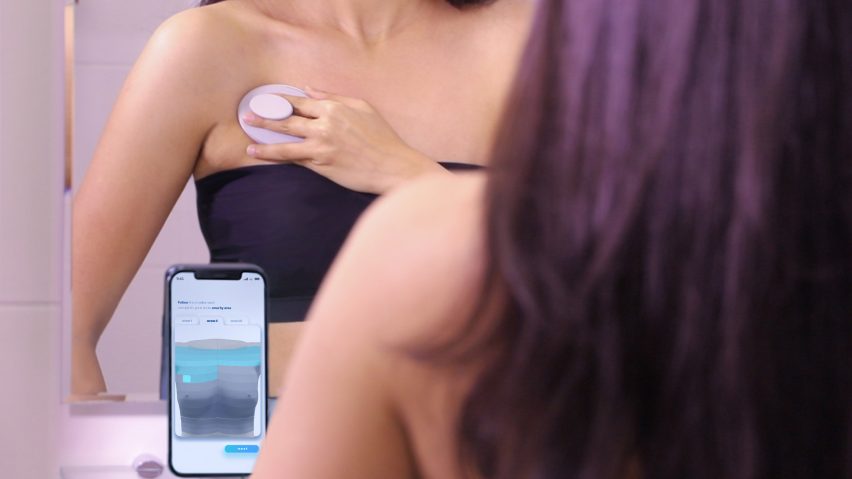
Dotplot, breast monitor device designed by Indian origin post-graduate student in UK. (Supplied)
They had started looking for such a device after Bohra discovered an unusual knot in one of her breasts, and was advised by a gynaecologist to monitor it using her own fingers for a few months.
Though the knot self-resolved, the lack of a DYI device motivated the two to create one.
“We were shocked to discover that there are no products available that can assist women to carry out a breast self-check, so we set ourselves the goal of creating a device that can allow women to perform self-checks with clarity, ease and confidence,” Bohra was quoted by the UK paper Metro as saying.
Doctors South First spoke to say the process of screening through mammograms cannot be skipped.
“These devices are still in the development stages, and give a general picture, but that is better than not doing anything,” said Dr Kritika Murugan, surgical oncologist at HCG Cancer Hospital, Bengaluru.
“They can detect abnormalities early, and early detection is always useful. However, it is only a screening tool and needs to be substantiated with routine tests in case of abnormal reports,” she said.
Dr V Annapurna, senior consultant and HoD, Gynaecologic Oncology, at Sri Shankara Cancer Hospital and Research Centre, Bengaluru, was less impressed.
“Such equipment come and go,” she said. “They need to be standardised against the gold standard — the Mammogram test.”
Dr Annapurna also felt people need to be aware about how to do self-breast examination, and when to go to a doctor.
“Family history is paramount,” she said.
Dr Monika Pansari, senior consultant and HOD Surgical Oncology, Gleneagles Global Hospitals in Bengaluru, believes evaluation by an oncologist is a must.
“Dotplot is… definitely is a promising invention to help in early diagnosis of breast cancer. But the device has to undergo medical regulatory checks for its efficacy,” Dr Pansari told South First.
“If any abnormality is detected, patients will need further evaluation by an oncologist for confirmation,” she added.
Number of cases going up
However, what cannot be denied is the market among millennials that awaits any handy product to detect tumorous growths at home.
As Dr C Ramachandra, director, Kidwai Cancer Hospital, Bengaluru, said, “More and more women below the age of 21 years are visiting our hospital. Their age is falling every year.”
He cited two reasons for this: Early menstruation and late childbirth.
Dr Ramachandra insisted that screening programmes for breast cancer detection be carried out in colleges and villages.
But till that becomes commonplace, the market for devices like Dolpot can only be expected to grow.
View this post on Instagram



