

Published Oct 20, 2026 | 7:00 AM ⚊ Updated Oct 20, 2026 | 7:00 AM

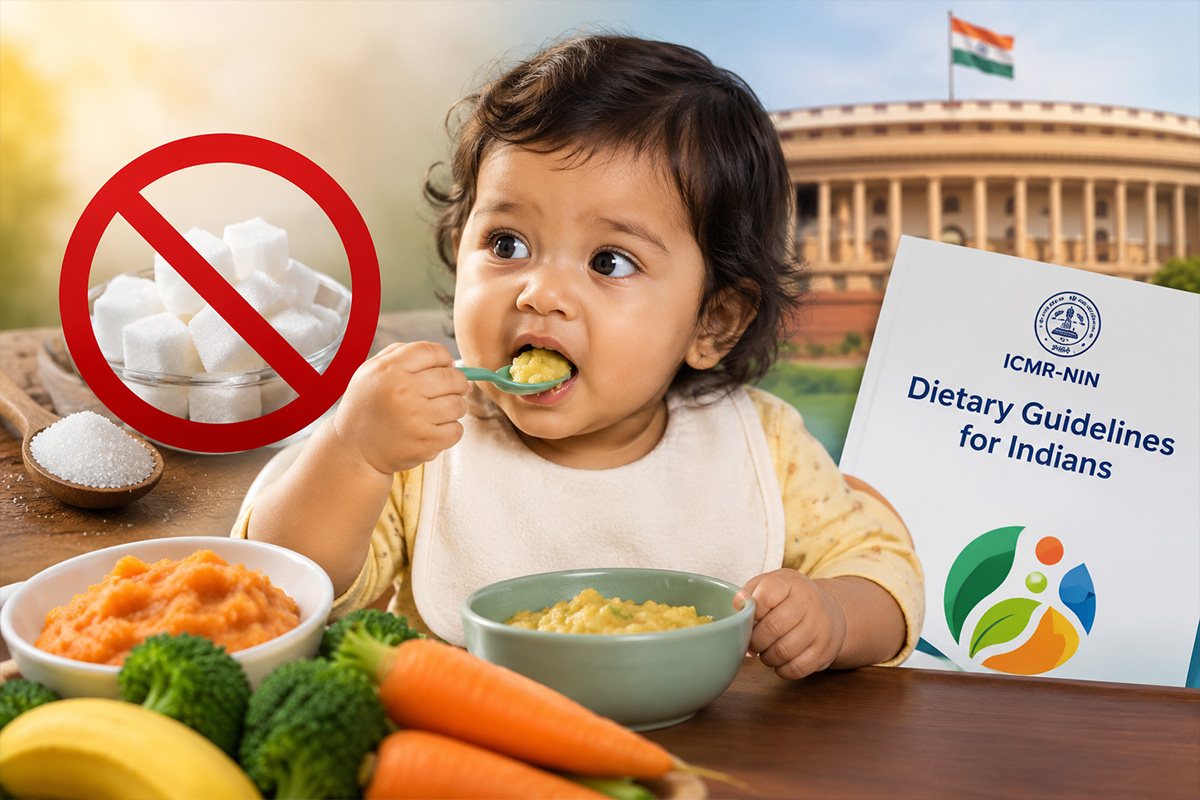
Image used for representational purpose only. (AI generated image)

Synopsis: India’s dietary guidelines recommend no added sugar for children under two, but FSSAI’s proposed restrictions focus on products for infants up to six months. Paediatricians explain why the complementary-feeding period matters, highlighting concerns about nutrient intake, dental health and food preferences, and call for stronger standards for older infants and toddlers.
India’s Dietary Guidelines for Indians 2024 recommend no added sugar for children below two years. However, a proposed amendment by the Food Safety and Standards Authority of India (FSSAI) focuses on products intended for infants up to six months, raising questions about standards for older infants and toddlers.
The guidelines, issued by the Indian Council of Medical Research’s National Institute of Nutrition (ICMR-NIN), state: “No added sugar for children <2 years old.” They also advise against adding sugar or salt to complementary foods introduced around six months.
The FSSAI’s draft Food Safety and Standards (Foods for Infant Nutrition) Amendment Regulations, 2026, proposes that “sucrose and fructose shall not be added in the products intended for infants up to the age of 6 months.”
Published in the Gazette of India on 16 October, the draft seeks to remove the existing provision allowing sucrose and/or fructose in these products as carbohydrate sources, subject to specified conditions and limits. Stakeholders have 60 days to submit objections and suggestions.
The proposal is not yet final, and existing regulations also cover infant nutrition products for children up to two years.
The key question is whether standards for products intended for children aged six months to two years should be strengthened to reflect the national dietary recommendation against added sugar.
The ICMR-NIN guidelines place early childhood nutrition within the broader goal of supporting growth and preventing malnutrition. Their recommendation against added sugar is not restricted to the first six months, when exclusive breastfeeding is recommended.
Guideline 4 addresses complementary feeding, which begins around six months as children need additional nutrients alongside continued breastfeeding. It says sugar or salt need not be added to complementary foods and advises avoiding foods and beverages with added sugar, including biscuits, cakes and sweetened drinks.
This is the period when packaged cereals, complementary foods and other products intended for young children may become part of a family’s feeding routine.
Dr C Sai Narasimha Reddy, Consultant Paediatrician and Neonatologist at Gleneagles BGS Hospital, Bengaluru, says the change in feeding requirements after six months does not create a nutritional need for added sugar.
“Yes, there is a difference in the feeding requirements but not in the recommendation to avoid added sugar,” he told South First. “At the age of about six months, complementary foods such as soft-cooked pulses, mashed fruits and vegetables and infant cereals are introduced in suitable textures because nutritional requirements increase. However, it is important to remember that the added food is nutrient dense and should not contain added sugar.”
The purpose of complementary feeding, he says, is to provide additional nutrients.
“No. Complementary foods are introduced to provide additional nutrients like iron, zinc, protein and energy. Sugar is not necessary to meet these requirements,” Reddy said. “Foods such as mashed vegetables, fruits, pulses and cereals can support growth without added sugar. The focus should be on nutritional quality rather than making foods sweeter.”
Dr Rashmi Jeenakeri, Consultant Neonatal Paediatrician at Apollo Hospital, Sheshadripuram, Bengaluru, says introducing complementary foods around six months offers an opportunity to familiarise children with different flavours without adding sugar.
“From a paediatric perspective, adding sugars when the baby is trying to learn food flavours will restrict their curiosity and openness to explore different kinds of food,” Jeenakeri told South First. “We will completely miss this developmental window of curiosity and openness to accepting different flavours if we restrict exposure to different flavours early on.”
She describes the period between six months and one year as an important window for introducing varied foods. Repeated exposure to sweetened products, she says, may influence children’s food preferences.
Added sugar can also displace nutrient-rich foods in a young child’s limited diet. “Empty calories from added sugars fill their tiny stomach quickly, leaving less or no room for vital nutrients like iron, protein and healthy fats which are essential for brain and body growth,” Jeenakeri said.
Dr C Sai Narasimha Reddy, Consultant Paediatrician and Neonatologist at Gleneagles BGS Hospital, Bengaluru, says frequent consumption of sweetened foods can increase the risk of dental caries and contribute to excessive calorie intake and unhealthy weight gain.
“The recommendation is based on scientific evidence from nutrition, epidemiological studies, the association between sugar consumption and tooth decay, and from a public health perspective,” Reddy told South First. However, he noted that studying the effects of introducing minimal amounts of added sugar in early childhood remains difficult.
The FSSAI’s proposal seeks to strengthen the rules for products intended for infants up to six months. Under the existing Food Safety and Standards (Foods for Infant Nutrition) Regulations, 2020, lactose and glucose polymers are the preferred carbohydrate sources. Sucrose and/or fructose may be added when needed as a carbohydrate source, provided their combined amount does not exceed 20% of total carbohydrate.
The draft proposes prohibiting the addition of sucrose and fructose to products intended for infants up to six months. The FSSAI has said the change is intended to ensure that infant nutrition products meet age-appropriate nutritional requirements while minimising exposure to added sugars during the earliest stages of life.
The authority has also linked the proposal to public health recommendations promoting exclusive breastfeeding during the first six months.
However, the existing regulatory framework also recognises products intended for children aged six months to 24 months, including milk-cereal-based and processed cereal-based complementary foods, as well as follow-up formula. The provisions governing these products are distinct from the proposed amendment for younger infants.
This is why the two-year recommendation in the dietary guidelines should not automatically be read as proof that FSSAI’s proposal is inconsistent with national guidance. Dietary guidelines advise families on healthy eating, while food regulations prescribe requirements for products manufactured and sold in the market.
But the difference in scope raises a legitimate policy question: should the restrictions on added sugars be extended or clarified for products intended for children who have started complementary feeding?
Reddy believes there is a need to adhere to food standards for this age group as well.
“Yes, food standards should also cover products intended for children between six months and two years,” he said. “This is a critical stage of growth when children begin consuming complementary foods and developing food preferences. This is also a stage where the food they consume becomes increasingly important in meeting their nutritional requirements.”
He argues that standards should reflect children’s nutritional needs and potential health risks, with clear labelling and enforceable limits on added sugars to help parents make informed choices.
Another question is whether a restriction on two sugars would adequately address the broader issue of added sugar in products marketed for infants and young children.
Reddy says restricting sucrose and fructose would be useful, but it would not resolve the problem if manufacturers could substitute other sweetening ingredients.
“Restricting sucrose and fructose is a useful step, but it does not solve the whole problem, especially when other added sugars are used as substitutes,” he said. “Regulations should consider the range of ingredients that contribute sweetness and assess their nutritional and health implications.”
For parents, this means reading ingredient lists rather than relying only on a product’s age label or marketing claims. Reddy advises looking for ingredients such as sugar, sucrose, fructose, glucose syrup, dextrose, honey and other syrups. The nutrition panel can help, although total sugars may include naturally occurring sugars as well as added sugars.
Jeenakeri also warns parents to look beyond familiar terms such as table sugar.
“Parents should be able to spot hidden and disguised sugars like maltodextrin, honey, date syrup, jaggery, sucrose and high fructose corn syrup and fruit juice concentrate,” she said, adding that some commercially available cereals can function more like desserts than nutrient-rich meals.
The distinction between added sugars and naturally occurring sugars is important. Whole fruits and milk contain naturally occurring sugars alongside other nutrients. Whole fruits also provide fibre, making them different from sweetened fruit preparations or juices, which may contain added sugars and generally provide less fibre than the whole fruit.
Jeenakeri recommends that parents prioritise whole-food ingredients and check the nutritional quality of packaged products, including their protein and fibre content. Her advice is not a substitute for product standards, particularly when caregivers cannot easily identify every ingredient or interpret the label.
Both paediatricians support a broader approach that combines product standards, clear labelling and parental counselling.
Reddy says stricter rules could reduce added sugar at the source, while responsible marketing and clearer labels could help parents identify products that are appropriate for young children. He also stresses the role of paediatricians and healthcare workers in explaining complementary feeding.
He added, “Stricter product standards can reduce added sugar at the source, while clear labels help parents identify unsuitable products. Responsible marketing is important so that parents are not misled by claims suggesting that a product is healthy simply because it is intended for babies.”
Jeenakeri also supports regulation to prevent added sugars from being included in products in different forms. She argues that mandatory standards would be more effective than relying only on manufacturers’ voluntary choices or parents’ ability to interpret labels.
Also Read:
Can a doctor approve your test report without being physically present? NMC clarifies
(Edited by R Rajesh Kumar.)



